
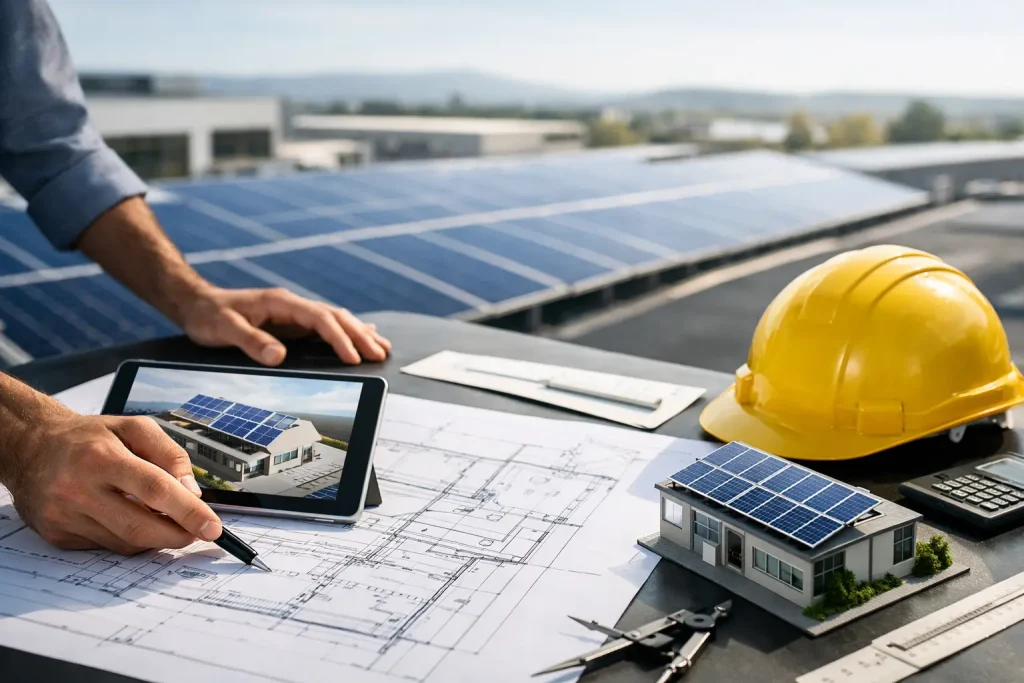
What Is PV System Design for Business?
A solar project rarely fails because panels were a bad idea. It usually fails because the system was designed around the wrong assumptions – the wrong load profile, the wrong roof layout, the wrong export rules, or the wrong financial target. That is why asking what is pv system design matters long before procurement or installation begins.
For commercial and industrial users, PV system design is the engineering process of turning a site, an energy demand pattern, and a financial objective into a workable solar power system. It defines how many modules are needed, where they should go, how they connect, what inverters and protection equipment are required, how the system will interact with the grid, and whether the project will actually reduce operating costs as planned.
This is not just a drawing exercise. Good design sits at the intersection of electrical engineering, structural constraints, utility requirements, operating behavior, and return-on-investment analysis. If one of those areas is ignored, the system may still get installed, but it may not perform the way the business expects.
What Is PV System Design in Practical Terms?
In practical terms, PV system design is the full technical planning of a solar photovoltaic installation before construction starts. It translates business goals into engineering decisions.
For a factory, that goal may be reducing daytime grid consumption without disrupting production. For a warehouse, it may be cutting peak demand charges. For a commercial building, it may be maximizing rooftop generation within utility export limits. In each case, the final design will look different because the energy pattern, operating hours, tariff structure, and physical site conditions are different.
That is why system size alone is not a useful design strategy. Bigger is not always better. An oversized system can trigger unnecessary capital cost, curtailment, or poor payback if export compensation is limited. An undersized system may leave too much savings on the table. The design process exists to find the right fit.
What a PV System Design Actually Includes
At the early stage, designers assess the site and collect the data that will drive the rest of the project. That usually includes electricity bills, interval load data if available, roof or land dimensions, shading conditions, transformer and switchboard information, and local utility or regulatory requirements.
From there, the design team develops a system architecture. That means deciding the array layout, module orientation, tilt angle, string configuration, inverter sizing, cable routing, protection schemes, and interconnection method. If the project includes battery storage, the design must also define charging logic, dispatch behavior, and how the battery will interact with PV generation and site loads.
For commercial projects, this work often goes beyond generation estimates. It can include demand management strategy, power quality considerations, backup requirements, energy monitoring design, and long-term performance visibility through cloud-based reporting. In other words, the PV system is not treated as an isolated asset. It is designed as part of the site’s wider energy operation.
Why Load Profile Matters More Than Many Buyers Expect
One of the most misunderstood parts of solar design is the load profile. Two facilities can use the same total monthly electricity, but require very different PV system designs.
A site that operates mostly during daylight hours can typically consume more solar energy directly, which improves savings. A site with heavy evening use may need storage, tariff optimization, or a smaller PV array to avoid low-value excess generation. If the business shuts down on weekends, that also changes the economics.
This is where engineered design creates value. Instead of simply matching solar capacity to annual usage, a serious design process studies when electricity is used, how much is used at different times, and how the utility tariff rewards or penalizes that pattern. For many businesses, the best-performing solar project is the one designed around self-consumption and tariff reduction, not the one with the highest DC capacity.
The Engineering Side of PV System Design
When people ask what is pv system design, they often picture panel placement. That is only one part of the job.
Electrical design is central. The system must be configured within voltage and current limits, with proper string sizing, inverter matching, isolation, surge protection, earthing, and safe shutdown considerations where required. Grid interconnection must be planned carefully so that the PV system integrates with the existing electrical infrastructure without creating compliance or reliability issues.
Structural design matters just as much. Roof-mounted systems depend on loading limits, wind exposure, mounting methods, waterproofing details, and maintenance access. A design that looks efficient on paper can become risky if it ignores roof condition or structural tolerances.
Then there is thermal and environmental performance. Local irradiance, temperature, soiling, shading, and ventilation all affect output. A design team must account for these variables when modeling generation, because nameplate capacity does not equal real-world energy yield.
Compliance, Utility Rules, and Approvals
A technically sound design still has to be approvable.
Commercial solar projects often involve utility interconnection requirements, authority submissions, protection settings, engineering sign-off, and safety documentation. In some cases, export limits or transformer capacity constraints shape the design more than the available roof area does.
This is one reason experienced design and engineering support matters. If a project is designed without considering approval pathways, it can face redesign delays, extra equipment cost, or restrictions that weaken the business case. The most efficient projects are designed for both performance and compliance from the start.
Financial Modeling Is Part of Good Design
For business decision-makers, the question is not only whether the system works. It is whether the system performs financially.
That means PV system design should be tied to expected savings, payback period, internal rate of return, and capital planning priorities. Different design choices affect those numbers. Module efficiency, inverter topology, export assumptions, storage integration, and monitoring scope can all change project economics.
There is usually a trade-off. A lower-cost system may shorten payback but offer less visibility, lower resilience, or weaker long-term control. A more advanced design with battery storage, adaptive controls, and detailed monitoring may improve operational performance, but only if the tariff structure and site behavior justify the added complexity.
That is why good design is not about chasing the most sophisticated configuration. It is about aligning technical choices with the financial objective.
What Is PV System Design When Battery Storage Is Added?
Once battery energy storage enters the picture, PV design becomes more strategic.
The battery should not be treated as an attachment to the solar system. It must be designed around load timing, tariff exposure, backup priorities, charge-discharge cycles, and control logic. In some facilities, storage improves solar self-consumption. In others, its main value comes from peak shaving, demand control, or resilience.
This is also where software and controls matter more. AI-assisted energy management, adaptive power control, and live monitoring can improve the way solar and storage work together, especially at sites with variable loads or complex tariffs. But the technology only adds value when the underlying design is sound. Automation cannot fix a system that was sized around poor assumptions.
Why Design Quality Shows Up After Commissioning
A weak design may not be obvious on day one. Panels generate, the inverter turns on, and the project appears complete. The problems show up later.
You may see lower-than-expected savings because daytime demand was overestimated. You may run into clipping because the inverter ratio was too aggressive for the site conditions. Maintenance access may be poor. Monitoring may be too limited to diagnose underperformance. Utility restrictions may reduce export value. None of these issues are random. They are usually design-stage decisions that were never challenged properly.
By contrast, a well-designed project tends to be quieter after commissioning. It performs closer to forecast, integrates cleanly with site operations, and gives management a clearer line of sight into savings and energy behavior.
For that reason, experienced providers such as Amsolar approach PV system design as both an engineering discipline and a cost-optimization exercise, not just a pre-installation formality.
How to Judge Whether a PV Design Proposal Is Credible
If you are reviewing a commercial solar proposal, look beyond installed capacity and projected annual generation. Ask what assumptions were used about your load profile, tariff structure, export conditions, and operating hours. Ask whether structural and electrical constraints were verified. Ask how performance losses were modeled and what monitoring data will be available after commissioning.
A credible design should make clear why the chosen system size, equipment mix, and control strategy fit your site. It should also explain the trade-offs. If every answer sounds generic, the design probably is.
The strongest solar outcomes usually come from projects designed around how a business actually consumes energy, not how a brochure says solar should work. If you start there, the numbers tend to make much more sense.
