
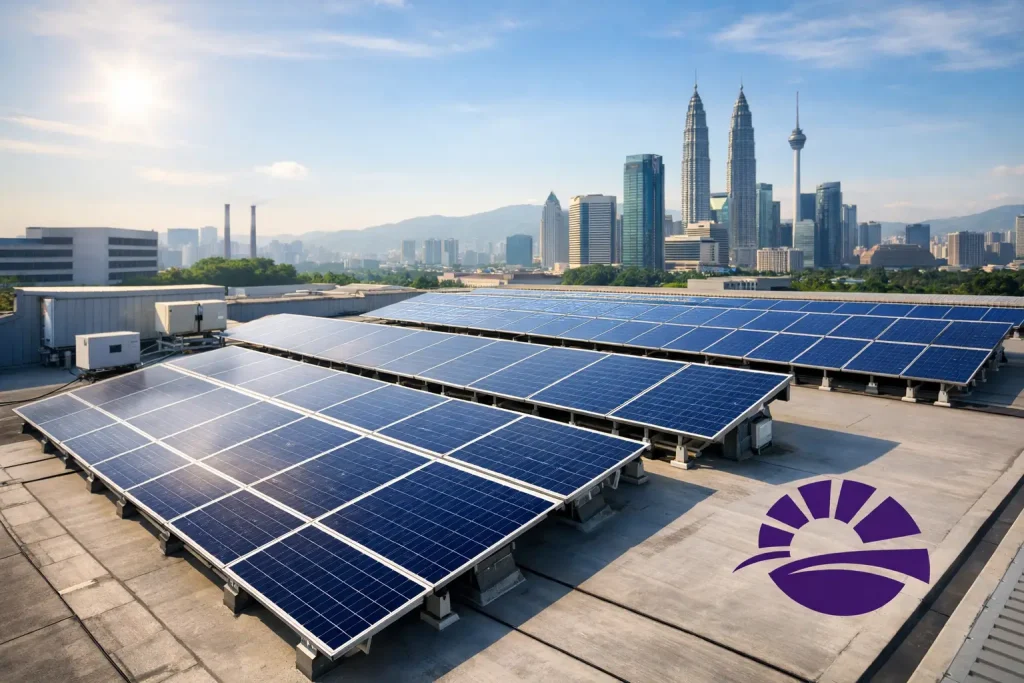
Commercial Rooftop Solar Malaysia Guide
Key takeaways
Commercial rooftop solar Malaysia projects work best when they are evaluated as energy assets, not just equipment purchases. The strongest business cases combine tariff savings, sound system design, regulatory compliance, and ongoing performance monitoring. For commercial and industrial users, results depend on load profile, roof condition, financing structure, and whether battery storage or AI-based energy control can improve overall economics.
A factory with a large daytime load can turn an idle roof into a cost-control tool faster than many managers expect. But the difference between a good outcome and a disappointing one usually has little to do with the panels themselves. It comes down to engineering accuracy, tariff analysis, regulatory handling, and how well the system matches the building’s actual demand. That is why commercial rooftop solar Malaysia decisions should be made with both operations and finance in mind.
Why commercial rooftop solar Malaysia is a business decision first
For commercial and industrial operators, solar is rarely just about sustainability branding. The main driver is cost. Electricity tariffs, peak daytime usage, and long operating hours can make rooftop PV financially attractive, especially for facilities that consume most of the generated power on-site.
Self-consumption matters because exported power may not deliver the same value as avoided purchased electricity. A warehouse with light daytime demand will have a different return profile than a manufacturing plant running process loads throughout business hours. This is where many early-stage evaluations go wrong. A simple estimate based on roof size and panel count is not enough. Decision-makers need to understand annual yield, hourly consumption behavior, and whether the proposed system is sized to reduce grid dependence without creating unnecessary oversupply.
This is also why finance leaders ask better questions than “How many kilowatts can fit on the roof?” They want to know expected payback, IRR, tariff offset, degradation assumptions, and operational risk. Those are the right questions.
What determines project viability
The economics of commercial rooftop solar Malaysia depend on a few practical variables. First is the load profile. Buildings with strong daytime consumption typically get better value because more solar energy is used directly. Second is roof suitability. Structural capacity, waterproofing condition, available area, shading, and orientation all affect output and installation approach.
Third is tariff structure. A commercial customer on a demand-based tariff may need a more detailed strategy than a simple PV offset model. In some cases, reducing imported energy is valuable but does not fully address peak demand charges. That is where battery storage and adaptive control can become relevant, though not every site needs them.
The final variable is execution quality. A low-cost installation that underperforms, causes roof issues, or fails to meet grid and safety requirements is expensive in the long run. Businesses should look beyond component brand names and focus on design accuracy, EPC capability, testing standards, commissioning quality, and post-installation monitoring.
How to assess commercial rooftop solar Malaysia properly
A credible assessment starts with data. At minimum, that means reviewing electricity bills, interval consumption if available, site operating hours, and roof drawings or survey information. The goal is to determine how solar production aligns with real demand, not hypothetical demand.
Next comes engineering. This includes PV layout, string design, inverter selection, cable routing, protection systems, and structural review. For larger commercial roofs, details such as thermal movement, drainage pathways, and maintenance access should not be treated as minor issues. They affect both safety and long-term performance.
Regulatory compliance is another area that deserves attention. Submission requirements, utility coordination, and approval steps can delay projects if handled poorly. For businesses managing multiple sites or operating across different states, that administrative burden can become significant. An end-to-end provider with submission support reduces internal workload and lowers the risk of avoidable mistakes.
Then comes financial modeling. A proper model should reflect system yield, consumption offset, capital cost or zero-capex structure, operating assumptions, and sensitivity scenarios. A project may look strong under current tariffs but weaker if production is overstated or site consumption changes materially. Good modeling does not sell certainty where uncertainty exists. It shows the likely range of outcomes.
Where monitoring, AI, and battery storage add value
Not every commercial solar project needs advanced controls from day one. But more businesses are moving beyond basic generation monitoring because they want tighter visibility over energy cost and asset performance.
Cloud-based reporting helps operations and management teams verify whether the system is producing as expected. It also makes it easier to detect inverter faults, performance drops, or unusual consumption patterns. For multi-site operators, centralized reporting turns solar from a passive installation into an active management tool.
AI-driven energy cost control becomes more relevant when the business is trying to optimize more than solar output alone. For example, a site with variable demand, time-sensitive loads, or battery storage may benefit from smarter dispatch and control logic. The objective is not to add technology for its own sake. It is to reduce energy cost volatility and improve how solar, storage, and consumption work together.
Battery energy storage can improve project economics in certain cases, especially where demand management, backup support, or tariff optimization matter. But batteries are not automatically the right answer for every rooftop PV project. They add cost and complexity, so the business case should be tested carefully. A zero-capex BESS model may make sense for companies that want resilience or demand optimization without a large upfront investment, but it still needs technical and financial scrutiny.
This is where a technology-led engineering approach stands out. The right provider should be able to explain when storage and advanced control improve returns, and when a simpler solar-only system is the better choice.
What commercial buyers should look for in a solar partner
Commercial buyers are not just selecting a contractor. They are selecting a long-term energy partner. The provider should be able to handle design and engineering, procurement and construction, testing, grid commissioning, monitoring, and approval support in one coordinated scope. That reduces handoff risk and gives the client a clearer line of accountability.
Engineering credibility matters. So does the ability to connect technical design with financial outcomes. A project team that can discuss payback and IRR with the same confidence it brings to string sizing and protection design is more likely to deliver an asset that performs as modeled.
It also helps to work with a company that understands how solar fits into a broader energy strategy. Some businesses are planning phased upgrades across facilities in Penang, Johor, or East Malaysia, while others are preparing for future storage integration or smarter building controls. In those cases, the solar system should not be treated as a one-off installation. It should be designed with expansion, monitoring, and operational data in mind.
For business decision-makers, the real question is not whether solar is broadly beneficial. It is whether your roof, load, tariff, and capital strategy support a strong project now. When the answer is yes, commercial rooftop solar can do more than lower bills. It can give the business better control over one of its most persistent operating costs.
If you are evaluating your next energy investment, start with the numbers, test the assumptions, and insist on a design that performs on paper and on the roof.
