
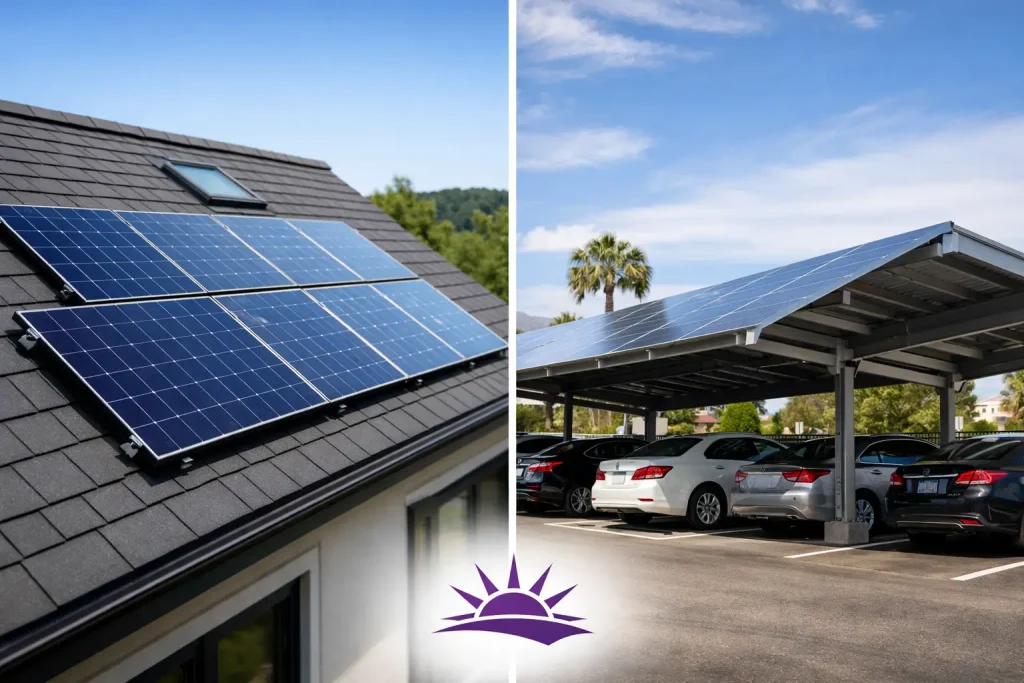
Rooftop Solar Versus Carport Solar: Which Fits?
Key Takeaways
- Rooftop solar is usually the most cost-efficient starting point when a home has a large, structurally sound, low-shade roof.
- Carport solar can be the stronger choice when roof space is limited, shaded, complex, or needed for other equipment.
- A carport array does more than generate electricity. It can shade vehicles, improve outdoor comfort, and turn parking space into an energy asset.
- The best decision comes from a site-specific engineering review of usable area, shading, household consumption, cable routes, and long-term energy goals.
A landed home can have plenty of sunshine and still be a poor candidate for a large rooftop array. Roof valleys, water tanks, chimneys, nearby trees, awkward orientations, and future maintenance access can reduce the area that is truly usable. That is why rooftop solar versus carport solar is not simply a question of where panels look better. It is a decision about energy yield, installation complexity, household comfort, and the value each square foot can deliver over time.
For most homeowners, the roof is the logical first place to assess. But a carport deserves serious consideration when it solves a practical space problem while creating a reliable solar platform. The right answer depends on the home, not a one-size-fits-all rule.
Rooftop Solar Versus Carport Solar: Start With Space
Rooftop solar uses an existing surface. That is its biggest advantage. Because the roof structure is already there, the solar system generally requires less supporting steel than a purpose-built carport. When the roof has a clear, well-oriented plane and limited shade, it can offer a direct path to reducing daytime electricity purchases.
The first engineering question is not the total size of the roof. It is the usable solar area after allowing for panel spacing, safe maintenance paths, obstructions, roof edges, and shading. A wide roof can produce less energy than expected if mature trees cast afternoon shadows or if panels must be split across several small sections facing different directions.
Carport solar begins with a different premise: the parking area becomes a purpose-designed generation surface. Panels are mounted on a dedicated canopy above vehicles rather than fitted around roof constraints. This can provide a cleaner, more consistent panel layout, especially on homes where the car porch has good sun exposure but the roof is heavily segmented.
A carport also gives the design team more control over tilt, orientation, drainage, and access. That control can improve performance, but it comes with a higher structural scope. The canopy, foundations, steelwork, drainage approach, and electrical routing all need to be engineered as one system.
When Rooftop Solar Makes Financial Sense
A rooftop system is often the best first investment when the roof is in good condition and has enough unshaded space to support the household’s daytime load. It makes effective use of an asset the homeowner already owns, without changing the appearance or function of the parking area.
The financial case is especially strong when solar generation aligns with how the home uses electricity. Air conditioning, kitchen appliances, pumps, home offices, and daytime charging can consume power while the panels are producing. A properly sized system should be based on actual consumption patterns, not just the largest number of panels that can fit.
Roof condition matters more than many homeowners expect. If major roof repair or replacement is likely in the near future, it may be wiser to address that work before installing solar. Removing and reinstalling panels later is possible, but it adds cost and disruption. A professional assessment should also review roof loading, mounting locations, waterproofing details, and cable pathways before design is finalized.
Rooftop solar is not automatically the lower-cost winner in every case. A steep roof, fragile roof finish, difficult access, or complex shading can increase installation effort and reduce expected output. If those issues are significant, a carport may deliver better long-term value despite its higher initial construction scope.
When Carport Solar Earns Its Footprint
Carport solar is compelling when it provides two useful outcomes from the same space: electricity generation and covered parking. In Malaysia’s heat and frequent rain, shaded parking can make a real daily difference. It can help keep vehicle cabins cooler, reduce weather exposure, and create a more comfortable arrival point at home.
For homes with limited roof area, a carport can also make a larger solar system possible. This is valuable for households with high daytime consumption, multiple electric vehicles, a home office, or plans to add battery storage. Instead of forcing panels onto small or partially shaded roof sections, the array can be designed on a clear, purpose-built structure.
The trade-off is straightforward: carport solar is construction as well as solar. A quality project needs appropriate structural design, foundations suited to the site, water management, corrosion-resistant materials, safe wiring routes, and a layout that preserves convenient vehicle movement. Lower upfront quotes can hide compromises in steel thickness, drainage, cable protection, or installation workmanship.
A thoughtfully designed canopy should feel like part of the house rather than an afterthought. Roofline height, column placement, lighting, rainwater flow, and access all influence whether the result is functional and visually balanced. This is where solar engineering and architectural coordination matter.
Design Details That Change Output and Value
Panel location is only one part of solar performance. Shade is often the biggest variable. Even a small shadow from a tree branch, neighboring structure, or roof feature can affect the output of a panel group during key generation hours. A site survey should assess shading across the day rather than relying on a quick visual estimate.
Orientation and tilt also matter, although they should be evaluated alongside available space. A slightly less-than-ideal panel direction may still be worthwhile if it allows more capacity or better matches the home’s daytime consumption. The goal is not to chase a theoretical maximum on paper. It is to produce useful electricity consistently and improve the household’s energy economics.
Electrical design deserves equal attention. Inverters, panel grouping, cable runs, monitoring equipment, and protection components should be selected for the property’s layout and expected load profile. If a home may later add a battery energy storage system, electric vehicle charging, or smart energy controls, planning these pathways early can avoid unnecessary rework.
This is also where advanced monitoring becomes practical. Cloud-based reporting can show how much energy the system produces, when the home consumes it, and where opportunities exist to shift demand. With a home energy management approach, selected loads can be managed more intelligently around solar generation, battery availability, and household priorities.
Amsolar approaches this decision as an energy design exercise, combining site assessment, engineering, financial modeling, installation, testing, and performance monitoring. The objective is not merely to place panels on the most visible surface. It is to build a system that performs predictably and supports lower operating costs over its working life.
Choose the Structure That Supports Your Next Step
If your roof is clear, sound, and suitably sized, rooftop solar will often be the most direct route to value. If the roof is constrained while the car porch receives strong sunlight, carport solar can turn an everyday parking area into a productive energy asset with added comfort.
For some properties, the strongest result is a combination: rooftop panels for efficient existing space, plus a carport array when more capacity is justified by the home’s load. The deciding factor should be measured performance potential, not assumptions about which structure is traditionally used for solar.
Start with a proper site and consumption review, then choose the surface that gives your home the best foundation for cleaner, more controlled energy use.
