
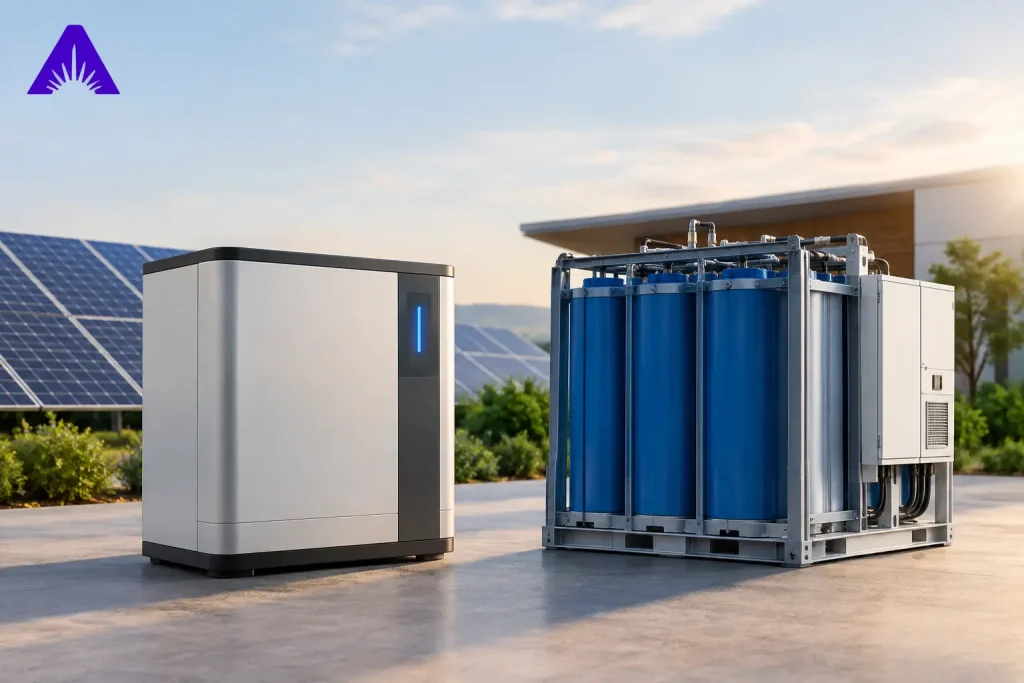
Lithium Versus Flow Batteries for Solar Storage
Key takeaways: Lithium batteries are usually the practical choice where space is limited and fast response matters, including most homes and many commercial sites. Flow batteries are designed for long-duration storage, with capacity that can be expanded independently from power output. The right decision depends less on battery chemistry alone than on the energy profile, required backup duration, site constraints, and lifetime economics.
A battery can turn a solar system from a daytime generator into a controlled energy asset. But the battery market is not one product category. In the discussion of lithium versus flow batteries, the central question is not which technology is universally better. It is which one matches the work the system must perform.
For a landed home, that may mean carrying essential loads through an evening outage, maximizing self-consumption from rooftop solar, or reducing grid purchases after sunset. For a commercial operation, it may mean controlling peak demand, maintaining critical loads, or shifting a substantial volume of solar energy across several hours. Those are different operating cases, and they produce different engineering priorities.
Lithium Versus Flow Batteries: The Core Difference
Lithium-ion batteries store energy inside sealed cells. The same cell structure determines both how much energy the system holds and, to a significant degree, how quickly it can deliver power. This compact architecture is why lithium has become the dominant technology for electric vehicles, residential storage, and many commercial battery energy storage systems.
Flow batteries store energy in liquid electrolytes held in external tanks. Electricity is generated when the electrolyte is pumped through an electrochemical stack. In this design, the stack largely determines power output, while tank size determines stored energy. A project can therefore add more storage duration by increasing electrolyte volume without proportionally increasing the power equipment.
That distinction matters. Lithium systems are highly effective when a site needs a compact battery that can charge and discharge quickly. Flow systems become more compelling when the main requirement is repeated, long-duration discharge – commonly four hours or more – and when the site has sufficient space for tanks and supporting equipment.
Neither option should be selected from a specification sheet alone. A battery’s usable capacity, discharge rate, inverter configuration, control strategy, thermal environment, and load profile all affect real-world performance.
Where Lithium Batteries Deliver the Strongest Value
Lithium batteries are typically the better fit for residential solar because they provide substantial energy capacity in a relatively small footprint. A wall-mounted or floor-mounted system can support a home energy management strategy without requiring separate electrolyte tanks, pumps, or a dedicated process area.
Their fast response is equally valuable. A properly designed lithium system can react quickly to changing solar output and household consumption. When clouds reduce PV production or a high-load appliance starts, the battery control system can respond in seconds. This makes lithium well suited to solar self-consumption, time-based energy shifting, and backup applications.
For commercial and industrial sites, lithium batteries also suit projects focused on shorter, high-value operating windows. A facility that needs to reduce brief afternoon demand peaks, stabilize intermittent solar generation, or protect sensitive operations during short interruptions may gain more value from power density and rapid dispatch than from very long storage duration.
There are trade-offs. Lithium systems require disciplined thermal design, battery management controls, and installation practices that account for the chemistry’s operating limits. Battery life is influenced by temperature, depth of discharge, charge rate, and cycling frequency. A low upfront price can be misleading if the design does not account for future capacity degradation or the actual duty cycle.
For homeowners, the decision should start with the loads that matter. Backing up selected circuits such as refrigeration, lighting, communications, security, and essential outlets requires a very different battery than attempting to run air conditioning, electric water heating, and every appliance as normal throughout an outage.
When Flow Batteries Make More Sense
Flow batteries are built around a different economic logic. Their advantage is not compactness. It is duration, cycle resilience, and the ability to separate energy capacity from power output.
A flow battery can be attractive for a site that produces significant solar energy during the day and needs to use it steadily over a long evening or overnight period. It may also suit a large facility with predictable, frequent cycling requirements, adequate equipment space, and a long asset-planning horizon. The electrolyte-based design can offer a long operational life with less concern about the same type of capacity fade associated with repeated cycling in many lithium systems.
The technology also has a different safety profile. Many flow chemistries use nonflammable aqueous electrolytes, reducing the fire-related concerns associated with high-energy lithium cells. That does not eliminate the need for engineered installation, containment, controls, and maintenance. It does change the design conversation.
The limitation is practical: flow systems are larger and more mechanically complex. They need tanks, pumps, piping, stacks, and space for maintenance access. Their lower energy density means they are rarely the natural answer for a space-constrained landed home, balcony solar setup, or small carport installation. For these applications, a compact lithium battery generally provides a clearer path to useful storage capacity.
Flow batteries are also not automatically lower cost. Their project economics depend heavily on scale, duration, local service capability, expected cycling, and the value of stored energy over time. They deserve serious evaluation for long-duration commercial storage, but they should not be treated as a drop-in substitute for every lithium battery system.
Choose by Energy Profile, Not Battery Hype
A sound storage decision begins with measured electricity data. The most useful question is: when does the site consume energy, and how much of that consumption can solar and storage realistically serve?
For a residence, assess daytime PV generation, evening consumption, essential backup loads, available installation space, and the desired level of energy independence. A battery that is too small will provide limited value during an outage. One that is oversized for the household’s usable solar surplus may spend much of its life underutilized.
For businesses, the analysis should go further. Load interval data can reveal demand spikes, production schedules, nighttime baseload, solar curtailment risk, and the number of cycles the battery could perform annually. This is where financial modeling becomes essential. A battery should be evaluated against avoided energy purchases, peak-demand reduction where applicable, backup value, operational continuity, maintenance requirements, replacement assumptions, and projected degradation.
Battery controls matter as much as battery size. An intelligently controlled system can prioritize solar charging, preserve reserve capacity for critical loads, discharge during expensive or high-demand periods, and avoid unnecessary cycling. Without a strategy matched to the site’s operating goals, even a premium battery can produce disappointing returns.
At Amsolar, storage planning is approached as an energy-system design exercise rather than a product sale. PV production, consumption behavior, battery dispatch, monitoring, and financial performance need to work as one coordinated model.
A Practical Decision for Homes and Larger Sites
For most landed homes adopting solar storage, lithium is the practical first option. It is compact, mature, responsive, and widely suited to the typical objective of using more rooftop solar while improving resilience for selected household loads. The exact capacity should follow the home’s consumption pattern and backup expectations, not a generic package size.
For larger sites with substantial space and a clear need for multi-hour energy shifting, flow batteries deserve consideration. They can be particularly relevant where daily cycling is heavy and long duration has measurable economic value. However, their footprint and system complexity demand a more deliberate engineering and commercial assessment.
The best battery system is the one that delivers useful energy at the moments it matters, for enough years to justify the investment. Start with real load data, define the outcome you want from solar storage, and let the operating profile determine the technology.
