
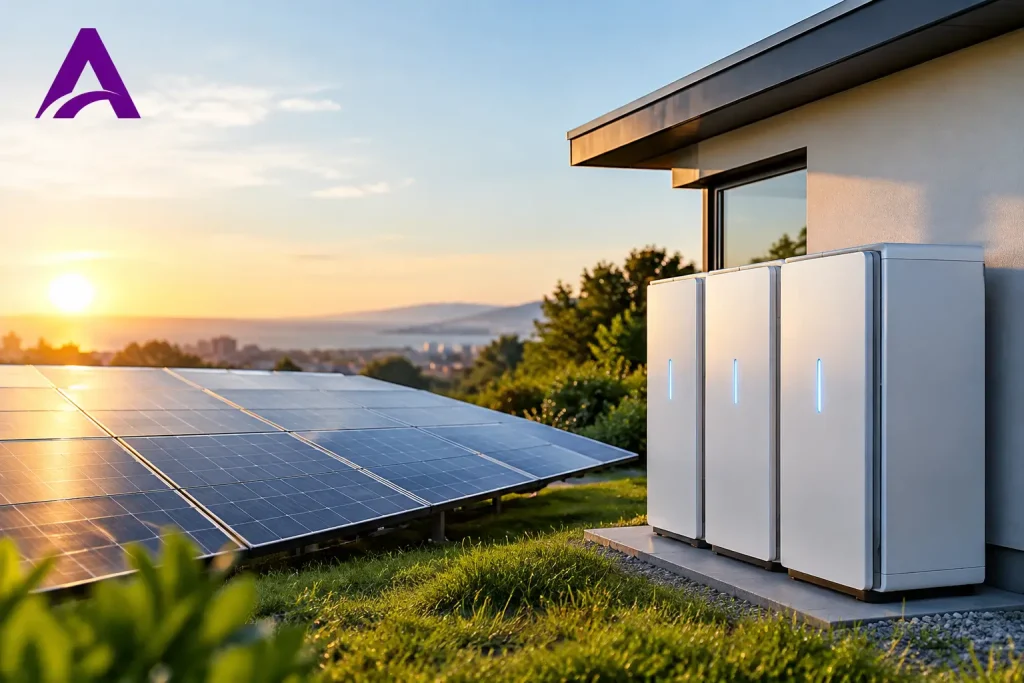
Solar Storage Market Trends Shaping Energy Costs
Key takeaways
- Battery storage is moving from a backup-only asset to an active tool for controlling electricity costs.
- Software, monitoring, and intelligent dispatch now matter as much as battery capacity.
- Flexible commercial models are making battery energy storage more accessible without requiring large upfront capital.
- The best storage investment depends on a site’s load profile, tariff exposure, solar production, and reliability needs.
A battery sitting idle until an outage is an expensive form of insurance. The most consequential solar storage market trends point in a different direction: businesses and homeowners increasingly expect batteries to work every day, shifting energy use away from expensive periods, absorbing solar generation, and improving visibility over how power is consumed.
For solar owners, this changes the investment question. It is no longer simply, “How many kilowatt-hours of storage should I buy?” It is, “What operating result should this system deliver, and how will it be controlled?” The answer requires sound engineering, accurate consumption data, and a financial model built around actual site behavior rather than generic assumptions.
Storage is becoming an energy cost-control asset
The market’s clearest shift is from standby backup toward daily value creation. Commercial and industrial facilities often experience sharp demand peaks, irregular operating schedules, and energy costs that vary by time of use. A properly sized battery can charge when solar production is high or electricity is less costly, then discharge when site demand is highest.
This practice, commonly called peak shaving or load shifting, can reduce exposure to costly demand periods. It can also help a facility use more of its own solar generation instead of sending excess power away when it has limited immediate value. For a business with daytime operations, solar and storage may be highly complementary. For a site that operates heavily at night, the battery’s role and economics will be different.
That distinction matters. A battery is not automatically a savings machine because it is installed alongside PV. Its value depends on the timing of solar generation, the pattern of building loads, and the control strategy used to coordinate them. An oversized battery may add capital cost without producing proportionate savings. An undersized unit may miss the periods that matter most.
For homeowners, the same principle applies at a smaller scale. Storage can preserve daytime solar production for evening use and provide selected backup capability, but the appropriate system depends on household consumption after sunset, roof production, and the appliances the owner wants to support. A sophisticated home energy management system can make these decisions more consistent without requiring the homeowner to manage them manually.
Battery intelligence is becoming a core differentiator
Battery hardware is increasingly available from multiple suppliers. What separates a high-performing project is the intelligence around it: metering, monitoring, forecasting, and automated dispatch. This is why energy management platforms are taking a larger role in solar storage design.
A battery controller should understand more than its state of charge. It needs to account for real-time site demand, expected solar output, historical consumption patterns, battery health, and the operating priorities set by the customer. If resilience is the priority, the system may reserve a portion of capacity. If cost reduction is the priority, it may discharge more aggressively during defined peak windows. In practice, many sites need a balance between both.
AI-driven energy control can improve this decision-making by identifying repeatable load behavior and adapting dispatch plans as conditions change. It is particularly useful where operations are variable: cold storage facilities, manufacturing plants, retail sites, education campuses, and larger homes with changing occupancy can all have load patterns that do not fit a fixed schedule.
Visibility is equally important. Cloud-based reporting should show solar generation, battery charging and discharging, grid import, demand peaks, and savings performance in terms that decision-makers can verify. Without credible measurement, a battery system may look active while failing to meet its financial purpose.
Flexible ownership models are widening access
Another important market trend is the growth of service-based storage models. Traditionally, a customer had to fund the full battery system upfront, then carry the technical and performance risk over its operating life. That remains appropriate for some organizations, particularly those with strong capital budgets and a clear long-term asset strategy.
But it is not the only path. BESS as a Service can allow a business to pursue energy savings with a lower initial capital commitment, typically through a structured commercial arrangement tied to system use and performance. This can be attractive for organizations that prefer to preserve cash for core operations while still addressing high energy costs.
The trade-off is straightforward: ownership can provide greater long-term asset control, while a service model can reduce initial financial pressure and shift more technical responsibility to the provider. Neither is universally better. The right choice depends on a company’s balance sheet, investment horizon, operating risk appetite, and confidence in projected savings.
Financial modeling should test several scenarios, not just the best-case outcome. A credible assessment considers changes in load growth, solar production variation, battery degradation, operating schedules, and the value of backup power. Payback and internal rate of return are useful measures, but they should be supported by transparent assumptions and site-specific data.
Resilience is being designed with more precision
Extreme weather, grid disturbances, and operational sensitivity have increased interest in backup power. Yet resilience is not a simple yes-or-no feature. A battery may support an entire home for a limited duration, protect only critical circuits, or keep a commercial facility’s essential systems operating while nonessential loads are curtailed.
The practical question is which loads truly need continuity. For a residence, that may include refrigeration, lighting, internet connectivity, security, and selected cooling. For a business, it may include servers, process controls, safety systems, cold rooms, or critical production equipment. Defining these priorities early prevents a costly mismatch between expected backup performance and the system installed.
Storage systems also need to be designed as part of the wider electrical architecture. Inverter capability, switchgear, protection settings, solar capacity, and critical-load separation all influence whether the system performs as intended. This is where turnkey engineering matters. The battery cannot be treated as an add-on box; it must function as part of an integrated energy system.
Amsolar approaches this through site assessment, engineering design, energy analysis, system deployment, commissioning, and ongoing performance monitoring. That end-to-end view is essential because a storage project succeeds through coordinated design and operation, not through component selection alone.
What smart buyers should evaluate now
The strongest storage projects start with data, not equipment brochures. At minimum, decision-makers should examine interval electricity consumption, demand peaks, operating hours, available solar generation, and the cost of interruptions. A site with a high, predictable late-afternoon peak may have a very different storage opportunity from one with flat consumption throughout the day.
Buyers should also ask how the system will be operated after installation. Who monitors performance? How are savings measured? Can dispatch settings adapt when operations change? What happens when solar output is lower than expected or a battery needs maintenance? These questions reveal whether a proposed solution is engineered for sustained results or simply sized for a sales presentation.
The market is moving toward storage that is measurable, controllable, and financially accountable. The most effective next step is to turn your own consumption data into a clear operating case, then select a solar and battery design that delivers value on the days your energy costs are hardest to control.
