
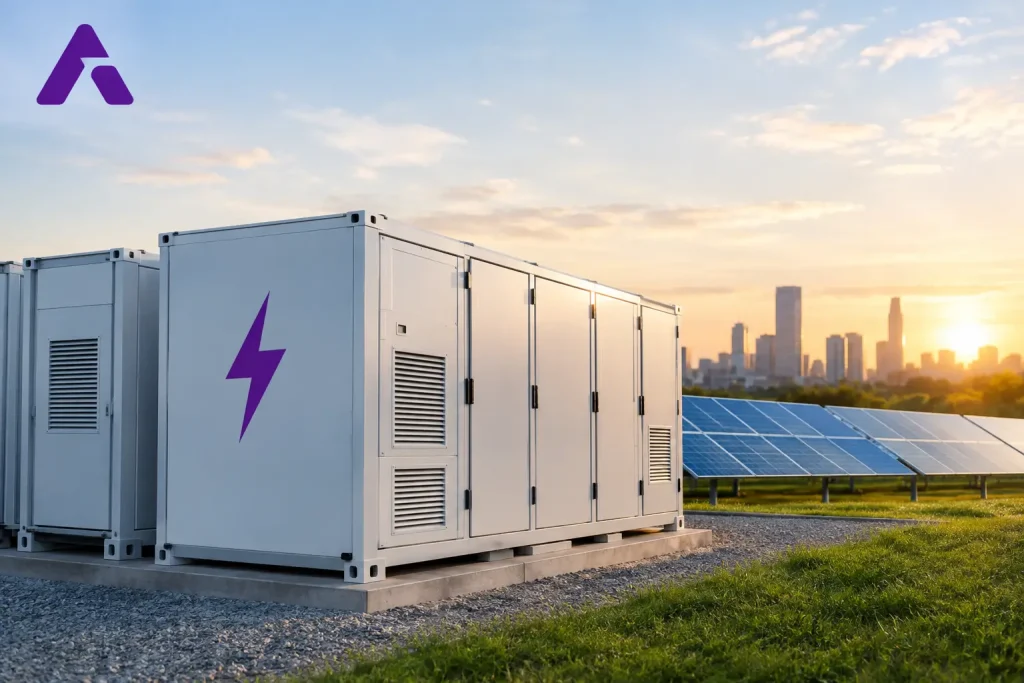
Battery Energy Storage for Lower Demand Costs
Key Takeaways
Battery energy storage is not simply backup power for a facility. For factories, hospitals, data centers, malls, and other high-use sites, it can be a controlled energy asset that reduces costly demand peaks, supports power quality, and improves visibility over how electricity is consumed.
- The strongest business case is usually driven by maximum demand reduction, not energy shifting alone.
- Battery performance depends on correct sizing, site load analysis, control logic, and ongoing monitoring.
- AI-driven controls can respond to live consumption patterns rather than following a fixed battery schedule.
- A zero-capex BESS as a Service model can make storage accessible without tying up capital needed for core operations.
What Battery Energy Storage Does at a Commercial Site
A battery energy storage system, commonly called BESS, stores electricity for use when the facility needs it most. The battery charges during selected periods and discharges when site demand rises above a target level. This is known as peak shaving.
Consider a manufacturing plant where several production lines, compressors, chillers, and motors begin operating at nearly the same time. Even if that spike lasts only 15 or 30 minutes, it can set the facility’s maximum demand charge for the billing cycle. A properly controlled battery can discharge during that interval, reducing the amount of power drawn from the grid.
That distinction matters. Solar PV reduces the amount of electricity purchased while the sun is available. Battery storage adds timing and control. It can retain solar generation that would otherwise have limited immediate value, but it can also charge from the grid when a site strategy supports it. The right operating mode depends on the facility’s load profile, tariff structure, operating hours, and financial objectives.
Storage also provides a useful degree of operational resilience. It can support critical loads during a grid interruption when designed with the appropriate switching and backup architecture. However, backup capability should not be assumed. A system optimized only for demand management may have limited duration or may not be configured to operate selected loads during an outage. The required outcome must be defined before system design begins.
Where the Financial Value Comes From
The value of a BESS is rarely a single line item. For high-consumption facilities, the main opportunity is often preventing short, expensive demand peaks that are difficult to manage manually. A battery can respond faster than operational teams can reschedule equipment, especially when production requirements cannot be interrupted.
A hospital may need to maintain stable operations while cooling loads, medical equipment, and building systems change throughout the day. A fabrication facility may experience sudden peaks from welding, cutting, lifting, or compressed-air loads. A data center may have a consistently high base load but still need to manage cooling and equipment transitions. These facilities have different energy signatures, which is why a standard battery size is rarely the best answer.
The second source of value is solar self-consumption. When solar output is available but the site cannot absorb all generation at that moment, a battery can store part of that energy for later use. This can improve the economic output of a PV system, particularly at sites where daytime load patterns fluctuate.
The third is power quality support. Reactive power, poor power factor, and voltage-related issues can affect the efficiency and stability of electrical systems. Battery storage is not a replacement for dedicated power quality equipment in every case. For some sites, a static VAR generator, or SVG, provides the more direct solution for reactive power compensation, while the battery focuses on active power and demand control. In many commercial and industrial applications, the best result comes from coordinating both assets as part of one energy management strategy.
Financial modeling should account for expected demand savings, solar utilization, equipment lifecycle, operational constraints, and the cost of capital. Payback and internal rate of return improve when the system is designed around real interval data rather than estimates based on monthly utility bills alone.
Why Control Software Determines Results
A battery without intelligent controls can still charge and discharge. It may follow a simple timetable, such as charging at night and discharging in the afternoon. That approach can work where operations are predictable, but it may miss the actual peak or discharge too early on a variable production day.
High-energy users need controls that understand what is happening behind the meter. A smart platform monitors incoming load, solar generation, battery state of charge, and defined operating limits. It can then make decisions based on current site conditions instead of a fixed schedule.
This is where an AI-driven energy control platform can create a measurable difference. Amsolar’s eCOS platform is designed to support battery control and energy monitoring, allowing the system to respond to load behavior and protect a defined demand threshold. The objective is practical: use stored energy only when its value is highest, maintain sufficient reserve when needed, and avoid unnecessary battery cycling.
Battery cycling requires disciplined management. Discharging too aggressively may reduce the ability to manage a later peak. Holding too much reserve can leave savings unrealized. Repeatedly using the full depth of discharge may also affect long-term battery life, depending on the technology and warranty conditions. Control logic must balance daily cost savings against asset performance over the full operating life.
Cloud-based reporting completes the picture. Facility managers should be able to see demand trends, battery dispatch, solar contribution, energy savings, and exceptions that require attention. Data turns energy management from a monthly finance exercise into an operational discipline.
Engineering Decisions That Cannot Be Skipped
Battery capacity, expressed in kilowatt-hours, determines how long a system can support a load. Battery power, expressed in kilowatts, determines how much demand it can offset at one time. Both figures matter, and confusing them can lead to a system that looks adequate on paper but cannot address the actual peak.
For example, a site may need to reduce demand by 1,000 kW for 30 minutes. That requirement calls for sufficient discharge power to deliver 1,000 kW and sufficient usable energy to sustain it for the required period, with appropriate design margin. If the site peak lasts longer or occurs in several intervals, the sizing approach changes.
A proper assessment examines interval load data, daily and seasonal patterns, major equipment starts, solar generation, transformer capacity, available space, thermal conditions, and electrical integration requirements. It should also evaluate whether a peak is a recurring issue or an occasional event. Batteries are highly effective for repeatable peaks. If the underlying load is continuously above a desired limit for many hours, energy efficiency improvements, process changes, or additional generation may be needed alongside storage.
Safety and execution are equally important. A BESS project requires coordinated engineering across battery equipment, inverters, protection systems, switchgear, communications, civil works, commissioning, and testing. An end-to-end delivery team reduces the risk of gaps between system design, construction, controls integration, and performance verification.
Selecting the Right Commercial Model
Buying a battery outright gives the owner direct control of the asset and may suit organizations with available capital and a clear long-term energy strategy. It also means the owner carries the upfront investment and must evaluate the financial return carefully.
BESS as a Service offers a different path. Under a zero-capex structure, the customer can access battery capacity and energy optimization without making the full initial equipment investment. This can be attractive for businesses that want to protect cash flow, preserve borrowing capacity, and focus capital on production, expansion, or service delivery.
The right model depends on site economics and risk preference. Decision-makers should ask how savings will be measured, what performance targets apply, who monitors the system, how maintenance is handled, and how the system will adapt if the facility’s load profile changes. A battery project should be treated as an operating energy program, not a one-time equipment purchase.
For facilities facing rising demand peaks, unpredictable production loads, or underused solar generation, the next practical step is to start with detailed electricity data. The most valuable battery is not the largest one. It is the one engineered, controlled, and monitored to solve the specific energy cost problem the site experiences every day.
