
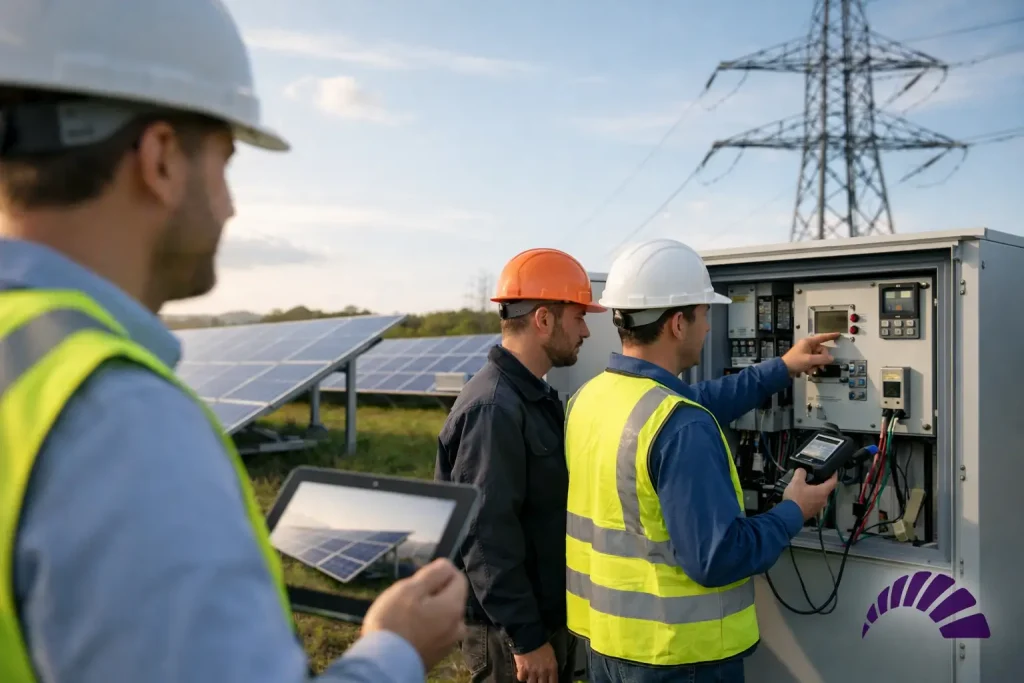
Grid Commissioning for Solar Systems
Key takeaways: Grid commissioning for solar systems is the final technical and regulatory checkpoint before energization. It confirms that the PV system is safe, utility-compliant, correctly configured, and ready to deliver expected performance. For commercial and industrial owners, good commissioning reduces approval delays, avoids avoidable rework, and protects long-term energy yield.
A solar project can look complete on the roof, at the carport, or beside the factory – and still be nowhere near ready to export power. That gap is where grid commissioning for solar systems matters most. It is the stage where engineering design, installation quality, protection settings, utility requirements, and actual operating behavior are tested against each other in the real world.
For business owners and facility teams, this is not a paperwork exercise. Commissioning is where latent installation errors, inverter setting mismatches, communication faults, and protection issues usually surface. If they are found before energization, the project stays controlled. If they are found after handover, the cost shows up in downtime, delayed savings, and strained utility approvals.
What grid commissioning for solar systems actually covers
Grid commissioning sits between construction completion and commercial operation. In practical terms, it confirms that the system can connect to the grid safely, perform according to design intent, and satisfy the local utility and regulatory framework.
That usually starts with document verification. Single-line diagrams, protection studies, equipment datasheets, as-built drawings, test records, and approval documents need to align. If the field installation differs from the approved design, even in ways that seem minor, that can trigger revalidation.
The physical system is then checked in detail. DC string polarity, insulation resistance, cable terminations, torque settings, earthing continuity, breaker labeling, inverter installation, protection devices, and meter integration all need to be verified. For larger commercial and industrial systems, this often extends to transformer interfaces, switchgear inspection, relay coordination, and SCADA or monitoring communication.
The last part is operational testing. The team energizes sections in a controlled sequence, validates inverter startup behavior, confirms anti-islanding response, checks grid voltage and frequency settings, verifies export limits where required, and ensures that the monitoring platform reports the right values. This is also where power quality and protective trip behavior may be reviewed, depending on project scale and utility conditions.
Why this stage affects project economics
For an industrial facility, a commissioning delay is not just a scheduling issue. It pushes back the date when the system starts offsetting purchased electricity. If the site has already committed capital, or if the business model depends on forecast savings, every week of delay changes the financial picture.
This is why grid commissioning should be treated as part of asset performance, not only compliance. A system that is approved but incorrectly configured can still underperform. Common examples include wrong CT orientation, export control instability, poorly mapped strings in the monitoring platform, or inverter settings that are technically functional but not optimized for site conditions.
A disciplined commissioning process protects the expected return by catching those problems early. It also supports cleaner baseline data for ongoing electricity usage monitoring, cloud reporting, and later optimization work. If a business plans to add battery storage, adaptive power control, or AI-driven energy cost management, the commissioning stage becomes even more important because the control foundation must be right from day one.
The most common issues found during commissioning
Commissioning tends to reveal a predictable set of problems. Some are simple workmanship issues. Others come from coordination gaps between engineering, procurement, installers, and utility requirements.
One frequent issue is mismatch between approved settings and actual inverter configuration. Anti-islanding parameters, voltage ride-through windows, frequency protection thresholds, and export limits must match what has been submitted and approved. Another is metering and communication failure. The plant may generate power, but if the revenue meter, smart meter, or data gateway is not integrated correctly, the site cannot validate performance properly.
Protection coordination is another common trouble point on commercial sites. If circuit breakers, relays, and inverter protections are not aligned, nuisance trips can occur during normal fluctuations. That creates a system that appears unreliable even when the core equipment is sound.
There is also the issue of documentation quality. A site may be physically ready, but handover stalls because test reports are incomplete, as-built drawings do not reflect installation changes, or required utility forms are missing. In many projects, the delay comes from administration just as much as from hardware.
Grid commissioning for solar systems in commercial settings
Commercial and industrial projects are more demanding than residential systems because they typically involve higher capacities, more complex switchboards, tighter safety controls, and stronger expectations around reporting and financial performance. A factory, cold storage site, mall, office campus, or logistics facility cannot afford uncertainty at interconnection.
In these settings, commissioning needs to account for the way the facility actually uses electricity. Daytime demand profile, load variability, power factor correction equipment, backup generators, and any battery system all influence how the solar plant should be configured. A technically correct installation can still be operationally inefficient if those site conditions are not considered.
This is where an engineering-led, turnkey approach adds value. The team handling design, regulatory submission, procurement, testing, and commissioning can close the loop faster because they are not inheriting fragmented assumptions from multiple vendors. That matters even more when the project includes advanced controls, battery integration, or energy management layers intended to reduce peak demand and improve payback.
What a strong commissioning process looks like
The best commissioning work starts long before the first live test. It begins during design with clear utility requirements, equipment compatibility checks, and a commissioning plan tied to the actual grid interconnection scheme.
Before energization, the project team should have completed internal pre-commissioning checks. These cover installation verification, protection settings review, communication setup, and document readiness. By the time utility witnessing or final approval takes place, the project should already have passed its own technical gate.
During live commissioning, the sequence should be deliberate. Energize, verify, observe, record, and only then move to the next stage. Rushing this process often creates intermittent faults that are hard to trace later.
After successful commissioning, the work should not stop at a signed form. The first days and weeks of operation are where real performance trends appear. Monitoring should be reviewed against design assumptions, inverter logs checked for hidden alarms, and export behavior validated under actual load conditions. For businesses focused on cost control, that post-commissioning period is where operational value starts to become visible.
The role of compliance, data, and long-term optimization
A system that passes commissioning is not automatically optimized. It is compliant and operational, which is the baseline. Optimization comes after the asset begins producing clean data.
That is why strong commissioning and strong monitoring belong together. If meters, sensors, and reporting channels are correctly configured at handover, the owner can see whether the plant is meeting expected generation, whether load offset is tracking the financial model, and whether additional action is needed. This is especially relevant for companies considering battery storage under a zero-capex or service-based model, where measured performance directly affects economics.
In more advanced projects, commissioning also sets the stage for future controls such as battery dispatch logic, demand shaving, export limiting, and AI-based energy cost adjustments. None of those layers work well if the base solar system was commissioned with incomplete testing or weak data integrity.
Choosing the right project partner
If you are evaluating solar for a commercial building or industrial facility, ask detailed questions about commissioning before you sign. Who defines the testing protocol? Who interfaces with the utility? Who verifies protection settings? Who owns the as-built documentation? Who checks that monitoring, metering, and controls are accurate after energization?
Those answers tell you whether the provider is acting as an installer or as an energy infrastructure partner. The difference shows up at the point of grid connection, where technical quality, compliance discipline, and business outcomes all meet.
A company like Amsolar, with integrated engineering, testing, regulatory support, monitoring, and optimization capability, is structured for that broader responsibility. That matters because commissioning is not the end of the project. It is the point where the asset proves it can start delivering what was promised.
The roof may be finished earlier, but the project only starts creating value when the system connects correctly, reports accurately, and performs under real operating conditions.
