
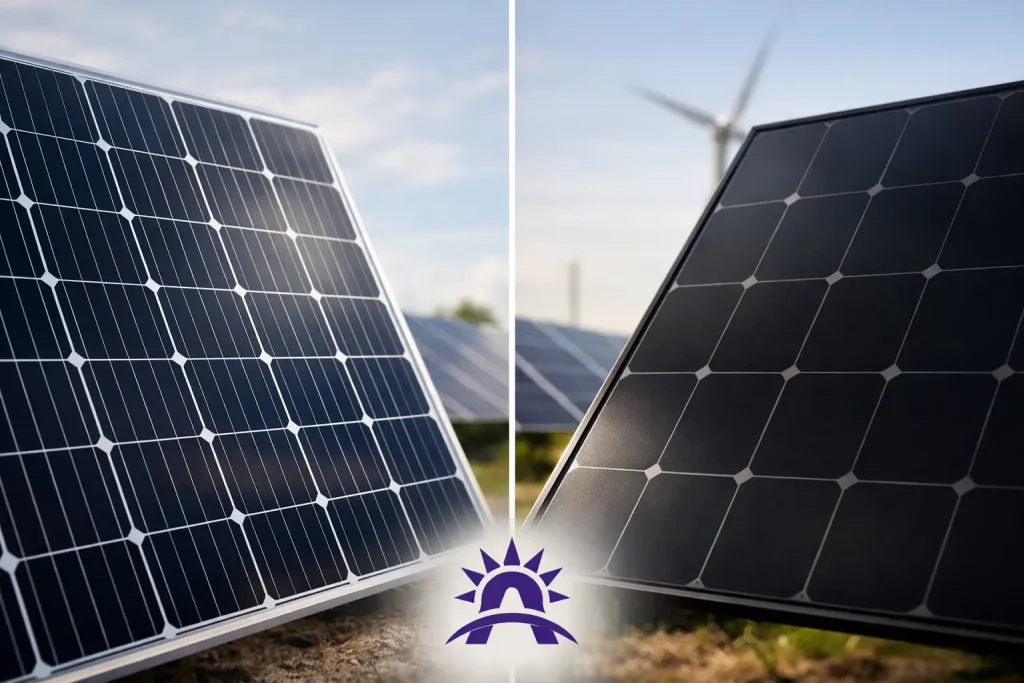
Latest PV Panel Technology: TOPCon vs Back Contact
Key takeaways
The latest PV panel technology and TOPCon, back contact conversation matters because module choice now affects far more than nameplate wattage. For commercial and industrial projects, the real question is which cell architecture delivers the best lifetime yield, heat performance, reliability, and financial return for the site. TOPCon has become the volume technology with strong efficiency and competitive pricing, while back contact modules offer premium performance and aesthetics but usually at a higher cost. The right answer depends on tariff structure, roof constraints, temperature profile, and how tightly the system will be integrated with monitoring, storage, and operating strategy.
A 550 W panel is no longer just a 550 W panel. The underlying cell architecture now plays a bigger role in how a system performs under heat, partial shading, and long-term degradation. That is why the latest PV panel technology and TOPCon, back contact options deserve a closer look before any procurement decision is made.
Why cell architecture matters more now
For many years, panel selection was mostly about tier, warranty, and front-side efficiency. That is changing. Commercial buyers are under pressure to reduce operating costs, protect project IRR, and make better use of limited roof or land area. At the same time, electricity tariffs, demand charges, and battery integration are making generation timing and consistency more valuable.
This shifts attention from headline module power to delivered energy over 20 to 30 years. A panel that performs better in high temperatures or loses less output over time may create more value than a cheaper module with slightly lower purchase cost. For factories, warehouses, shopping centers, and office assets, the right module can improve not only annual production but the economics of storage charging, self-consumption, and peak demand control.
Latest PV panel technology: TOPCon and back contact
The current market is moving beyond conventional PERC. Two of the most discussed paths are TOPCon and back contact designs. They address efficiency losses differently, and that difference affects both cost and performance.
What TOPCon does well
TOPCon stands for Tunnel Oxide Passivated Contact. In simple terms, it improves carrier selectivity and reduces recombination losses at the cell contact. That helps raise efficiency beyond standard PERC and usually improves temperature behavior and long-term retention.
For project developers and asset owners, the appeal is clear. TOPCon modules are now widely available, bankable, and increasingly cost-effective. They often offer a strong balance of module efficiency, lower degradation, and scalable procurement. Because manufacturing volume has grown quickly, TOPCon is becoming the practical default for many commercial systems.
In warm climates, this matters. A panel that holds performance better in high irradiance and elevated roof temperatures can lift real-world energy yield. On industrial roofs where heat build-up is common, small efficiency gains at the cell level can translate into meaningful annual savings.
Where back contact stands out
Back contact cells move electrical contacts to the rear of the cell. That removes front-side metal shading, allowing more sunlight to reach the active surface. The result is typically very high efficiency and a cleaner appearance.
Back contact modules have two obvious strengths. First, they can produce excellent output per square foot, which is useful where roof area is constrained. Second, they are visually superior, making them attractive for premium residential projects and architecturally sensitive commercial buildings.
There can also be performance benefits in low-light or diffuse-light conditions, depending on the cell design and module construction. But these gains are not universal enough to treat as automatic. The commercial question is whether the extra energy yield and design advantages justify the price premium.
TOPCon vs back contact for business cases
If the decision is framed only as efficiency versus cost, the analysis stays too shallow. A better approach is to compare the technologies against the operating profile of the site.
For a large C&I rooftop project, TOPCon is often the stronger financial fit. It offers high efficiency, mature supply availability, and a cost position that tends to work well in payback and IRR models. When the roof area is sufficient, TOPCon may deliver the better total project outcome because the incremental gain from back contact is not always enough to offset higher module cost.
Back contact becomes more compelling when space is tight, when premium output density matters, or when the project has architectural requirements. A high-value home, a corporate HQ, or a commercial building with limited usable roof sections may justify the premium. If every square foot counts, maximizing generation density can outweigh the higher upfront module price.
This is why panel selection should sit inside full system design, not outside it. DC/AC ratio, inverter selection, cable routing, shading profile, mounting layout, and future battery integration all influence which module technology produces the better commercial result.
Heat, degradation, and real-world yield
One of the biggest gaps between brochure data and operating reality is temperature. Panels are tested under standard conditions, but rooftops rarely operate there. In Malaysia and other hot, humid environments, module temperature can significantly reduce actual output.
TOPCon generally earns attention here because of improved temperature behavior relative to older PERC products. That does not mean every TOPCon panel performs the same. Encapsulation quality, glass configuration, frame design, and manufacturing consistency still matter. A well-engineered module from a credible supplier will usually outperform a poorly built panel, regardless of technology label.
Back contact modules can also deliver strong thermal and degradation performance, especially in premium product lines. But buyers should avoid broad assumptions. The right comparison is not TOPCon in the abstract versus back contact in the abstract. It is one specific module against another, with verified data on temperature coefficient, annual degradation, warranty terms, and independent test history.
For asset owners, the output that matters is lifetime delivered kilowatt-hours, not just initial efficiency. Lower degradation can improve long-term energy savings and support a stronger residual asset value.
Procurement risk and bankability
The latest PV panel technology and TOPCon, back contact debate is not only technical. It is also a procurement and risk management issue.
TOPCon currently benefits from scale. That generally means more vendor options, more stable pricing, and easier replacement planning if future expansion or warranty support is needed. For large portfolio buyers, this can be a practical advantage.
Back contact modules may come from fewer suppliers or more premium-focused product families. That is not a problem by itself, but it requires tighter diligence. Buyers should review supplier track record, manufacturing consistency, warranty claims handling, and long-term product roadmap. Premium technology only adds value if it remains supportable over the operating life of the system.
For financed projects, lender and insurer comfort also matters. Mature technologies with broad market adoption may move through approval processes faster. Again, this depends on the project structure, but it is worth considering early rather than during procurement delays.
Where batteries and controls change the equation
Module choice becomes more strategic when paired with battery storage and intelligent energy controls. If a site is optimizing self-consumption, shaving peak demand, or responding to tariff windows, then consistency of daytime generation matters as much as total annual production.
A slightly higher-performing module can improve battery charging behavior and reduce grid reliance during expensive periods. But the bigger gains often come from system-level optimization. Panel technology should be selected together with inverter architecture, monitoring, battery dispatch logic, and consumption profile.
That is especially true for businesses evaluating zero-capex or performance-based models. In those cases, technology decisions should support measurable operating outcomes, not just procurement savings. Amsolar approaches this from the engineering and financial side together, which is the right way to evaluate advanced module choices in a modern energy system.
So which one should you choose?
If your priority is strong commercial performance with disciplined capital cost, TOPCon is usually the leading choice today. It gives most businesses a very competitive mix of efficiency, reliability, availability, and bankable economics.
If your roof is constrained, your project has premium design requirements, or every increment of output density has high value, back contact deserves serious consideration. It may also suit high-end residential projects where appearance and module efficiency both carry weight.
The better decision is rarely made at the catalog level. It comes from yield modeling, thermal assumptions, degradation analysis, tariff review, and financial sensitivity testing. That is how you decide whether a premium module actually improves payback or simply raises capex.
Panel technology is advancing quickly, but procurement should stay disciplined. The smartest buyers are not chasing whichever label sounds newest. They are choosing the architecture that fits the site, the operating profile, and the financial target. That is where good solar projects become strong energy assets.
