
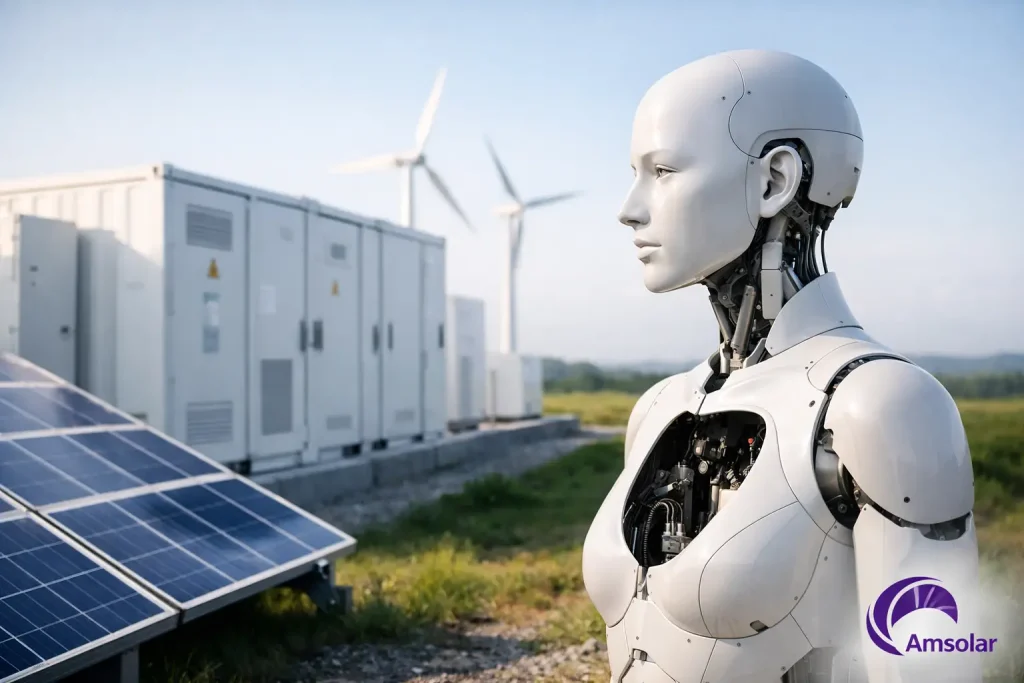
BESS Without AI Is a Body Without a Soul
Key takeaways: BESS without AI is a body without a soul because battery storage only delivers full commercial value when it can predict load, respond to tariffs, protect battery health, and coordinate with solar, grid, and site demand in real time.
A battery can sit on a site, charge, discharge, and still leave money on the table every day. That is why the phrase bess without ai is a body without a soul is more than a slogan. For commercial and industrial energy users, it is a practical truth. A battery energy storage system has hardware value, but without intelligence directing its behavior, it cannot consistently make the best decisions for cost, resilience, and asset life.
For factory owners, building operators, and finance teams, this distinction matters. Buying battery hardware is not the same as buying an optimized energy strategy. The real question is not whether a site has BESS. The real question is whether the BESS knows what to do, when to do it, and why.
Why BESS without AI is a body without a soul
At its simplest, BESS stores electricity for later use. That sounds straightforward, but commercial energy use is rarely straightforward. Loads shift by hour, production schedules change, solar output moves with weather, and utility tariff structures can punish poorly timed consumption. A battery working on a fixed rule set cannot keep up with that complexity.
AI gives BESS its operating logic. It turns storage from a passive asset into an active energy management tool. Instead of discharging at the same time every day, an AI-enabled system can analyze load patterns, forecast solar generation, detect tariff windows, and decide whether it is better to shave peak demand, avoid expensive imports, reserve energy for backup, or support power quality.
That is the difference between owning a battery and operating an energy asset.
The business case is operational, not theoretical
For most commercial sites, battery storage is approved on economics. Leaders want to know how much grid consumption can be reduced, how peak demand charges can be controlled, what the payback period looks like, and whether the asset will perform reliably over time.
AI directly affects each of those outcomes.
A conventional BESS controller may follow predefined schedules. That can work in stable environments, but many sites are not stable. Manufacturing plants add shifts. Office buildings change occupancy. Hotels move through seasonal demand swings. Mixed-use developments experience uneven load across the day. When the operating environment changes, static battery logic often becomes inefficient.
AI improves this by learning from actual site behavior. It can identify recurring peaks, detect anomalies, and refine charge-discharge strategy to match real energy patterns. That often means lower maximum demand, better use of self-generated solar, and fewer missed opportunities during high-tariff periods.
The result is not just better energy performance. It is a better financial outcome.
Where AI creates measurable value in BESS
The strongest value of AI is not in one dramatic feature. It comes from hundreds of small, fast decisions made correctly.
Tariff optimization and peak shaving
Many commercial electricity bills are shaped by when power is consumed, not just how much is consumed. If a battery discharges too early, the site may still hit a demand spike later in the day. If it charges at the wrong time, it may increase imported energy costs instead of lowering them.
AI can forecast probable peaks and preserve battery capacity for the periods that matter most. It can also adapt when a site behaves differently from normal. This matters for facilities where one bad 15-minute interval can influence the monthly bill.
Solar self-consumption
On a site with solar PV, storage should not simply absorb excess generation whenever it appears. It should decide whether charging now creates more value than exporting, whether capacity should be held for later arbitrage, and whether the battery should support evening operations or standby resilience.
AI helps coordinate PV, load, and battery behavior as one system. That coordination is what turns solar and storage into a unified cost-control strategy rather than separate assets sharing the same switchboard.
Battery health and lifecycle protection
A battery that cycles aggressively may show good short-term savings but suffer faster degradation. A battery that is operated too conservatively may last longer but underperform financially. The right answer depends on tariff structure, usage profile, warranty conditions, and business priorities.
This is where the statement BESS without AI is a body without a soul becomes especially relevant. AI can balance economic return against battery health. It can avoid unnecessary deep discharges, manage charge rates, and reduce stress based on temperature, cycling history, and operational context. That protects asset value while still pursuing savings.
Power reliability and resilience
Not every site uses BESS for the same reason. Some prioritize bill reduction. Others need ride-through support for sensitive equipment or backup continuity during grid instability. In those cases, discharging the battery for tariff savings might be the wrong move if resilience capacity is needed later.
AI enables prioritization. It can allocate battery capacity based on business rules that reflect what matters most to the site at that moment, whether that is savings, uptime, or a balance of both.
Static control works – until it doesn’t
It would be inaccurate to say every battery needs advanced AI from day one. Some small or highly predictable applications can perform reasonably well with simpler controls. If a load profile is flat, tariff structures are basic, and resilience needs are limited, a rule-based system may be enough.
But most serious commercial users do not operate in that kind of environment for long. Expansion, new equipment, EV charging, process changes, and utility pricing shifts all introduce complexity. What worked in year one may underperform in year three.
That is the trade-off. A lower-intelligence system may appear simpler at the start, but it often creates performance drag over the life of the asset. For decision-makers evaluating long-term returns, that drag matters.
AI does not replace engineering – it multiplies it
There is a common misconception that AI can fix poor system design. It cannot. If the battery is undersized, the inverter architecture is wrong, the metering is incomplete, or the operating objectives are unclear, software alone will not rescue the project.
Strong BESS performance starts with engineering. The site needs proper load analysis, financial modeling, dispatch logic, interconnection planning, commissioning, and reporting. AI then enhances the system by continuously improving how it runs under real-world conditions.
That is why experienced delivery matters. The best results come when battery sizing, tariff analysis, solar integration, monitoring, and controls are designed as one framework, not as separate decisions made by different parties.
What commercial buyers should ask before approving BESS
If you are evaluating battery storage, ask a harder question than battery capacity or inverter brand. Ask how the system will think.
Will it respond dynamically to your tariff structure? Can it adapt to production changes? How does it protect battery health while pursuing savings? Can it integrate with monitoring and reporting that your operations and finance teams can actually use? Can the dispatch strategy be refined after commissioning as site conditions change?
These questions reveal whether the project is being treated as equipment procurement or as energy optimization.
For businesses considering BESS as a Service under a zero capex model, this becomes even more important. The value proposition depends on sustained operational performance over time. If the battery is not intelligently managed, the commercial model has less room to deliver its full potential.
The future of storage belongs to intelligent control
Battery prices, inverter quality, and deployment models will continue to improve. That is good news for the market. But as hardware becomes more standardized, intelligence will increasingly be what separates average projects from high-performing ones.
For companies managing multiple sites, that gap becomes even wider. Portfolio-level visibility, cloud-based reporting, AI-led optimization, and adaptive control can turn distributed energy assets into a measurable operating advantage. Without that intelligence layer, businesses may still own modern equipment, but they will not extract the full financial and operational value.
In practical terms, a battery stores electricity. AI turns that stored electricity into strategy.
That is why serious energy users should treat control logic as core infrastructure, not an optional add-on. When storage is expected to reduce costs, support resilience, and improve the economics of solar, intelligence is what gives the system purpose. A battery may be the body, but the performance comes from the mind running it.
