
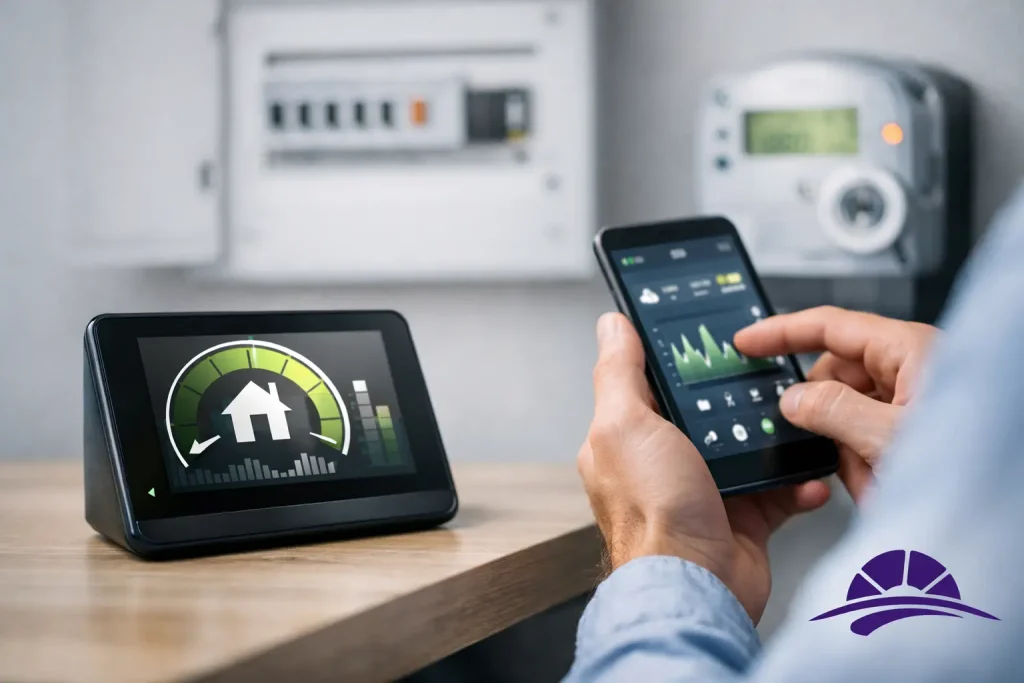
Electricity Usage Monitoring System Guide
Key takeaways: An electricity usage monitoring system gives you real-time visibility into where power is consumed, when demand spikes happen, and which actions deliver measurable savings. For commercial and industrial sites, it is often the missing layer between installing energy assets and actually controlling energy cost.
A factory can spend heavily on solar, efficient equipment, or battery storage and still miss the real savings opportunity because nobody can clearly see what is driving the bill. That is where an electricity usage monitoring system changes the conversation. It turns power consumption from a monthly surprise into an operational data stream that can be measured, managed, and improved.
For business decision-makers, this is not just a reporting tool. It is a control layer for energy cost, asset performance, and planning. If you are responsible for operating margins, production uptime, or capital deployment, the value is practical: better visibility, faster decisions, and stronger financial outcomes.
What an electricity usage monitoring system actually does
At its core, an electricity usage monitoring system captures power data from your site and translates it into something your operations and finance teams can use. That usually includes total consumption, circuit-level or equipment-level demand, load profiles by time of day, peak demand behavior, and historical trends.
The difference between basic metering and a true monitoring system is context. A utility bill tells you how much was consumed. A monitoring platform shows when the load increased, which process lines contributed, whether the spike was expected, and how that behavior affects tariff costs.
For commercial buildings, this can reveal inefficient HVAC scheduling, after-hours energy waste, or poor load balancing. In industrial environments, it can expose oversized demand events, compressed air losses, abnormal motor behavior, or production patterns that drive avoidable charges.
When cloud-based reporting and analytics are included, the system becomes more useful over time. You are not just collecting numbers. You are building an operating picture of the site.
Why electricity usage monitoring systems matter more after solar installation
Many companies assume the biggest energy decision is whether to install solar. In reality, the bigger question is how well the site will use and control energy after the system is commissioned. Solar reduces purchased electricity, but it does not automatically fix inefficient consumption patterns, unmanaged peaks, or poor load timing.
This is where electricity usage monitoring systems become essential. They help you verify whether solar generation aligns with daytime demand, whether battery storage is discharging at the right times, and whether certain loads should be shifted to improve savings.
Without monitoring, a site may underuse its own generated power or continue incurring high demand charges despite having on-site generation. With monitoring, you can see if solar is offsetting the right loads, if battery strategy is financially sound, and whether adaptive controls are needed.
That matters even more for businesses evaluating AI-driven energy cost control or BESS optimization. Advanced energy assets perform best when they are fed accurate, site-level consumption data. Poor visibility leads to poor dispatch decisions. Good visibility supports measurable cost reduction.
What to look for in an electricity usage monitoring system
Not every platform is built for decision-making. Some systems are little more than dashboards with attractive charts. For a commercial or industrial site, the right system should support action.
First, data granularity matters. If you can only see monthly totals, you cannot diagnose demand spikes or process inefficiencies. Fifteen-minute interval data is useful. Finer resolution can be even better for operational troubleshooting, especially in manufacturing environments.
Second, the monitoring scope should match the business objective. If your priority is tariff optimization, the system needs strong demand and time-of-use visibility. If your concern is plant efficiency, submetering of major equipment or process zones may be more important. If you are planning solar and storage, the platform should be able to correlate consumption with generation and battery behavior.
Third, alerts and reporting should help teams act quickly. A site team should not need to hunt through dashboards to find anomalies. Useful systems flag unusual demand increases, excessive after-hours usage, or performance deviations so issues can be investigated before they become recurring costs.
Fourth, integration is increasingly important. The best value often comes when the monitoring layer connects to inverters, battery systems, building controls, or financial analysis workflows. That is where data starts supporting optimization rather than observation.
Finally, accuracy and implementation quality should not be overlooked. A poorly configured system creates false confidence. Meter placement, communication setup, commissioning, and validation all affect whether the data can be trusted.
The business case: cost control, planning, and operational resilience
The strongest case for monitoring is usually financial, but the payoff is broader than lower utility bills.
On cost control, the gains often come from three areas: reducing waste, managing peak demand, and improving the use of on-site energy assets. Even small demand reductions can make a meaningful difference where tariff structures penalize short-duration spikes. In many facilities, one poorly timed load event can distort the monthly bill.
On planning, an electricity usage monitoring system improves investment decisions. If you are evaluating solar expansion, battery storage, equipment replacement, or process changes, load data gives you a stronger basis for sizing and financial modeling. Instead of relying on assumptions, you can model projects against actual demand behavior.
That is especially relevant for businesses comparing capex projects against service-based models. A battery solution may look attractive on paper, but the economics depend heavily on load shape, peak timing, and operational priorities. Monitoring reduces guesswork and makes IRR or payback analysis more credible.
On resilience, visibility helps you understand critical loads and power quality behavior. Not every site needs the same level of backup capability. Some need short-duration support to ride through disturbances. Others need a strategy to protect refrigeration, process stability, or tenant operations. Monitoring helps define what should be protected and when.
There is also a compliance and governance angle. For organizations with sustainability targets or reporting obligations, better energy data supports more defensible reporting. But the real value is operational discipline. When energy becomes visible, it becomes manageable.
Where companies get it wrong
The most common mistake is treating monitoring as a side feature instead of core infrastructure. A site installs meters, opens the dashboard once or twice, and then the system becomes background software. That usually happens because ownership is unclear. If nobody is responsible for reviewing trends and acting on them, the data will not change outcomes.
Another mistake is trying to monitor everything from day one. More data is not always better. Start with the loads, panels, or process areas that most affect cost and performance. Build from there. A focused deployment often produces faster results than a site-wide rollout with no clear purpose.
The third issue is ignoring trade-offs. A highly detailed system costs more to deploy and manage. For some facilities, whole-site and major-load visibility is enough. For others, especially energy-intensive operations, deeper submetering is justified because small inefficiencies compound quickly. The right level depends on tariff exposure, operational complexity, and how much control the site wants to exercise.
For companies investing in solar, storage, and smart energy controls, monitoring should be part of the design logic, not an afterthought. That is where an engineering-led provider such as Amsolar can add value: connecting monitoring, reporting, and optimization to real operating and financial outcomes rather than treating them as separate services.
An electricity usage monitoring system does not reduce cost by itself. What it does is remove the blind spots that keep costs high. Once you can see how power is being used, you can make sharper decisions about operations, solar, battery strategy, and future investment. That is when energy management stops being reactive and starts becoming a measurable business advantage.

5 Comments
Does a Home Battery Work During Power Outages? - Amsolar
[…] to actual usage patterns and the level of continuity the homeowner expects. A system sized around real load data is more likely to deliver dependable performance than one chosen solely by battery capacity […]
How to Optimize Peak Demand With Solar and Storage - Amsolar
[…] with visibility. Before selecting panel capacity or battery size, measure when your home uses power and which circuits are responsible. A monitoring platform can show whether your largest spikes come […]
Energy Auditing Finds Costs You Can Control - Amsolar
[…] useful audit combines historical consumption with interval data where available. It reviews base load, daytime demand, evening peaks, and sudden changes in usage. […]
How to Optimize Battery Dispatch for Lower Bills - Amsolar
[…] dispatch should begin with measured data, not assumptions. A household that uses most electricity after sunset needs a different strategy […]
Can Batteries Prevent Outages? What They Can Do - Amsolar
[…] engineering assessment should review historical electricity usage, expected essential loads, peak demand, available roof solar capacity, and typical outage patterns. […]