
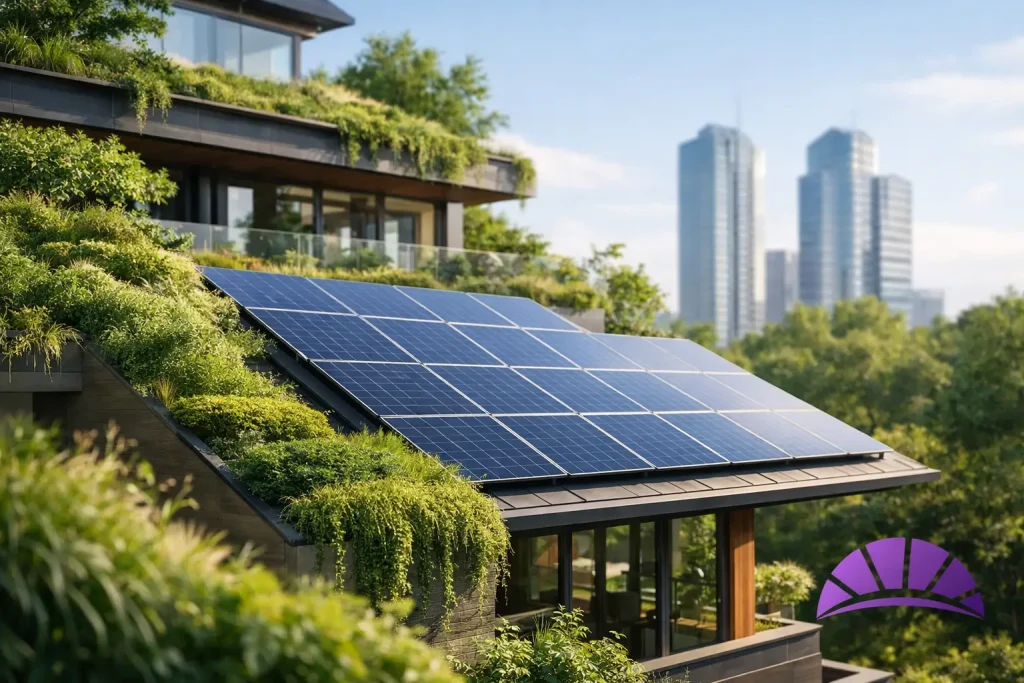
Green Architecture and Blending Solar Buildings
Key takeaways: Green architecture and blending solar to your building works best when solar is planned early, matched to load profiles, integrated with the envelope, and backed by sound financial modeling.
A rooftop covered with panels after the building is already finished can still deliver savings. But the stronger result usually comes earlier – when green architecture and blending solar to your building are treated as one design and engineering decision, not two separate scopes. For commercial and industrial assets, that changes more than aesthetics. It affects structural loading, daytime self-consumption, thermal performance, maintenance access, payback, and how well the site can support future battery storage or AI-driven energy control.
For owners, developers, and facility teams, this is the difference between installing solar and building an energy asset.
Why green architecture and blending solar to your building matters
Most decision-makers start with one question: how much can solar reduce electricity cost? That is the right question, but not the only one. A building that integrates solar well can improve usable roof strategy, reduce heat gain in selected applications, support ESG targets, and protect long-term asset value. In some projects, solar elements can serve dual purposes as shading structures, façade features, car park canopies, or architectural roof components.
That does not mean every building should chase a highly visible solar design. In many commercial facilities, the best answer is low-profile rooftop PV designed around load demand and maintenance practicality. In other cases, especially for new developments, the better move is to align orientation, roof geometry, cable routes, switch rooms, and future battery provisions from day one.
The key point is simple: solar integration should respond to the building’s function. A factory, logistics hub, office block, retail site, and high-end residence all use energy differently. Green architecture is not about forcing one visual idea onto every asset. It is about using design and engineering to improve performance.
Start with building use, not panel count
One of the most common mistakes in solar planning is starting from available roof area alone. Roof size matters, but energy economics depend more on how and when the building consumes electricity. A site with strong daytime demand can usually capture better value from self-consumed solar generation. A site with lower daytime usage may still benefit, but the system sizing logic changes, especially where export rules, tariff structures, or future battery plans come into play.
This is why energy profiling should come before detailed design. Interval consumption data, seasonal loads, operating hours, HVAC behavior, and production cycles all shape the right solar architecture. For industrial facilities, load diversity between process equipment, chillers, compressors, and office areas often reveals where solar delivers the most value. For commercial properties, tenancy patterns and common area consumption matter just as much as the roof itself.
At this stage, architectural integration also becomes more practical. If the project is new-build, designers can reserve cleaner roof zones, avoid shading conflicts with plant equipment, and plan structural support with fewer compromises. If the project is a retrofit, the assessment should confirm whether the roof condition, access routes, waterproofing details, and electrical infrastructure support the intended system life.
Amsolar typically approaches this as an engineering and financial exercise together, because a visually neat solar layout is not enough if it underperforms against the building’s real operating profile.
Solar should work with the envelope and structure
When people hear green architecture, they often think about appearance first. On a live project, the building envelope and structure usually matter more. Solar integration must respect waterproofing systems, roof penetrations, wind loading, fire pathways, drainage, and maintenance access. These are not side issues. They are central to whether the installation remains safe, serviceable, and cost-effective over time.
For example, a metal deck roof may be suitable for a large PV array, but fixing methods, corrosion exposure, and load distribution need proper engineering review. On concrete roofs, ballast or anchoring choices can affect both structure and waterproofing strategy. Façade-integrated solar may create a stronger architectural statement, yet it also introduces trade-offs around tilt angle, generation yield, cleaning access, and installation cost.
This is where blended solar design becomes more than product selection. It is coordination across disciplines. Architects, MEP consultants, structural engineers, solar designers, and operations teams need a shared view of what the building is trying to achieve. If the project may later include battery storage, EV charging, or adaptive power control, those pathways should be considered early. Reserving space for inverters, switchgear, and future BESS can avoid expensive redesign later.
In practical terms, good integration often looks quiet. Cable runs are shorter and protected. Access paths are preserved. Roof zones remain serviceable. Structural assumptions are documented. The energy system feels like part of the building, not an add-on fighting for space.
The financial case improves when design choices are deliberate
For most commercial and industrial decision-makers, green architecture has to stand up financially. That means moving beyond headline system size and asking better questions about yield, avoided tariff, maintenance cost, financing structure, and operational risk.
A larger system is not always the better investment. If generation significantly exceeds site demand during key hours, the value per kilowatt installed may fall. A lower-profile design with stronger self-consumption can produce a better payback than an oversized array designed around maximum roof coverage. The same applies to architectural solar features. A canopy or façade element may have wider building value, but the return should be judged on both energy output and functional benefit.
This is also where technology-led optimization starts to matter. Monitoring systems, cloud-based reporting, and AI-assisted energy cost control can improve how the system performs against actual site behavior. On sites with variable loads, adaptive controls and battery storage can reduce wasted solar generation and improve peak management. In some cases, a BESS as a Service model can make the economics more attractive by reducing upfront capital pressure while improving energy resilience.
Financial modeling should reflect these realities. That includes sensitivity around tariff changes, degradation, operating patterns, and possible expansion. Serious solar integration is not just a capex purchase. It is an operating cost strategy.
What good execution looks like on a real building
A successful project usually shares a few traits. The design team starts with data, not assumptions. The system is matched to building usage. Regulatory submissions and grid requirements are addressed early. Construction methods protect the building envelope. Commissioning verifies that actual performance aligns with design intent. And after energization, the owner has visibility into production, savings, and system behavior.
That last point is often underestimated. A well-integrated building should not become a black box after installation. Owners and facility managers need clear reporting, fault visibility, and usable performance data. If a string underperforms, if demand patterns shift, or if battery operation can be optimized, the system should show that clearly. Otherwise, part of the promised value stays theoretical.
For property developers, there is another advantage to getting this right. A building designed with integrated solar thinking tends to present better in due diligence. Buyers, tenants, and operators increasingly look at energy infrastructure as part of asset quality. A project that demonstrates engineering discipline, measurable savings, and room for future energy upgrades stands on firmer ground than one with a loosely attached sustainability story.
The best green architecture does not treat solar as decoration, and it does not treat the building as a passive surface. It treats both as part of one performance strategy. If you are planning a new facility, upgrading an existing asset, or evaluating a portfolio-wide energy program, the smartest move is to make solar part of the building conversation early enough that design, operations, and economics can align. That is where lower energy cost becomes more than a utility saving. It becomes a better-built asset.
