
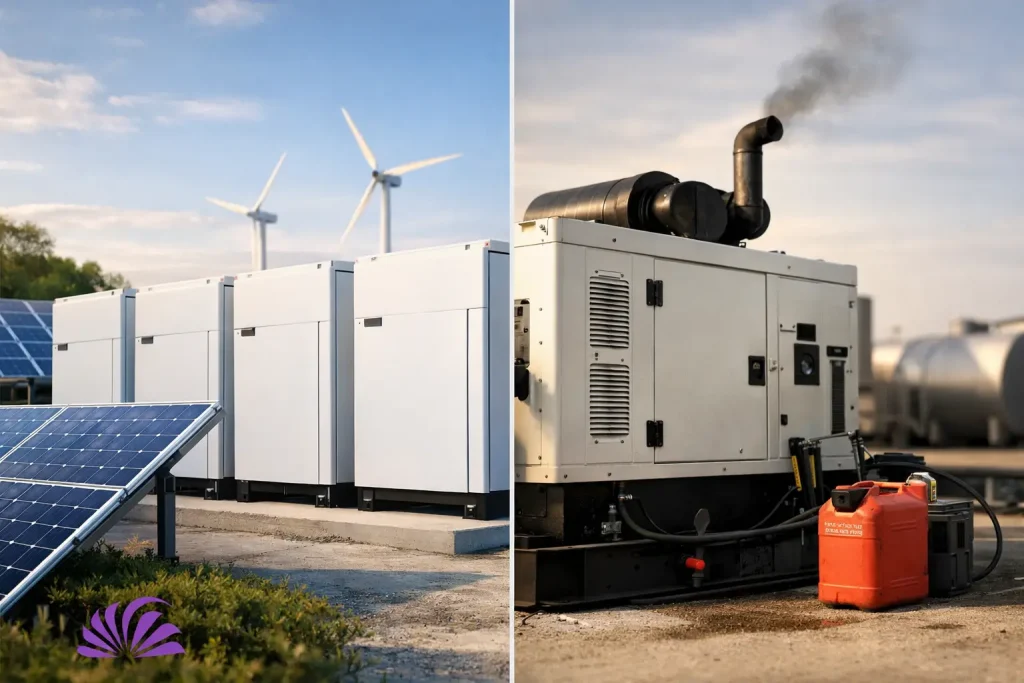
Battery Storage Versus Diesel Backup for Business
Key takeaways
Battery storage versus diesel backup is no longer a simple choice between a familiar generator and a newer technology. For commercial and industrial facilities, batteries can reduce peak-demand exposure, support solar self-consumption, and provide fast backup power. Diesel generators remain useful for long-duration outages and sites with limited electrical infrastructure, but they bring fuel volatility, maintenance demands, noise, and emissions.
The best answer is often a properly engineered hybrid system. The decision should be based on outage duration, critical load profile, tariff structure, existing solar capacity, fuel logistics, and the financial value of uninterrupted operations.
The real comparison starts with the load
A diesel generator is designed primarily to produce electricity when the grid is unavailable. A battery energy storage system, or BESS, stores electricity for use when it creates the most operational or financial value. That can mean covering a brief outage, reducing a facility’s peak demand, shifting solar energy into evening operations, or controlling site demand in real time.
This difference matters because backup capacity and energy capacity are not the same thing. A facility may need 500 kW of instantaneous power to keep production equipment online, but only require that support for 15 minutes while a process is safely paused or another source starts. In that case, a battery can be highly effective. A remote operation that requires 500 kW continuously for two days without dependable grid access has a very different requirement.
For business decision-makers, the first engineering question is not “battery or generator?” It is: which loads must remain energized, at what power level, and for how long? Critical loads may include servers, cold-room systems, security equipment, fire systems, process controls, lifts, medical equipment, or selected production lines. Separating those loads from nonessential consumption prevents unnecessary oversizing and improves project economics.
Battery storage versus diesel backup: cost beyond purchase price
Diesel equipment can appear less expensive at the point of purchase, especially where an existing generator room, fuel tank, and transfer switch are already in place. Yet capital cost alone does not reflect the operating cost of a diesel-based resilience strategy. Fuel purchases, delivery coordination, testing, servicing, oil changes, parts replacement, generator run hours, and emissions compliance can materially affect lifetime cost.
Battery storage has a higher technology and integration component, but its value can extend beyond emergency backup. A correctly sized BESS can discharge during high-demand periods, charge during lower-cost periods where applicable, absorb surplus solar generation, and reduce reliance on imported electricity at targeted times. These recurring operational benefits can improve the investment case even when major outages are infrequent.
The financial model should therefore quantify several scenarios rather than apply a single payback calculation. Model the avoided cost of downtime, demand reduction potential, solar energy shifted to higher-value periods, expected battery cycling, diesel fuel consumption, generator maintenance, and financing structure. Businesses evaluating zero-capex BESS arrangements should also compare the service payment against the value created through lower energy costs and improved continuity.
A battery is not automatically the lowest-cost choice. If a site experiences only rare, extended outages and has little opportunity for peak shaving or solar optimization, a generator may remain the more economical standby asset. However, when a facility has significant daytime solar production, costly demand peaks, or high losses from even short interruptions, battery value becomes much stronger.
Speed, reliability, and operational quality
Battery systems respond almost immediately. This is valuable for sensitive electronics, automated manufacturing, data systems, and equipment that cannot tolerate the interruption associated with generator startup and transfer. Depending on the system architecture, a BESS can bridge the gap before a generator starts, operate as the primary backup source for short events, or maintain selected loads through the full outage period.
Diesel generators are proven equipment and can provide substantial output for extended periods, provided fuel is available and the unit starts as intended. That condition deserves more attention than many facilities give it. Generators that sit unused can develop battery, fuel, lubrication, and control issues. Regular load testing is essential, and a generator’s rated output may not reflect its practical performance under high ambient temperatures, aging components, or poor fuel quality.
Battery reliability also depends on engineering discipline. The system needs suitable cell chemistry, thermal management, fire protection, protection coordination, inverter sizing, and controls that clearly define how the BESS interacts with the grid, solar PV, and backup circuits. Monitoring is equally important. Cloud-based reporting can show state of charge, available power, battery health, cycling history, and abnormal events before they become operational problems.
For many industrial sites, the most dependable configuration is not a replacement decision but a layered one: battery storage handles immediate ride-through and high-value demand management, while the generator supports longer events. This approach can reduce generator run time, lower fuel consumption, and give operations teams more control during a disruption.
Maintenance, emissions, and site constraints
Diesel backup introduces visible and ongoing site requirements. Fuel must be stored safely, generators produce noise and exhaust, and periodic testing can be disruptive for nearby occupants. These factors can be particularly relevant for commercial buildings, dense developments, healthcare-adjacent facilities, hospitality properties, and sites where environmental reporting influences customer or investor expectations.
Battery storage produces no on-site combustion during operation. That does not eliminate planning obligations. A BESS needs an appropriate installation location, ventilation or thermal design as required, fire safety planning, access controls, electrical protection, and compliance with applicable utility and authority requirements. The practical advantage is that these requirements are engineered into the installation rather than managed through recurring fuel handling and engine maintenance.
For facilities with solar PV, storage also prevents a common waste pattern. Without a battery, surplus daytime solar may be exported or curtailed depending on the site’s arrangement. With storage and intelligent controls, part of that energy can be retained for later use, improving self-consumption and reducing dependence on grid supply when solar generation falls.
Commercial and residential decisions are different
Commercial and industrial buyers should focus on load criticality, tariff exposure, production risk, power quality, and financial return. A factory may prioritize preventing a process shutdown that creates scrap, lost batches, or restart delays. A building operator may prioritize keeping essential tenant services operating while controlling maximum demand. These cases require site data, interval consumption analysis, and an engineered control strategy, not a generic battery size.
Residential customers typically have simpler loads but should still distinguish between whole-home backup and essential-load backup. Supporting lighting, refrigeration, internet, selected outlets, and a small air-conditioning load is far more practical than attempting to back up every appliance without limits. A home battery paired with solar can provide useful day-to-evening energy management and outage protection, while a larger system may be needed for high-consumption households with multiple air conditioners, EV charging, or pool equipment.
Amsolar approaches this decision as an integrated energy design exercise: analyze consumption, define critical loads, model solar and battery behavior, and establish the financial case before installation. That process helps avoid an oversized system that sits underused or an undersized system that fails when operations need it most.
The most useful next step is to collect interval energy data, outage records, generator fuel and maintenance costs, and a list of critical loads. With those inputs, the choice between battery storage, diesel backup, or a hybrid solution becomes an investment decision grounded in operating reality rather than equipment preference.
