
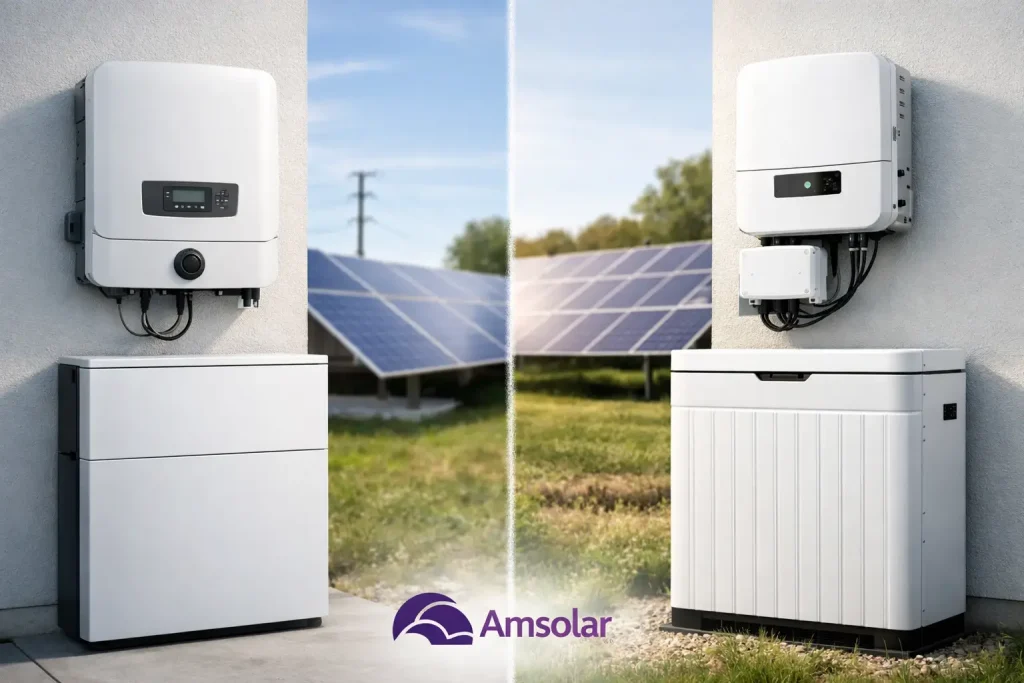
AC Coupled Versus DC Coupled for Solar Storage
A battery can lower peak-demand exposure, preserve critical operations during outages, and increase the value captured from solar generation. But AC coupled versus DC coupled is not a specification to select in isolation. The right architecture depends on whether the project is a retrofit or new build, how power flows through the site, the desired backup scope, and the financial value of each kilowatt-hour.
Key takeaways
- AC-coupled storage is often the practical choice for adding batteries to an operating solar PV system because it works alongside the existing solar inverter.
- DC-coupled storage can capture solar energy more efficiently in a purpose-designed new system, with fewer conversion steps between PV panels and the battery.
- Commercial and industrial projects should evaluate demand charges, load profile, critical loads, export limits, and control strategy before choosing an architecture.
- Homeowners should prioritize backup expectations, roof and inverter age, usable battery capacity, and installer support over headline efficiency alone.
How AC-Coupled and DC-Coupled Systems Work
Solar panels generate direct current electricity. Buildings and the utility grid use alternating current. The difference between these storage designs is where the battery connects and how many times electricity must be converted between DC and AC.
In an AC-coupled system, solar panels feed a solar inverter that converts DC power to AC for the building. The battery has its own battery inverter. When surplus solar is available, AC power is converted back into DC to charge the battery. When the battery discharges, its inverter converts the stored DC power into AC for site loads.
In a DC-coupled system, the solar array and battery connect on the DC side of a hybrid inverter or power conversion system. Solar electricity can charge the battery directly before being converted to AC for the building or grid. This removes one conversion stage during solar-to-battery charging.
Neither configuration is automatically superior. A well-engineered AC-coupled project can deliver strong operational results, while a poorly sized DC-coupled system can miss its savings target. Architecture must support the site’s operating and financial objectives.
AC Coupled Versus DC Coupled: The Core Trade-Offs
DC coupling generally has an efficiency advantage when excess solar is stored for later use. Because solar energy reaches the battery without first becoming AC, less energy is lost to power conversion. This can be meaningful where a site regularly produces substantial midday solar surplus and uses it after sunset.
AC coupling adds an extra conversion step, so round-trip efficiency can be lower depending on equipment and operating conditions. Yet it provides a major practical advantage: modularity. A battery can often be added to an existing solar PV system without replacing its solar inverter. For facilities that have recently commissioned PV and now need peak shaving or resilience, this may protect the value of the original investment.
DC-coupled systems can also make better use of a shared inverter capacity in some designs. However, the inverter must be sized carefully to manage simultaneous solar production, battery charging or discharge, and building demand. If not, clipping or operating constraints may reduce the expected benefit.
AC coupling separates the solar and battery conversion equipment. That can simplify staged investment, future battery expansion, and certain maintenance decisions. It may also provide more flexibility when integrating batteries from different manufacturers, subject to engineering compatibility and warranty requirements.
What Commercial and Industrial Buyers Should Assess
For a factory, warehouse, retail center, or multi-tenant property, the decision is primarily an energy economics and operational continuity question. The battery should be modeled against interval-meter data, not selected based only on its nameplate capacity.
An existing PV system with available grid connection capacity may favor AC coupling, particularly when the project objective is to reduce peak demand during specific periods. The storage system can be controlled to discharge during forecast demand peaks, while the PV system continues operating through its existing inverter. This approach is especially relevant when capital is being phased and the site needs results without a full solar system redesign.
A new build may favor DC coupling when solar and storage are planned as one integrated asset. The design team can coordinate PV capacity, inverter rating, battery duration, protection settings, export controls, and the facility’s expected load growth from the beginning. Direct solar charging may strengthen the business case where daytime production is high and evening consumption remains substantial.
Backup requirements need separate attention. A battery that reduces bills is not necessarily designed to maintain all site operations during a grid outage. Critical-load segmentation, transfer equipment, black-start capability, fire safety design, and protection coordination are part of the resilience scope. A manufacturing line, cold storage room, data equipment, or safety system may require a different design than general office loads.
For commercial projects, advanced controls are often as consequential as coupling method. Load forecasting, tariff-aware dispatch, solar production forecasting, and adaptive power control determine when a battery charges, discharges, or holds reserve capacity. Amsolar evaluates these operating conditions alongside EPC design, commissioning, monitoring, and financial modeling so battery performance is tied to measurable site outcomes.
Choosing the Right Architecture for a Home
Residential customers usually face a more straightforward choice, but the decision still depends on the home and its goals. An AC-coupled battery is commonly appropriate when the home already has a functioning solar inverter and the owner wants to add storage for backup power or better self-consumption. It avoids disturbing a working PV installation and can reduce retrofit complexity.
DC coupling is often compelling for a new solar-and-battery installation, especially when a hybrid inverter is already part of the design. The system can be built around a single coordinated platform, with solar generation charging the battery directly. This may improve energy capture, though homeowners should compare usable capacity, backup output, warranty terms, and monitoring capability rather than focus only on efficiency percentages.
Backup expectations should be stated clearly before equipment is selected. Supporting lights, refrigeration, internet, and selected outlets is different from powering air conditioning, water heating, induction cooking, or a whole home. The desired backup load and duration determine the battery size, inverter output, and electrical design.
In Malaysia, homeowners considering solar incentives or programs should also ensure the battery design aligns with applicable utility, safety, and regulatory requirements. A complete proposal should explain the system’s expected energy flows, assumptions, limitations, and monitoring access in plain terms.
Design for Energy Value, Not Just Equipment Cost
The lowest equipment quote may not produce the lowest energy cost over the system’s life. A sound comparison considers conversion losses, battery degradation, usable capacity, inverter limits, control capabilities, installation scope, warranty coverage, and the cost of downtime. It should also account for whether batteries will be charged from solar, the grid, or both.
For C&I operators, financial analysis should test several operating scenarios: normal production days, low-solar periods, high-demand events, weekends, and grid outages. A battery’s value may come from demand management, time-based energy shifting, backup resilience, solar self-consumption, or a combination of these uses. If the projected savings rely on a specific dispatch strategy, the monitoring and control platform must be capable of executing it consistently.
For homeowners, the same principle applies at a smaller scale. A battery should fit the household’s actual evening use and backup priorities, not simply maximize installed kilowatt-hours. A clear design prevents paying for capacity that rarely delivers value.
The best starting point is a site-specific energy assessment. When the battery architecture is matched to actual consumption, solar production, electrical constraints, and financial targets, AC or DC coupling becomes a deliberate engineering decision rather than a sales preference.
