
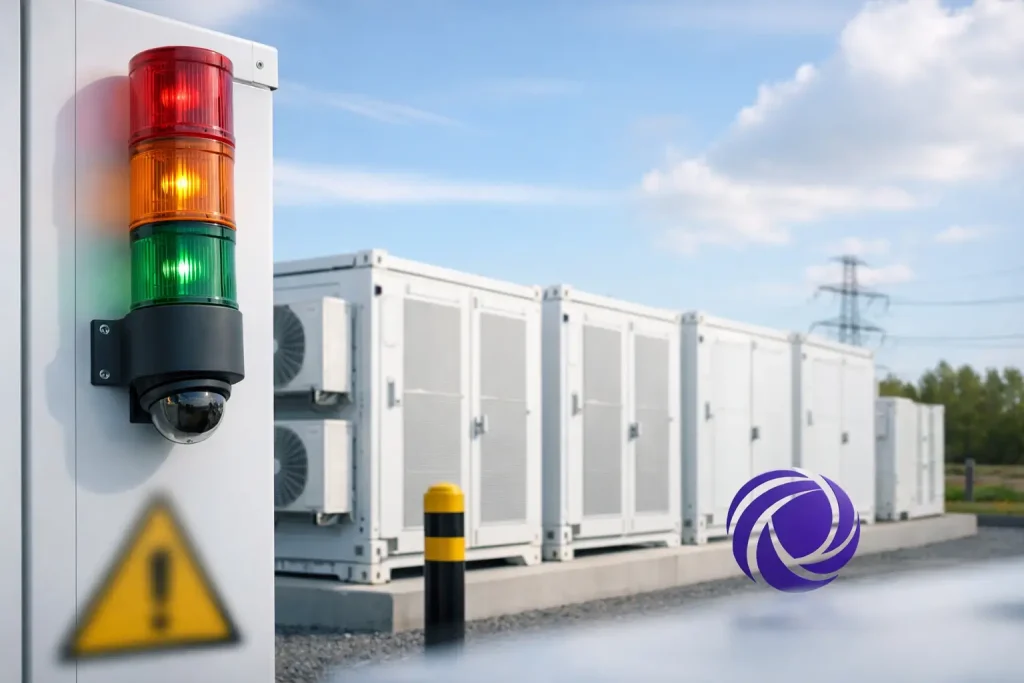
BESS Safety: How Battery Systems Stay Safe
A battery energy storage system is designed to make electricity more useful: store solar generation when it is abundant, supply it when demand rises, and reduce dependence on costly grid consumption. But that value only holds when BESS safety is built into the system from the first design decision through daily operation. A battery is not simply a larger backup power bank. It is an engineered energy asset that requires the right equipment, installation environment, controls, and service discipline.
Key takeaways
- BESS safety begins with correct system design, not with a warning label or a last-minute add-on.
- Battery chemistry, enclosure quality, thermal management, and protection equipment must work as one system.
- Continuous monitoring helps identify abnormal temperature, voltage, and operating behavior before it becomes a serious issue.
- The safest battery system is appropriately sized for the property and its actual energy use, rather than oversized for headline capacity.
- Professional commissioning and ongoing maintenance protect both people and the financial performance of the asset.
BESS safety starts with engineering the complete system
A battery cell is only one component in a BESS. Safe performance depends on how cells are assembled into modules, racks, battery management systems, inverters, cables, isolators, enclosures, and control platforms. A weakness in any one of these areas can affect the reliability of the whole installation.
The first decision is selecting a battery solution suited to the application. A residential system supporting a landed home with rooftop or plug-in solar has a different load profile, space constraint, and backup requirement than a commercial facility managing demand peaks. Capacity should be based on measured consumption patterns, desired backup loads, solar production, and the operating strategy. More storage is not automatically better. An oversized system can add capital cost without delivering proportionate savings, while a poorly matched system may cycle in ways that reduce its useful life.
Battery chemistry also matters. Lithium iron phosphate, commonly referred to as LFP, is widely used for stationary storage because of its strong thermal stability and long cycle life. That does not remove the need for careful engineering. Every battery technology requires correct charging limits, temperature control, electrical protection, and quality manufacturing.
The physical location deserves the same attention. A BESS needs a stable, well-considered installation area that supports safe access for inspection and service. It should be protected from direct heat exposure, water ingress, physical impact, and clutter that could compromise ventilation or restrict access. For homeowners, the best placement is usually determined by practical conditions around the car porch, utility area, or external wall, not by whichever space is most convenient on the day of installation.
Thermal control and protection systems do the hard work
Heat is one of the most important factors in battery performance and safety. Excessive heat can accelerate battery degradation and place additional stress on electrical components. A properly engineered BESS manages temperature through battery selection, enclosure design, ventilation or cooling where required, and intelligent controls that keep the battery within its intended operating range.
The battery management system is central to this process. It monitors individual cells and the battery pack for voltage, current, temperature, state of charge, and state of health. If it detects conditions outside defined limits, it can reduce charging or discharging power, isolate the battery, or shut the system down. This automated protection is essential because battery conditions can change far faster than a person can react.
Other protective layers matter just as much. Correctly rated cables and connections reduce the risk of overheating. Fuses, circuit breakers, and isolation devices help control electrical faults. High-quality enclosures protect equipment from environmental exposure and accidental contact. In integrated systems, the inverter and energy management platform coordinate how solar, battery, grid supply, and household or business loads interact.
No single component should be treated as the safety solution. Safe battery operation comes from layered protection. If one layer detects an abnormal condition, another should support controlled isolation and prevent the issue from escalating.
Monitoring turns BESS safety into an everyday discipline
A battery system should not operate unnoticed until there is a problem. Cloud-based monitoring gives owners and system operators visibility into solar production, battery status, charging behavior, energy consumption, and system alerts. This is valuable for performance optimization, but it is also a practical safety advantage.
Data can reveal patterns that deserve attention. For example, a battery that repeatedly reaches unusually high temperatures, disconnects unexpectedly, or shows uneven cell behavior may require inspection before its performance is affected. Likewise, repeated inverter faults or unusual charging cycles can point to a configuration issue, changing site loads, or an equipment problem.
For commercial users, monitoring supports a more disciplined energy strategy. A BESS may be scheduled to discharge during high-demand periods, absorb excess solar generation, or preserve a defined reserve for critical loads. Those controls should be tuned to the facility’s real operating conditions. Aggressive cycling may improve short-term savings in some situations, but it can increase wear if not managed carefully. The right balance depends on the battery warranty, the site load profile, electricity cost structure, and the value of backup resilience.
For homeowners, the same principle applies on a smaller scale. A battery can be set to prioritize solar self-consumption, evening usage, or selected essential circuits during an outage. Clear settings and visible reporting help ensure the system behaves as intended, rather than becoming an expensive asset that operates on assumptions.
Installation quality and maintenance protect long-term value
Even premium equipment can underperform when installation quality is poor. Correct cable routing, secure terminations, suitable mounting, weather protection, labeling, and commissioning checks all influence safe operation. The commissioning process should verify that the battery, inverter, solar system, and energy management controls communicate correctly and respond properly under normal and fault conditions.
This is where turnkey engineering capability makes a material difference. Amsolar approaches energy storage as part of a wider energy system, combining system design, installation, testing, monitoring, and optimization. The goal is not simply to place a battery beside a solar inverter. It is to create a coordinated system that lowers energy costs while maintaining dependable operation.
Maintenance needs vary by equipment type and site environment, but it should never be ignored. Routine checks can identify damaged enclosures, signs of moisture, loose connections, blocked ventilation, pest activity, or changes in system behavior. Remote alerts should be reviewed, not dismissed as background notifications. If the system reports repeated faults, unusual odor, heat, swelling, visible damage, or unexpected shutdowns, it should be isolated and assessed by qualified personnel.
Owners should also know what not to do. Do not modify battery wiring, open battery enclosures, block ventilation paths, stack stored items around the system, or use damaged equipment. A battery installation is not a DIY service area. The safest response to uncertainty is to stop using the affected system and arrange a professional inspection.
A safer BESS is a better-performing BESS
Safety and financial performance are closely connected. Poor temperature management can shorten battery life. Incorrect sizing can weaken returns. Inadequate monitoring can allow avoidable faults to reduce solar self-consumption or disrupt operations. By contrast, a well-designed BESS can provide controlled energy savings, more useful solar generation, and greater resilience for selected loads.
The most effective approach is to treat battery storage as a managed energy asset. Start with accurate consumption data, select proven equipment, design for the actual site conditions, and use monitoring to keep performance visible. For a home or business, that discipline turns BESS safety from a technical afterthought into a practical foundation for reliable, long-term energy value.
A battery should make energy simpler to manage, not create uncertainty. When design, installation, and monitoring are handled with the same care as the solar system itself, storage becomes a dependable part of a smarter energy plan.
