
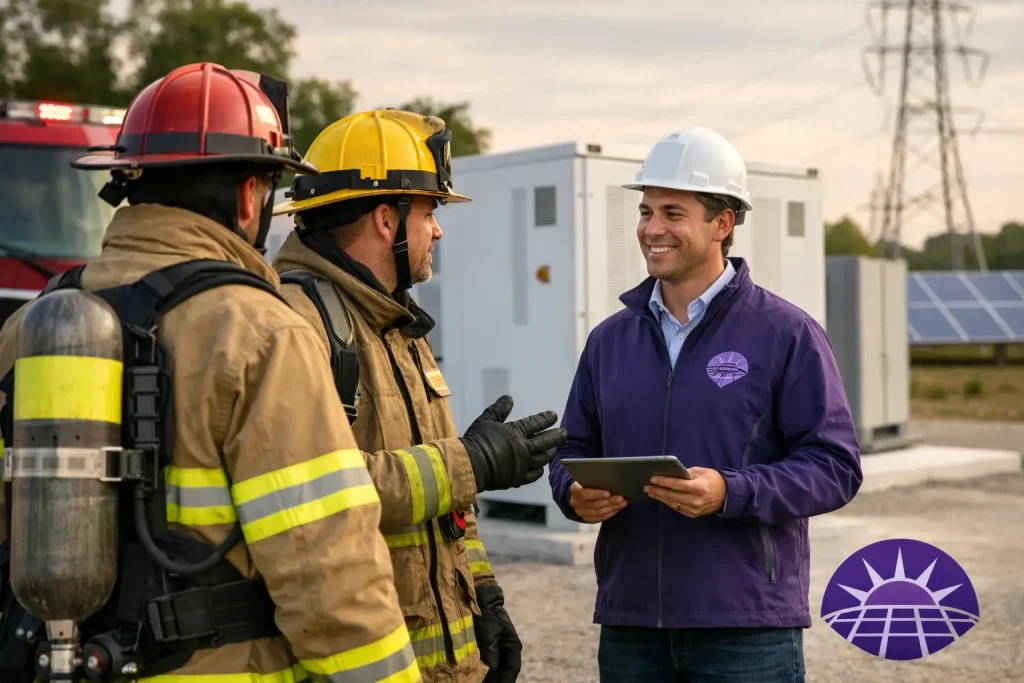
How Fire Department and BESS Teams Plan Safer Response
A battery energy storage system can protect a facility from expensive demand peaks, unstable supply, and avoidable downtime. But when a BESS is installed, the fire department and BESS owner need a shared understanding of the site long before an incident occurs. The objective is not to predict failure. It is to give responders clear, dependable information and give facility teams a practical plan for protecting people, operations, and critical assets.
For commercial sites, that planning begins during engineering, not after commissioning. Battery chemistry, enclosure layout, isolation capability, monitoring data, and access routes all affect how an event is assessed and managed. A well-designed system makes essential information easier to find when time is limited.
Key Takeaways
- Fire response planning should be built into BESS design, installation, and ongoing operations.
- Responders need accurate site-specific information, including system location, energy capacity, isolation points, and monitoring contacts.
- Thermal detection, battery management data, and remote alerts support earlier decisions, but they do not replace trained human judgment.
- The right response plan depends on the battery technology, system size, building use, and whether the BESS is indoors, outdoors, or containerized.
Fire Department and BESS Planning Starts With Site Intelligence
A BESS is not a single piece of equipment. It is an integrated energy asset made up of battery racks or modules, power conversion equipment, controls, cooling systems, cable routes, and protective devices. During an emergency, responders must be able to identify what is present, where it is located, and whether the system has been electrically isolated.
That is why site intelligence is the foundation of a useful fire department and BESS plan. A concise emergency information package should show the BESS location, site access points, equipment layout, nominal energy capacity, isolation locations, and the contacts who can provide technical support. It should also distinguish the battery system from solar PV equipment, generators, and other electrical infrastructure that may be located nearby.
The information needs to match the actual installation, not an early design drawing. Facility expansions, equipment replacements, or control-system upgrades can change what responders encounter. Keeping records current is a simple operational discipline with a significant safety benefit.
For larger commercial systems, site walk-throughs can add value because they turn drawings into practical familiarity. Responders can see access routes, understand physical separation between equipment, and identify the safest places to establish an incident command position. The goal is not to prescribe emergency tactics to the fire department. It is to ensure that the team arriving on site has reliable technical context.
Design Choices Shape Incident Readiness
BESS safety is influenced by engineering decisions made well before a battery is energized. System placement, equipment spacing, enclosure construction, ventilation strategy, detection methods, and cable routing affect both everyday reliability and incident response conditions.
There is no universal layout that fits every project. An outdoor containerized BESS at an industrial facility presents different considerations from an indoor battery room supporting a data-heavy office, manufacturing line, or retail operation. The expected operating profile matters as well. A system that cycles daily for peak shaving may have different thermal and operational demands than a backup-focused system that is used infrequently.
Battery monitoring is central to this design approach. The battery management system tracks key operating conditions at cell, module, and rack levels, while the energy management system coordinates how the asset charges and discharges. When these systems are properly configured, abnormal temperature trends, voltage deviations, and communication faults can be identified before they develop into larger operational problems.
Detection and monitoring are valuable because they create time to assess, isolate where appropriate, and communicate. They are not a guarantee that an event will never occur. Battery incidents can develop differently depending on chemistry, state of charge, mechanical damage, external heat exposure, and the condition of associated equipment. A credible plan recognizes that uncertainty rather than relying on generic assurances.
Amsolar applies an engineering-led approach that combines system design, battery optimization, and cloud-based monitoring so owners can manage energy performance with better visibility. That same visibility supports clearer operating decisions when equipment behavior changes.
Build an Operating Plan Before an Alarm Occurs
A response plan is only useful if the people on site can act on it under pressure. Facility managers, security personnel, maintenance teams, and operations leaders should know who is responsible for contacting emergency services, who can provide site information, and who can access the BESS monitoring platform.
The plan should define communication clearly. If an alert is received after business hours, the escalation path should not depend on one person noticing an email. Critical contacts, technical support details, and system documentation should be available to the appropriate team members in a format that can be accessed quickly.
The operating plan should also account for business continuity. If the BESS is isolated or taken offline for inspection, what loads lose support? Can the facility continue operating on the grid? Are there sensitive processes, refrigeration loads, server rooms, or production assets that need a controlled shutdown? These questions are not secondary to safety. They help prevent a contained equipment issue from becoming a broader operational disruption.
Periodic scenario reviews are more useful than a document that sits untouched in a shared drive. A short discussion can test whether contacts are still current, whether staff understand the alarm process, and whether a recent site modification has changed access or isolation arrangements. The review should be practical and concise, with actions assigned to named owners.
Use Data to Improve Safety and Asset Performance
The strongest BESS programs connect safety readiness with everyday asset management. The same data used to reduce energy costs can reveal whether the system is operating within expected limits. Charge and discharge patterns, temperature behavior, availability, and fault history can indicate where maintenance attention is needed.
For a business using BESS to control demand charges or improve resilience, availability is a financial issue as well as an operational one. A battery that is unavailable during a high-demand period cannot deliver its expected savings. A battery that repeatedly reaches operating limits may require a review of dispatch settings, cooling performance, or the relationship between the facility load and battery capacity.
Remote monitoring helps owners move from reactive maintenance toward informed intervention. However, data only creates value when it is reviewed by people who understand the system and can separate a transient alert from a meaningful trend. This is where technical oversight matters. The right team can evaluate performance, recommend adjustments, and preserve the battery asset’s intended role in the wider energy strategy.
For facilities considering BESS as a service, these disciplines are especially relevant. The commercial model may reduce upfront capital pressure, but it does not reduce the need for clear engineering accountability, monitored operation, and a well-maintained incident plan. Energy savings and resilience should be supported by transparent system performance, not assumptions.
A battery storage project earns confidence when its technical details are clear before they are needed. Give the fire department accurate site intelligence, give operations teams a tested communication path, and give the BESS the monitoring and engineering attention required to perform reliably over time.
