
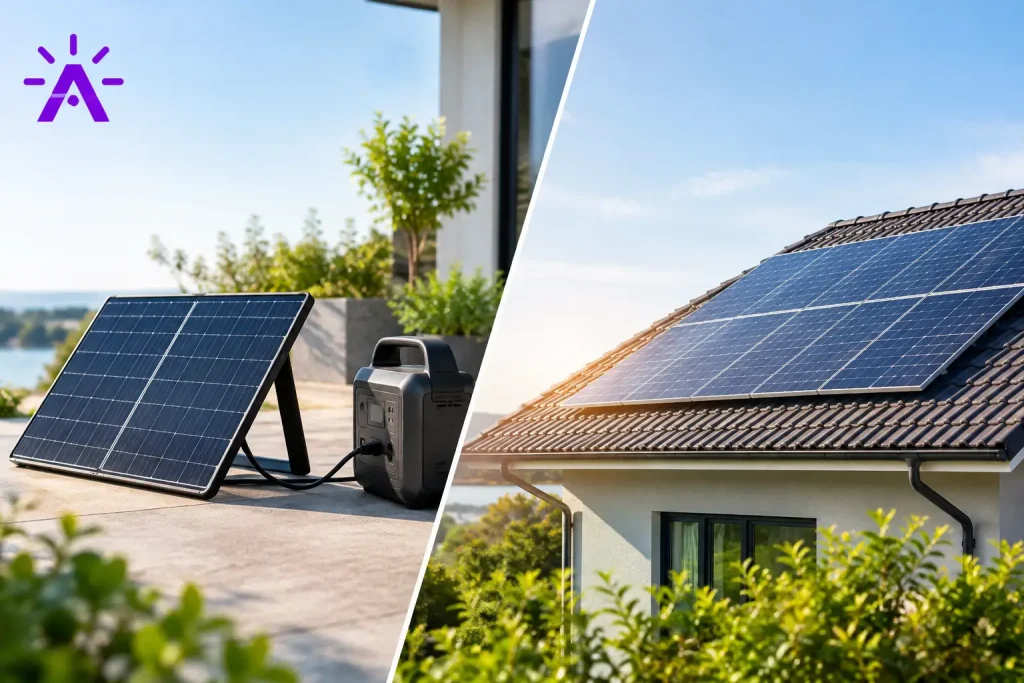
Plug In Solar Versus Rooftop: Which Fits?
A small plug-in solar panel can look like an easy first step, especially when electricity bills keep rising. But for a factory, hospital, mall, data center, or processing site, the real plug in solar versus rooftop decision is not about panel convenience. It is about whether the system can make a measurable difference to daytime consumption, maximum demand exposure, operating continuity, and long-term energy cost.
Key Takeaways
Plug-in solar is designed for limited, localized generation. It may suit small loads or controlled trials, but it is rarely a meaningful energy strategy for high-consumption commercial and industrial facilities.
A properly engineered rooftop PV system can offset a material share of daytime electricity use. Its value improves when system sizing follows interval load data, roof conditions, operating hours, and demand patterns.
Solar alone does not automatically solve maximum demand issues. Facilities with sharp load peaks, variable production, or critical operations may require battery storage, adaptive power control, and active energy monitoring alongside PV.
The right comparison is not only upfront cost. Decision-makers should assess delivered energy, avoided cost, system life, operational risk, monitoring capability, and the financial return produced under actual site conditions.
Plug-In Solar Has a Narrow Operating Role
Plug-in solar generally refers to a small photovoltaic unit that connects close to a building load, often through a standard outlet or compact connection point. Its appeal is understandable: installation appears simple, the initial spend is lower, and it can provide a visible introduction to on-site renewable generation.
For a high-load facility, however, scale changes the conversation. A small unit may help power isolated, low-energy equipment during sunny periods, but it will not materially offset the load of chillers, compressors, production lines, pumping systems, cold storage, server infrastructure, or large air-conditioning plants. When a site consumes substantial power every hour, a small solar source becomes difficult to see in the energy data.
There is also a control limitation. Commercial sites need to understand exactly how generation interacts with their load profile. Without proper metering, visibility, and electrical design, a plug-in setup provides little basis for cost forecasting or performance management. It can be a learning tool, but it should not be mistaken for a facility-scale energy solution.
Rooftop Solar Is an Engineered Asset
Rooftop solar is built around the building and its electricity behavior. The system begins with site assessment: usable roof area, structural conditions, shading, orientation, cable pathways, switchboard capacity, and the facility’s half-hourly or interval consumption profile. These details determine whether installed capacity will translate into useful energy generation.
A well-designed rooftop PV system produces most value when its output aligns with daytime demand. Manufacturing plants running daytime shifts, hospitals with continuous base loads, retail centers with cooling demand, and data-intensive operations can often consume solar generation directly as it is produced. This reduces purchased electricity during the hours when the system is generating.
The quality of engineering matters as much as panel quantity. Poor array layout, unmanaged shading, undersized cabling, weak protection design, or inadequate commissioning can reduce output and create maintenance complications over time. A commercial rooftop system should be treated as long-lived electrical infrastructure, not as a simple roof accessory.
This is where a full project scope adds value. Amsolar combines PV design, engineering, procurement, construction, testing, commissioning, financial modeling, and cloud-based performance reporting so the system is assessed as an operating asset from the start. That approach is particularly relevant where roof constraints and high energy use make every kilowatt of production important.
Compare Output Against Your Actual Load
The most useful plug in solar versus rooftop comparison starts with energy scale. Ask a straightforward question: how much electricity will the proposed system generate during the hours when the facility is consuming power?
A plug-in system may generate a small amount of energy, but its contribution is limited by its physical size. A rooftop system can use a much larger available area and can be designed to target a defined annual generation objective. The difference is not merely more panels. It is the ability to model expected production against historical usage and estimate avoided electricity cost with greater confidence.
Load shape is equally important. A facility with a consistent daytime base load is often a strong rooftop solar candidate. A site that operates mainly at night may still benefit, but the solar design and storage case need closer analysis. Facilities with frequent production changes should not rely on monthly utility bills alone. Interval data reveals when demand rises, when solar can contribute, and where energy is being consumed inefficiently.
A rooftop system should also be sized with room for operational reality. Roof access, future equipment additions, maintenance zones, and building expansion plans can affect the best design. Maximizing installed capacity is not always the same as maximizing financial value.
Maximum Demand Requires More Than Solar
Solar generation reduces net electricity drawn from the grid when the sun is available. That can lower energy charges, but it may not control the brief peaks that drive maximum demand costs. If a facility starts multiple motors, chillers, furnaces, compressors, or high-load processes at the same time, the peak may occur too quickly or too late in the day for solar alone to address it.
This is the key trade-off for energy-intensive operations. Rooftop PV can reduce daytime consumption at an attractive cost per kilowatt-hour, while battery energy storage can be dispatched to support peak management, load shifting, and operational resilience. The strongest result often comes from combining the two with an energy management platform that responds to actual site conditions.
AI-driven monitoring and battery control can identify demand patterns, track solar contribution, and improve dispatch decisions rather than leaving energy assets to operate independently. Reactive energy management, power factor correction, and static var generator solutions may also be relevant where power quality affects costs or equipment performance. The appropriate combination depends on measured electrical behavior, not assumptions.
Make the Decision on Lifecycle Value
Plug-in solar may have a place where a small, isolated load needs local generation or where an organization wants a tightly controlled pilot. Its modest scale can be an advantage when expectations are equally modest.
For facilities seeking a meaningful reduction in operating cost, rooftop solar is usually the more credible investment path. It offers scale, engineered integration, measurable production, and a clearer foundation for financial analysis. The investment case should consider annual generation, expected self-consumption, maintenance requirements, roof lifespan, energy escalation assumptions, and projected payback and internal rate of return.
Monitoring should remain part of the decision after installation. A system that performs well in its first month still needs ongoing visibility to identify underperformance, inverter alerts, unusual consumption, or changing load patterns. Cloud reporting turns the solar system from a static installation into a managed energy asset.
Before choosing the easier-looking option, measure the facility’s load, identify the source of costly peaks, and match the solution to the scale of the problem. A small panel can demonstrate solar generation. A well-engineered rooftop, supported by intelligent energy control where needed, can change how a business buys and uses power.
