
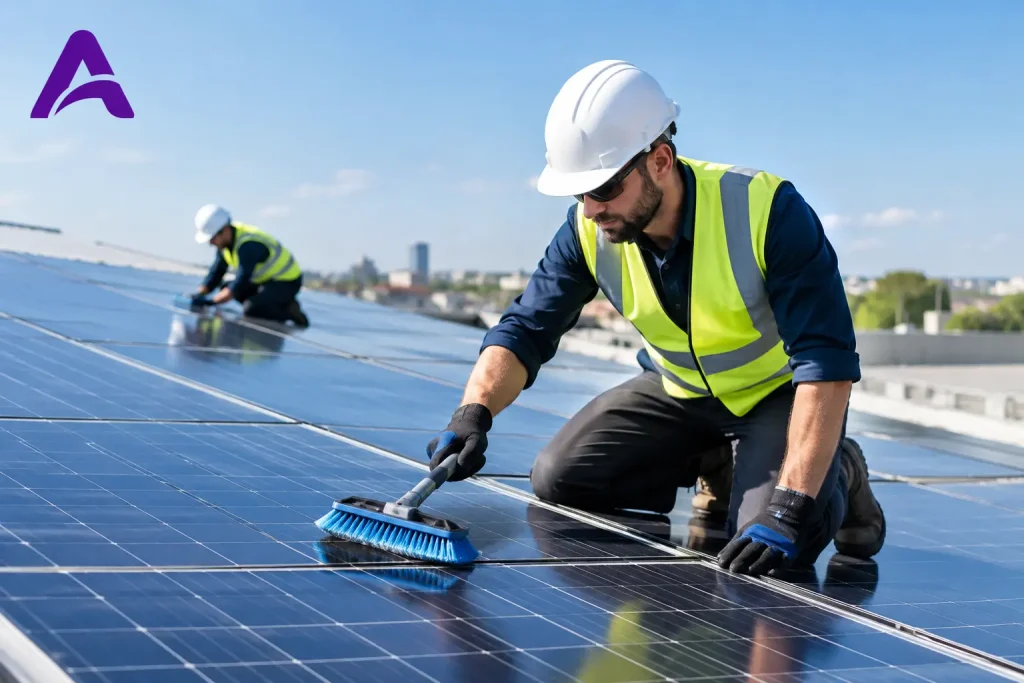
Commercial Solar Maintenance That Protects Output
Key takeaways: Commercial solar maintenance is an operating-cost discipline, not a basic cleaning task. A structured program combines field inspections, performance monitoring, inverter and electrical checks, and rapid fault response to protect generation, manage demand, and preserve the financial case for solar. For high-usage facilities, the strongest results come from connecting solar data with site load, battery behavior, and power-quality performance.
A solar plant can look perfectly healthy from the ground while quietly producing less energy than expected. One underperforming string, a recurring inverter alarm, soiling on a critical roof section, or a loose electrical connection can reduce output for weeks before it becomes obvious on an electricity bill. That is why commercial solar maintenance should be managed as a performance program with clear baselines, diagnostics, and accountability.
For factories, hospitals, malls, data centers, and processing facilities, lost solar production is more than missed renewable energy. It can mean higher daytime grid purchases, weaker maximum-demand control, and less predictable operating costs.
Commercial Solar Maintenance Starts With Performance Data
A maintenance visit is valuable, but it cannot reveal every issue between scheduled inspections. Continuous monitoring provides the operating context: how much each inverter is generating, whether production follows expected irradiance patterns, and where actual performance differs from the modeled yield.
The key is to avoid treating a single low-production reading as proof of a fault. Cloud cover, curtailment, unusual site load, scheduled shutdowns, and temperature all influence output. A capable monitoring platform compares trends over time and identifies deviations that deserve investigation. For example, a repeated production gap in one inverter may indicate string imbalance, module shading, communication failure, or an internal inverter issue.
For commercial sites, maintenance data should be reviewed alongside consumption data. A PV system may be generating well, yet savings can be diluted if facility demand shifts outside solar hours or if reactive energy and poor power factor are increasing charges. This is where a broader energy-management view becomes commercially useful.
What a Practical Maintenance Program Covers
The scope should match the facility, system size, roof environment, equipment age, and operational risk. A clean warehouse roof with limited airborne dust requires a different maintenance approach than a manufacturing site near particulate-heavy processes or a coastal facility exposed to salt and humidity.
A well-managed program typically covers four areas:
- Visual and mechanical inspections for damaged modules, mounting integrity, cable exposure, water ingress, pest activity, and signs of shading from new structures or vegetation.
- Electrical testing and verification for string performance, insulation health, connectors, protection devices, earthing, and abnormal thermal conditions.
- Inverter and communications checks to confirm alarms are addressed, firmware and settings remain appropriate, and monitoring data is reliable.
- Targeted cleaning and corrective work based on measured production impact rather than a fixed cleaning schedule that may add cost without improving returns.
Thermal imaging can be particularly useful when a site has unexplained underperformance. It can identify hotspots, failed bypass diodes, loose connections, and components operating outside normal temperature ranges. However, it works best as part of a diagnostic process, not as a stand-alone inspection exercise.
Cleaning Is Necessary, but Not Always the Main Issue
Module cleaning is often the first maintenance activity owners consider. It matters in dusty, industrial, agricultural, or high-pollution environments, but routine cleaning is not automatically the highest-value action.
The commercial question is simple: does the expected production recovery justify the cleaning cost and any access or safety requirements? Monitoring trends can help answer it. If output drops in a pattern consistent with soiling and recovers after rainfall or cleaning, a targeted schedule may be justified. If the loss is localized to one array or inverter, the cause may be electrical or shading-related instead.
Poor cleaning practices can also create problems. Abrasive materials, unsuitable chemicals, pressure that damages seals, or work performed during extreme module temperatures can affect equipment condition. Maintenance teams should use methods suitable for the module manufacturer, roof type, water availability, and site safety plan.
Protecting Solar Value During Demand Peaks
Commercial solar maintenance becomes more strategic when the facility uses batteries, manages peak demand, or operates energy-intensive equipment. Solar generation, battery dispatch, load behavior, and power quality should not be managed in separate silos.
A site may have strong solar output at midday but still experience costly demand peaks when chillers, compressors, furnaces, pumps, or production lines ramp up. If battery controls are poorly aligned with actual load patterns, stored energy may be used too early, held back unnecessarily, or discharged in a way that does not reduce the highest-demand interval.
Amsolar approaches this through engineering-led monitoring and AI-driven energy controls that connect PV performance with consumption visibility and battery optimization. Where reactive energy is contributing to avoidable cost or equipment stress, power-factor correction and SVG solutions can complement the solar system. The objective is not simply to keep panels generating. It is to improve how the facility uses every kilowatt generated and stored.
When to Escalate From Maintenance to Optimization
Some issues are maintenance problems. Others indicate that the original operating strategy needs adjustment. Repeated inverter trips, unexplained energy gaps, battery cycling that does not align with peak periods, or a widening gap between projected and actual savings should trigger a deeper review.
That review should examine equipment condition, generation forecasts, consumption profiles, maximum-demand behavior, and operating changes at the facility. New machinery, expanded production shifts, modified HVAC schedules, or a change in utility tariff structure can alter the financial performance of an otherwise healthy system.
The best maintenance partners provide more than fault reports. They explain the likely commercial impact, prioritize corrective work by value and risk, and show whether an issue is isolated or part of a wider energy-performance opportunity.
A commercial solar asset should earn its place in the facility every day. With disciplined maintenance and intelligent performance oversight, it can keep delivering dependable energy value long after commissioning is complete.
