
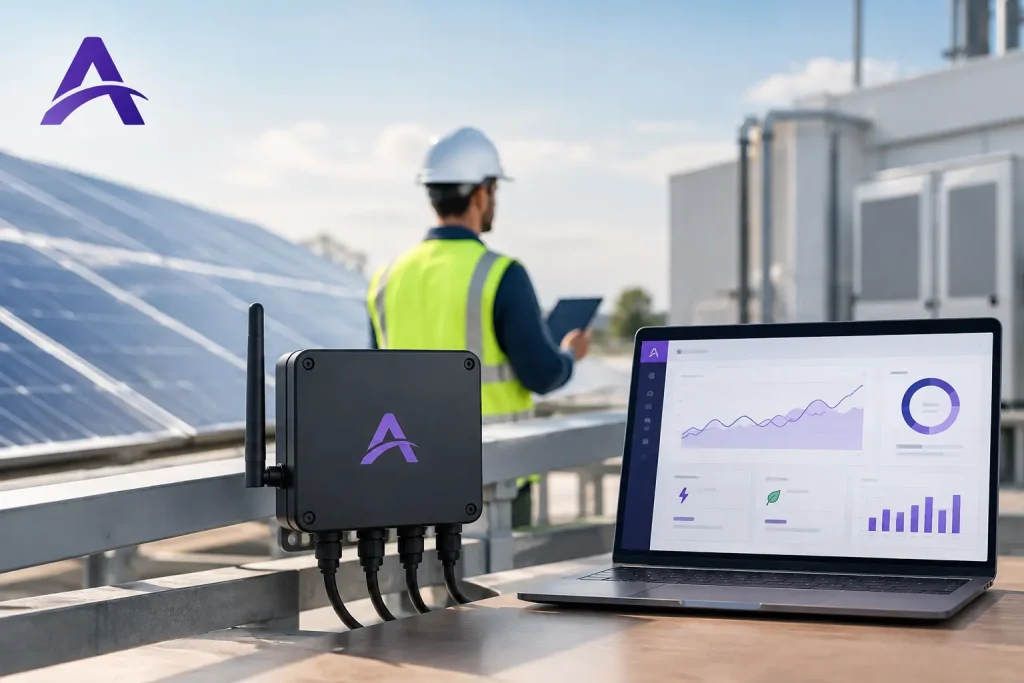
Energy Monitor Review for High-Demand Sites
For a factory, hospital, data center, or processing facility, an energy monitor review should not begin with a dashboard demo. It should begin with a tougher question: can the system identify the electrical events that are driving avoidable cost, production risk, and peak-demand exposure?
Basic monitoring can show monthly consumption. A useful platform explains where, when, and why demand rises – then gives operations teams a practical path to act. That distinction matters most at high-load sites, where a short peak or poor power factor can have an outsized effect on electricity costs and equipment performance.
Key takeaways
- A commercial energy monitor must measure more than total kilowatt-hours. Interval data, maximum demand, power factor, voltage quality, and load profiles are central to decision-making.
- The best results come when monitoring is connected to action, such as battery dispatch, staged load control, reactive power correction, or operational scheduling.
- Accuracy at the meter is only one part of the evaluation. Data granularity, system integration, alarm quality, and engineering interpretation determine the real value.
- Monitoring creates financial value when it supports verified reductions in demand charges, waste, downtime risk, and energy intensity per unit of output.
Energy Monitor Review: What Commercial Sites Need
Consumer energy monitors are designed to answer a simple question: how much electricity is a building using? Commercial and industrial sites need a more detailed answer. They need to know which incomers, feeders, production lines, chillers, compressors, pumps, and tenant loads create the highest demand at a particular time.
That requires properly specified metering architecture. A site-level meter may be enough for an initial energy baseline, but it cannot isolate the cause of a peak. Submetering at critical distribution boards and major loads creates a more useful picture. For example, a manufacturing plant may discover that its highest demand is not caused by a single large machine. It may be the combined start-up sequence of compressed air, chilled water, and process equipment within a 15-minute billing interval.
A strong monitoring platform should capture real power, reactive power, apparent power, power factor, current, voltage, frequency, and maximum demand. The exact meter specification depends on the site and the problem being solved. A data center may prioritize branch-level visibility and power quality trends. A fabrication facility with large motors may place greater value on reactive energy behavior and power factor correction opportunities.
Data frequency is another trade-off. Fifteen-minute interval data is valuable for cost analysis and demand tracking. One-minute or near-real-time data is more useful when operations teams need to see equipment behavior, respond to alarms, or control batteries and flexible loads. More frequent data produces more information, but only if the platform can organize it into clear decisions rather than a stream of unread charts.
Judge the Platform by Its Ability to Drive Action
A dashboard with colorful charts is not an energy management strategy. The practical test is whether the platform turns measured conditions into decisions that operators, facility managers, and finance teams can use.
At a high-demand facility, maximum demand management is a clear example. A monitoring platform should identify the developing load peak early enough to provide options. Depending on the site, the response could be adjusting a noncritical process, staggering equipment start-up, shifting flexible loads, or dispatching battery storage. The system should also show whether the intervention reduced the peak or simply transferred consumption to another costly period.
This is where an AI-driven control layer has an advantage over passive reporting. Rather than only reporting yesterday’s demand, it can assess current site conditions, historical load patterns, tariff periods, battery state of charge, and operating constraints. The goal is not to interfere with production. It is to reduce avoidable energy cost while respecting the loads that keep the business running.
Reactive energy management deserves similar attention. Low power factor can signal inefficient use of electrical capacity and may create avoidable charges or stress on electrical infrastructure. Monitoring should identify when power factor deteriorates, where the issue originates, and whether a static var generator or another corrective approach is appropriate. Installing correction equipment without measured load behavior can produce disappointing results. The right solution must match the facility’s actual reactive power profile, including how it changes across shifts and production modes.
Amsolar’s eCOS approach combines monitoring with battery control and adaptive energy management. That combination is significant because it links visibility to execution. For organizations considering battery energy storage, the value case should never rely on battery capacity alone. It depends on how intelligently the asset is charged, discharged, protected, and measured against the operating objective.
Data Quality Is the Difference Between Insight and Noise
An energy monitoring project can fail quietly. The meters may be installed, the portal may be live, and reports may be delivered each month, yet management may still lack confidence in the figures. Usually, the problem is not the concept of monitoring. It is incomplete commissioning, poor meter placement, incorrect current transformer ratios, missing communications, or data that is not reconciled with the utility meter.
During an energy monitor review, ask how the supplier validates measurement accuracy. The answer should include meter commissioning, phase checks, verification against known loads, communications testing, and comparison with the main billing meter over an agreed period. Variances are not automatically a failure. Submeter totals may differ from the utility meter because of transformer losses, unmetered loads, timing differences, or meter boundaries. What matters is that the differences are understood and documented.
Data continuity also matters. A platform should flag communication loss, abnormal values, and meter faults rather than treating missing data as normal consumption. If a major feeder goes silent for three days, a monthly report cannot repair the lost visibility. Teams need a clear process for alerts, ownership, and corrective action.
Reporting should serve different audiences without creating separate versions of the truth. Operations personnel need live conditions and alarms. Energy managers need load profiles, trends, and performance by area. Finance teams need a credible view of avoided cost, savings assumptions, and project payback. A well-designed cloud reporting structure allows each group to work from the same measured data.
Monitoring, Solar, and Batteries Work Better Together
Solar generation reduces purchased electricity, but it does not automatically reduce maximum demand. In some facilities, the monthly peak may occur before solar output is strong, after clouds reduce production, or when a large process load starts unexpectedly. Monitoring reveals whether solar generation aligns with the site’s costly load periods and where storage or control can improve the outcome.
Battery storage adds flexibility, not magic. A battery can shave peaks, support selected loads, and capture value from well-planned charging and discharging. Yet its economics depend on site demand patterns, usable capacity, cycle strategy, degradation assumptions, and the control logic applied every day. A battery that is discharged too early may not be available when the real peak arrives. A battery that is held too conservatively may leave savings unrealized.
For this reason, monitoring should be considered the operating foundation for solar and battery investments. It establishes the baseline before deployment, guides system sizing, and verifies performance after commissioning. It also helps teams separate savings created by lower consumption from savings created by lower peak demand, better power factor, or changed operating schedules.
How to Choose an Energy Monitoring Partner
The most capable monitoring provider is not necessarily the one offering the lowest meter price. Select a partner that can assess the electrical single-line diagram, identify meaningful metering points, install and commission equipment safely, and translate data into an energy-control plan.
Ask to see how the provider handles a site with changing production schedules, multiple buildings, critical loads, and intermittent communications. Discuss what alerts will be issued, who receives them, how baselines are established, and how savings are calculated. If battery storage, solar, or power factor correction is under consideration, require the monitoring design to support those decisions from the start.
Also look for engineering accountability after installation. A portal alone does not reduce cost. Measurable outcomes come from a cycle of monitoring, analysis, action, and verification. The provider should be prepared to explain not only what the data says, but what the facility should do next and what trade-offs that action may create.
The right energy monitor gives a high-demand site more than visibility. It gives managers time to make better decisions before a costly peak becomes permanent on the month’s bill.
