
How to Detect Solar Faults Before Costs Rise
Key Takeaways
- Solar faults rarely begin as a complete shutdown. Small output gaps, recurring alarms, unusual string behavior, and rising grid imports are earlier warning signs.
- Comparing actual generation against irradiance, temperature, load, and historical performance is more reliable than checking daily kWh alone.
- Inverters, DC strings, batteries, meters, and power-quality equipment must be monitored as one operating system.
- Fast diagnosis protects more than solar production. It can reduce maximum-demand exposure, avoid avoidable equipment stress, and preserve project returns.
A factory can have a PV system that appears to be running while losing meaningful value every day. Knowing how to detect solar faults early means looking beyond a green status light or an inverter that remains online. The real question is whether the system is producing the energy it should, responding correctly to site demand, and operating without creating hidden losses elsewhere in the electrical network.
For commercial and industrial facilities, fault detection is an operations discipline. A 5% performance loss may not trigger an obvious alarm, but across a large rooftop, carport, or ground-mounted installation, it can materially affect energy savings and expose the site to higher grid purchases during expensive operating periods.
Start With Performance, Not Just Production
The most useful starting point is expected performance. Daily production alone can be misleading because solar generation naturally changes with cloud cover, panel temperature, seasonal conditions, soiling, and site curtailment. A low-output day is not automatically a fault. A low-output day compared with the expected output under the same conditions deserves investigation.
Monitor the performance ratio and compare individual inverters, MPPT channels, and strings against similar equipment. If two roof sections have comparable orientation and shading conditions but one consistently produces less, the difference can point to string outages, module degradation, connector problems, blown fuses, or a tracking issue within the inverter.
For high-consumption sites, generation should also be reviewed against the facility load profile. A PV system may generate well at noon yet provide limited financial value if the major load occurs earlier or later. That is not necessarily a solar fault, but it is a control and energy-management gap. Monitoring should show solar output, grid import, maximum demand, battery dispatch where applicable, and reactive power behavior on the same operating view.
Amsolar approaches this as a site-wide energy question, combining PV monitoring with AI-driven energy control and battery optimization where the operating case supports it. The goal is not simply to report generation. It is to identify where performance is being lost and what that loss costs the business.
Read the Signals From PV and Inverter Equipment
Many solar faults leave a recognizable pattern in electrical data before they become a visible equipment failure. The fastest way to shorten troubleshooting time is to understand which data point is abnormal and what equipment sits upstream or downstream from it.
A sudden drop in one string’s current, while parallel strings remain stable, often indicates a DC-side issue. Possible causes include a tripped fuse, damaged cable, loose connector, failed module, or severe localized shading. A gradual decline across a whole array may instead indicate soiling, vegetation growth, module degradation, or a change in shading from nearby structures.
Inverter alarms require context. An isolated communications warning may be a network issue, while repeated insulation-resistance alarms, DC overvoltage events, grid-voltage trips, or overheating warnings should be treated as operational priorities. Repeated restarting is another red flag. Even if the inverter returns to service automatically, each restart creates lost production and may signal unstable grid conditions, ventilation problems, or an internal component issue.
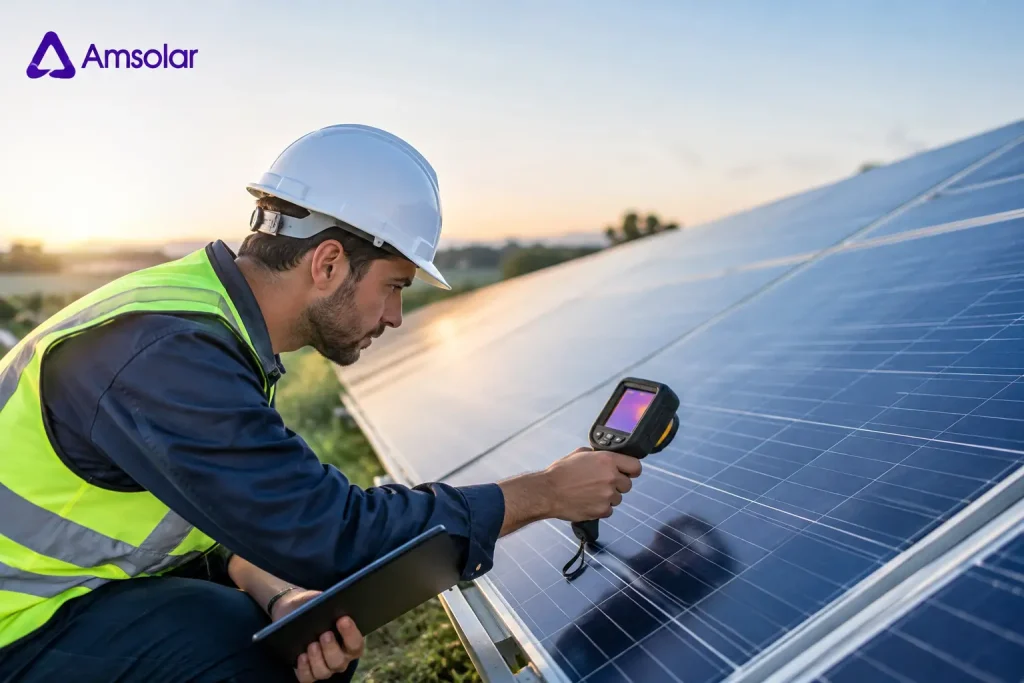
Thermal inspections add another layer of evidence. Hot connectors, isolators, combiner boxes, and modules can indicate high-resistance connections or failed bypass diodes. Thermal imagery is especially useful because some defects do not show clearly in ordinary production reports until the problem has progressed.
Separate Equipment Faults From Site Power Problems
Not every loss of solar value originates in the PV array. Commercial facilities with variable-speed drives, welding equipment, motors, compressors, chillers, or nonlinear loads can experience voltage fluctuations, poor power factor, harmonic distortion, and reactive-power demand. These conditions can affect inverter stability and complicate the interpretation of alarms.
If solar inverters are disconnecting during peak production, investigate the point of common coupling rather than assuming the inverter is defective. High grid voltage, phase imbalance, weak connections, or rapid load changes can push operating conditions outside acceptable limits. The correct remedy could involve electrical distribution work, adaptive power control, or reactive-energy management rather than replacement solar equipment.
Meter data is central to this diagnosis. Revenue-grade or appropriately specified energy meters should track import and export, phase voltage, current, power factor, reactive power, harmonics where required, and demand intervals. When this information is aligned with inverter and battery data, energy teams can distinguish a generation fault from a site-side power-quality issue.
Static VAR generators can be relevant where reactive power is driving avoidable electrical losses or constraining site performance. They do not repair a damaged PV string, but they can stabilize power factor and support more controlled energy use in facilities with challenging electrical loads.
Use Battery Data to Find Control and Dispatch Faults
At sites with battery energy storage, fault detection must include the battery management system, power conversion system, and dispatch logic. A battery may be available but not delivering value if its state-of-charge limits, charge schedule, inverter settings, or operating priorities are misaligned with the facility load.
Watch for unexplained state-of-charge drift, repeated alarms, temperature variation between battery racks, unavailable capacity, and a gap between commanded and actual charge or discharge power. A battery that charges from solar but fails to discharge during a high-demand interval may indicate a control setting problem rather than a hardware failure. Conversely, unexpected charging during a costly import period can reveal poor scheduling or faulty meter inputs.
Battery health should also be measured against usable capacity, not nameplate capacity alone. Over time, capacity changes are expected. The concern is a faster-than-expected decline, uneven rack behavior, or thermal conditions that increase degradation risk. These signals allow operators to intervene before a minor control problem becomes a costly availability issue.
Build a Fault Detection Routine That Leads to Action
Effective monitoring has to create a clear response path. A dashboard full of data is not a fault-management program unless someone owns the review, understands alarm severity, and can escalate a finding to the right technical team.
Set practical thresholds based on the site design. These may include underperformance against modeled output, mismatch between similar strings, recurring inverter trips, unusual grid-import increases during solar hours, low battery availability, and deteriorating power factor. The threshold should reflect material impact. An alert that triggers too often will be ignored, while an alert set too high may miss early-stage losses.
Review the system at three levels. Daily checks identify urgent outages and critical alarms. Weekly reviews reveal recurring anomalies and generation gaps. Monthly analysis connects technical performance with financial outcomes, including avoided energy costs, demand behavior, battery contribution, and equipment availability.
When a fault is found, document the time, affected equipment, operating conditions, corrective action, and post-repair results. This creates a useful fault history, helps identify repeat issues, and improves future maintenance planning. It also gives management a defensible view of whether the solar asset is meeting its expected business case.
The strongest solar monitoring program does not wait for an inverter to fail. It uses performance data, electrical insight, and disciplined response to catch small deviations while they are still inexpensive to fix.
