
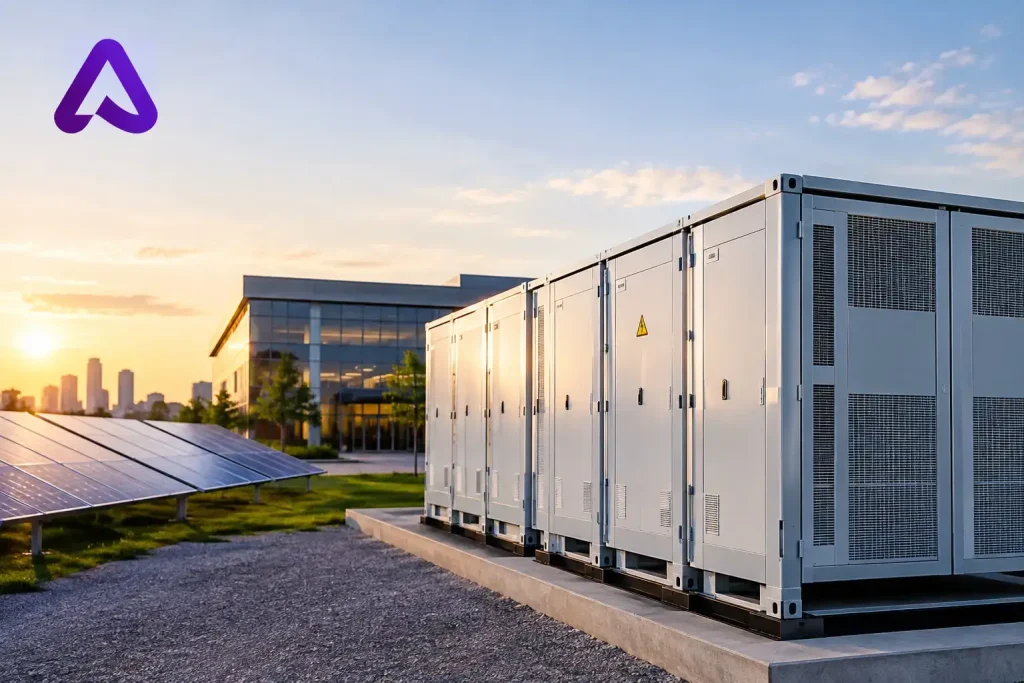
Commercial Energy Storage Trends for C&I Savings
Key takeaways
- Commercial battery storage is shifting from a backup asset to an actively managed cost-control tool.
- The strongest projects combine battery capacity, AI-based dispatch, load monitoring, and power-quality improvement.
- Zero-capex commercial models are making storage more accessible where cash preservation matters as much as energy savings.
A factory’s highest electricity bill is often created during a few short intervals of heavy demand, not across the entire month. That is why commercial energy storage trends are moving beyond simple backup power. For energy-intensive facilities, batteries are increasingly being used to control maximum demand, respond to changing load profiles, improve energy visibility, and protect operational continuity.
For manufacturers, hospitals, malls, processing plants, data centers, and fabrication facilities, the value of storage depends less on headline battery size and more on how intelligently the system operates. A battery that discharges at the wrong time may leave savings on the table. A system coordinated with real-time meter data, solar production, reactive power conditions, and site operations can produce a more measurable financial result.
Commercial Energy Storage Trends Are Becoming Control Trends
The most consequential change in commercial storage is the move from passive storage to active energy management. Earlier battery projects were commonly sized for backup duration or a fixed discharge schedule. That approach can work where outages are the primary concern, but it does not fully address the cost drivers faced by high-load commercial and industrial sites.
Modern battery energy storage systems are increasingly dispatched based on live site conditions. This means the system can observe facility demand, identify an approaching demand peak, and release stored energy before the site crosses a costly threshold. When paired with a solar PV system, it can also decide whether stored energy is more valuable during solar production, after sunset, or during a specific operating window.
This is where an AI-driven energy control platform has practical value. Rather than relying solely on static schedules, it can adapt battery behavior to the facility’s actual usage pattern. The goal is not simply to cycle the battery every day. The goal is to use each cycle where it has the greatest impact on energy cost, demand exposure, and operating resilience.
Maximum Demand Management Is Driving Project Decisions
For many commercial sites, maximum demand is the most immediate business case for battery storage. A single high-demand event can affect the month’s electricity costs, especially where large motors, chillers, compressors, furnaces, pumps, or production equipment start at the same time.
Battery storage can shave those peaks by supplying power during short, high-load intervals. However, peak shaving is not a one-size-fits-all exercise. A site with predictable production shifts may benefit from scheduled discharge. A hospital or data center with volatile loads needs faster, more responsive control. A shopping center may experience a different demand pattern during weekends, seasonal campaigns, or hot weather.
Accurate interval data is therefore as important as the battery itself. Before specifying capacity and power rating, an engineering team should examine load duration curves, demand spikes, operating hours, power factor, solar generation profiles, and anticipated changes in equipment use. A larger battery is not always the better investment. In some cases, a system with sufficient power output and disciplined control produces better demand savings than a larger system designed around energy capacity alone.
Solar, Storage, and Power Quality Are Being Designed Together
Commercial storage is no longer evaluated as an isolated technology. The better projects combine solar PV, battery energy storage, monitoring, and power-quality equipment into one operating strategy.
Solar reduces daytime grid consumption, but its generation profile does not always align with a facility’s highest demand period. Storage can shift a portion of that value, absorbing excess solar production when site demand is low and discharging later when the facility needs support. The exact benefit depends on the site’s load shape, available roof or land area, and the timing of its operations.
Power quality also deserves attention. Facilities with inductive loads can experience poor power factor and reactive energy issues that complicate cost control. A static var generator, or SVG, can provide dynamic reactive power compensation, while battery controls focus on demand and energy dispatch. These are different functions, but they can support the same commercial objective: a more stable, efficient electrical system with clearer performance measurement.
This integrated approach matters in facilities where electrical behavior changes throughout the day. Production lines do not operate like office loads. Chillers, pumps, welding equipment, conveyors, compressors, and variable-speed drives introduce different load conditions. A monitored, engineered system can respond to those conditions with more precision than disconnected equipment operating independently.
Financial Models Are Favoring Flexible BESS Delivery
Capital expenditure remains a barrier for many otherwise suitable battery projects. Even when the technical case is strong, management teams may prefer to direct capital toward production expansion, inventory, machinery, or other core business needs.
That is driving interest in Battery Energy Storage System as a Service models. Under a zero-capex structure, the customer can access battery capacity and energy management capability without carrying the full upfront equipment cost. The commercial structure must still be assessed carefully. Contract duration, savings-sharing terms, performance assumptions, asset ownership, operating responsibilities, and expansion options all affect the final value.
The strongest financial analysis does not rely on a single projected savings number. It tests different demand scenarios, production schedules, battery degradation assumptions, and electricity-use changes. A plant planning a new production line, for example, should model its future load rather than size a battery only around historic consumption. Similarly, a site with frequent operational changes may prioritize flexibility over the lowest initial modeled cost.
Amsolar approaches this type of assessment through energy monitoring, financial modeling, payback and internal rate of return analysis, and system design that connects technical performance to operating cost. That connection is essential. Storage should be evaluated as a managed energy asset with defined business outcomes, not as a standalone equipment purchase.
What High-Use Facilities Should Do Next
The practical starting point is a detailed energy assessment, not a battery quotation. Facilities should first establish when demand peaks occur, what causes them, how long they last, and whether those peaks are predictable. They should also identify the relationship between solar generation, operating schedules, reactive power conditions, and critical loads.
From there, the project can be sized around a specific strategy: maximum demand reduction, solar self-consumption, backup support, power-quality improvement, or a combination of these. Each strategy changes the preferred battery power rating, energy capacity, control logic, and financial model.
It also pays to look beyond the first year. A battery system should be capable of supporting operational changes, additional solar capacity, and evolving load patterns. Clear cloud-based reporting helps facility and finance teams verify whether the system is delivering the expected results, rather than relying on assumptions after commissioning.
Commercial energy storage is becoming a practical operating tool for businesses with large, variable electricity use. The next advantage will come from systems that see the whole electrical picture, make disciplined decisions in real time, and turn energy data into lower, more predictable operating costs.
