
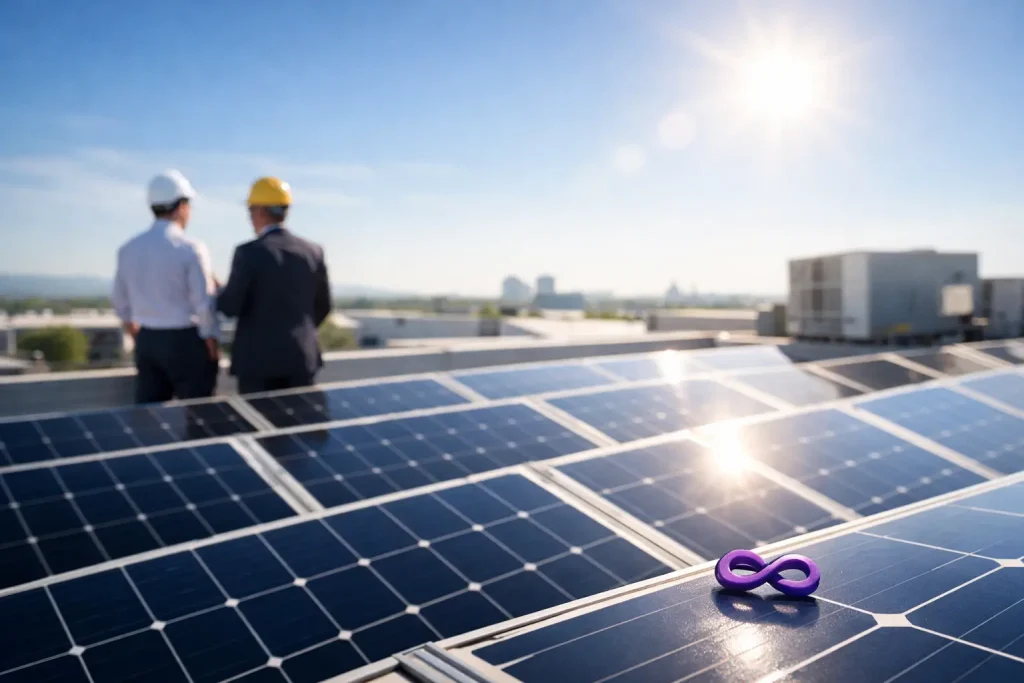
Commercial Solar PV System for Cost Control
When a factory’s electricity bill keeps rising while production margins stay tight, energy stops being a utility line item and becomes a strategic problem. A commercial solar PV system is often the first serious lever businesses pull to regain control, but the results depend far less on panel count than on how well the system is designed around load profile, tariff structure, operating hours, and long-term financial goals.
For commercial and industrial businesses, that distinction matters. Solar is not just about generating clean electricity on a roof. It is about reducing grid dependence when tariffs are unfavorable, improving visibility over consumption, and making sure the investment performs under real operating conditions. The companies that see the best outcomes treat solar as part of an energy cost strategy, not a standalone equipment purchase.
What a commercial solar PV system actually includes
A commercial solar PV system typically combines solar modules, inverters, mounting structures, protection systems, cabling, and monitoring platforms. On paper, that sounds straightforward. In practice, each part affects yield, compliance, safety, and the financial return of the project.
The biggest mistake buyers make is assuming all systems with the same installed capacity will deliver the same business value. They will not. A 500 kWp installation on a warehouse with predictable daytime demand behaves very differently from a similar system on a manufacturing site with peak loads in short intervals, reactive power issues, or weekend shutdowns.
This is why engineering scope matters. Good system design starts with site conditions, energy consumption patterns, roof limitations, interconnection requirements, and utility rules. It then moves into production forecasting, equipment selection, protection coordination, and performance assumptions that are realistic enough to support board-level investment decisions.
Why businesses invest in commercial solar PV systems
The main reason is cost reduction, but that phrase is often too broad to be useful. A business does not benefit from solar simply because the system produces electricity. It benefits when that electricity offsets the most expensive and most predictable portion of grid consumption.
For many facilities, daytime operating loads make solar attractive because generated power is consumed immediately. That improves self-consumption and reduces exposure to imported electricity costs. In some cases, the benefit extends beyond direct savings. A site with better energy planning can improve operating cost predictability, support ESG targets, and make future expansion easier to model.
There is also a resilience argument, although solar alone does not guarantee backup power. If a business needs continuity during outages or wants to manage peak demand more actively, battery storage and control systems may be required. That is where the conversation becomes more strategic. Solar can lower energy costs, but solar paired with battery optimization and intelligent control can reshape how a facility buys, stores, and uses electricity.
The financial case is stronger when the analysis is honest
Commercial buyers usually ask the right first question: what is the payback period? That matters, but payback alone is not enough. A proper evaluation should also look at internal rate of return, projected savings over system life, tariff escalation assumptions, maintenance costs, degradation, and financing structure.
This is where many proposals become too simplistic. If savings are based on idealized generation, static tariff assumptions, or a weak understanding of actual site consumption, the business case can look stronger than it really is. A credible solar partner should model the project against real load data and explain where performance assumptions may vary.
It also helps to separate capital cost from energy strategy. Some businesses prefer direct ownership because it maximizes long-term returns. Others care more about preserving cash flow and may prefer structured solutions that reduce upfront spending. Zero-capex models, where suitable, can be attractive for companies that want savings without tying up capital that could be used for core operations.
Design quality determines whether savings hold up over time
A commercial solar PV system should not be sized by available roof area alone. The right size depends on how the building consumes power, how utility billing works, and whether there are operational plans that could change future demand. Oversizing a system may look good in a proposal but perform poorly if export rules are restrictive or if daytime loads are lower than expected.
Roof condition is another practical issue that deserves more attention. If the structure needs reinforcement, waterproofing work, or replacement within a few years, the timing of the solar project should account for that. Removing and reinstalling a system later adds cost and operational disruption.
Inverter strategy also matters. Centralized and string inverter approaches each have trade-offs depending on site layout, shading, maintenance access, and redundancy requirements. Similarly, monitoring should not be treated as an optional extra. Businesses need clear visibility into generation, faults, performance trends, and consumption behavior if they want to protect returns.
That is why more sophisticated projects now include cloud-based reporting, remote diagnostics, and usage analytics. These tools help owners move from passive ownership to active energy management. If the system underperforms, the issue can be seen and corrected faster. If the load profile changes, future optimization decisions become easier.
Where battery storage and intelligent controls fit
Not every site needs battery energy storage on day one. For some facilities, solar by itself delivers strong economics. But when tariff structures include demand-related charges, when outage risk carries real operating cost, or when load shifting creates value, battery storage becomes worth evaluating.
The important point is that batteries should be sized around business use cases, not trends. A poorly matched battery system can add capital cost without producing a proportional return. A well-optimized one can improve self-consumption, reduce demand spikes, and support operational continuity.
This is where technology-led control makes a real difference. AI-driven energy cost control, adaptive power control, and battery optimization can improve how energy flows across the site. Instead of simply generating solar and hoping the savings appear, the facility can actively manage when energy is consumed, stored, or curtailed. For larger commercial users, that level of intelligence often separates a decent project from a high-performing one.
Compliance, approvals, and commissioning are not side tasks
Decision-makers often focus on equipment and financials early on, then discover that approvals and grid requirements can affect timeline and project viability. Interconnection standards, protection studies, safety requirements, and regulatory submissions are part of the core project, not administrative extras.
That is especially relevant in Malaysia, where commercial and industrial installations can involve utility coordination, engineering submissions, and site-specific approval pathways. A contractor that can design the system but not manage compliance introduces risk for the client. Delays in approval, missed technical requirements, or weak commissioning practices can push back savings and create avoidable disputes later.
Testing and grid commissioning should be treated with the same seriousness as design. If the system is not verified properly at handover, early performance issues can be difficult to diagnose. Businesses need confidence that the plant has been installed safely, commissioned correctly, and documented well enough for future operation and maintenance.
Choosing the right partner for a commercial solar PV system
The safest proposal is not always the cheapest, and the highest projected savings are not always the most credible. Commercial solar buyers need a delivery partner that can handle engineering, procurement, construction, compliance, commissioning, and post-installation performance support as one integrated scope.
That matters because handoff gaps are expensive. If one party designs, another installs, and no one takes ownership of performance analytics, it becomes harder to solve problems when they appear. Businesses are better served by a partner that can connect technical execution with financial modeling and operational monitoring.
Amsolar approaches this from that full-project perspective: engineering delivery backed by monitoring, financial analysis, and advanced energy optimization. For commercial users, that integrated model usually leads to fewer blind spots and clearer accountability.
What smart buyers ask before they commit
The best internal stakeholders do not ask only for installed cost per kWp. They ask how much of the generation will be self-consumed, what assumptions support the savings forecast, how the system will be monitored, what happens if operating hours change, and whether future battery integration has been considered.
They also ask about maintenance response, performance reporting, and degradation risk. Those questions may sound technical, but they are really business questions. They determine whether the project continues to deliver value after the ribbon-cutting photo is forgotten.
A commercial solar PV system can absolutely reduce operating costs and improve energy control, but only when it is treated as an engineered business asset. The real opportunity is not just to produce cheaper electricity. It is to build an energy platform that gives your business more certainty in a market where power costs rarely stand still.
