
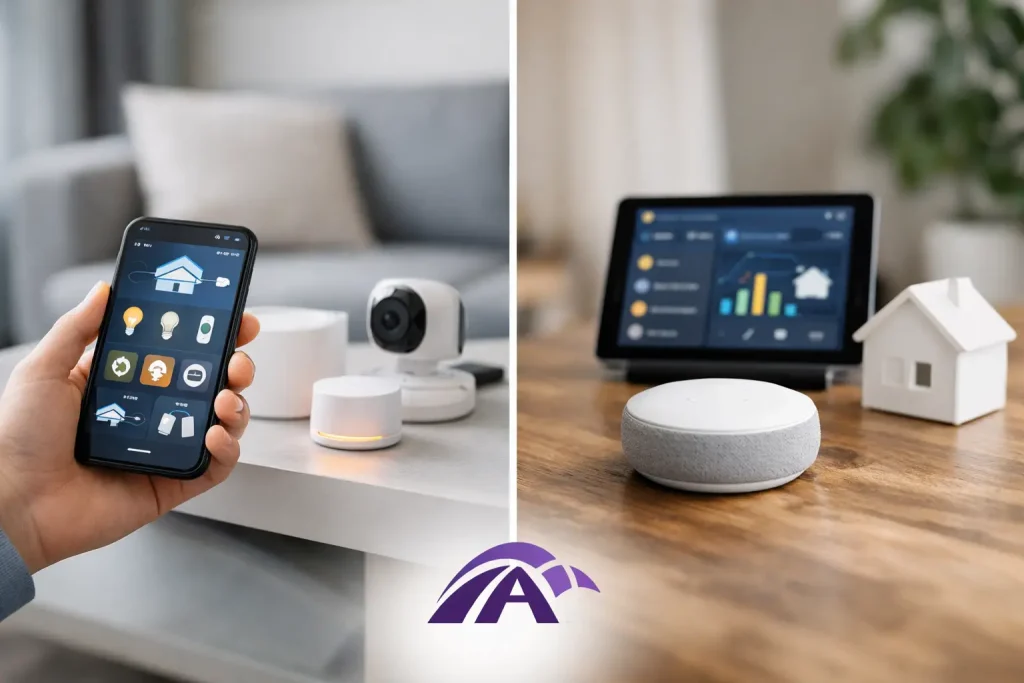
Smart Home Energy Management: Tuya vs Home Assistant
A homeowner with solar, battery storage, and high daytime loads usually asks the same question after installation: how much control do I really have over my energy use? That is where smart home energy management: Tuya versus Home Assistant becomes a practical decision, not a hobbyist debate. The right platform can help turn solar generation into lower grid imports, better battery timing, and more visible household energy behavior.
Key takeaways
For most households, Tuya is the easier starting point if the priority is a fast, user-friendly setup with app-based control. Home Assistant is the stronger platform if the goal is deeper automation, broader device integration, and more precise energy optimization around solar and battery usage. The trade-off is simple: Tuya favors convenience, while Home Assistant favors control. For higher-value residential projects, the better choice depends on whether the homeowner wants a managed energy experience or a customizable system that can keep evolving.
Smart home energy management: Tuya versus Home Assistant at a glance
Tuya is built for accessibility. It works well for homeowners who want smart plugs, lighting, air conditioning control, and selected monitoring devices running quickly through a polished mobile app. In a residential solar setting, that matters because ease of use often determines whether the system is actually used every day.
Home Assistant takes a different approach. It is a local-first automation platform designed for users who want to connect many brands, write custom logic, and build detailed energy dashboards. If a homeowner wants the house to respond dynamically to solar output, tariff periods, battery state of charge, or occupancy patterns, Home Assistant usually offers more room to do that.
This is why the comparison should not be framed as which one is better in absolute terms. The better question is which one aligns with the level of control, technical tolerance, and energy-saving ambition in the home.
Where Tuya fits best
Tuya is often the practical choice for households that want smart energy features without taking on system administration. Device onboarding is usually straightforward, the app is easy to understand, and many off-the-shelf products support it. For a homeowner who wants to schedule water heaters, control selected appliances, or monitor a few circuits, that simplicity has real value.
In homes with rooftop solar, Tuya can support useful actions such as running discretionary loads during solar production hours. If paired with compatible sensors and relays, it can help shift consumption away from expensive evening imports. That does not make it a full energy management platform in the engineering sense, but it can produce measurable gains when deployed with the right logic.
The limitation is depth. Tuya works well within its ecosystem and selected integrations, but it is not always ideal when the project requires complex, cross-brand coordination or detailed local control. If the homeowner later wants advanced battery dispatch rules, inverter-aware automation, or highly customized dashboards, Tuya may start to feel restrictive.
That is the main trade-off. It is efficient to deploy, but not always designed for highly customized energy strategy.
Where Home Assistant pulls ahead
Home Assistant is stronger when energy management needs to be tailored around real operating behavior. It can integrate data from inverters, smart meters, EV chargers, air conditioning systems, temperature sensors, and occupancy logic into a single automation layer. For homes with solar and battery systems, that can materially improve self-consumption and reduce unnecessary grid usage.
For example, a household could automate cooling pre-charge during peak solar hours, delay flexible appliance loads until solar generation exceeds a threshold, or preserve battery capacity for evening use rather than allowing avoidable daytime discharge. Those are the kinds of control strategies that move beyond convenience and into actual energy optimization.
Another advantage is visibility. Home Assistant dashboards can show generation, import, export, battery performance, and large load behavior in one place. For higher-value homeowners, this is often where confidence is built. People are more likely to adjust behavior or approve further upgrades when they can see exactly what the system is doing.
The downside is obvious. Home Assistant usually asks for more technical setup, more maintenance awareness, and more design discipline. If implemented casually, it can become overcomplicated. If implemented properly, it becomes a serious operating layer for the home.
The real decision: convenience or control
The choice between these platforms often comes down to the type of homeowner and the maturity of the energy system. If the home has a standard solar setup, a few smart devices, and the goal is simple load scheduling, Tuya may be enough. It lowers the barrier to entry and makes smart control approachable.
If the home includes battery storage, plans for EV charging, or a strong interest in maximizing energy economics, Home Assistant starts to make more sense. Its value grows as the system becomes more complex. That is particularly true when multiple devices from different manufacturers need to work together under one operating strategy.
This is also where project design matters more than brand preference. A platform on its own does not guarantee savings. The savings come from how controls are mapped to load patterns, tariff structures, solar production windows, and battery behavior. A technically capable platform with poor configuration can underperform a simpler system that is well designed.
For that reason, homeowners should avoid choosing based only on app appearance or online community enthusiasm. The smarter route is to define the actual use case first. Are you only trying to automate a few appliances around solar generation, or are you trying to operate the whole home as an energy-aware system?
What this means for solar homes in practice
For residential solar clients looking for a complete solution, the platform should support the broader energy objective, not just smart device control. That objective may include reducing imported electricity during evening peaks, improving solar self-consumption, preparing for future battery integration, or giving the homeowner clearer reporting on household energy behavior.
In that context, Tuya works well when the priority is reliable day-one usability. It is particularly suitable when the homeowner wants a managed experience and does not intend to customize the system heavily over time. A Tuya-based home energy management setup can be a sensible fit when paired with well-selected devices and practical automation rules.
Home Assistant is the better fit when the homeowner wants long-term flexibility and accepts that more capability usually means more setup effort. It is not the ideal answer for every household, but it is often the stronger technical foundation for advanced energy control.
At Amsolar, this distinction matters because energy systems should be engineered around outcomes, not just devices. The best platform is the one that supports measurable cost control, clear visibility, and future-ready operation without creating unnecessary complexity for the homeowner.
Before choosing, ask a simple question: do you want a smart home that can switch devices on and off, or an energy-aware home that actively supports your solar and battery strategy? That answer will usually point you to the right platform, and more importantly, to the right system design.
The smartest home is not the one with the most automations. It is the one that makes better energy decisions quietly, consistently, and with results you can actually see.
