
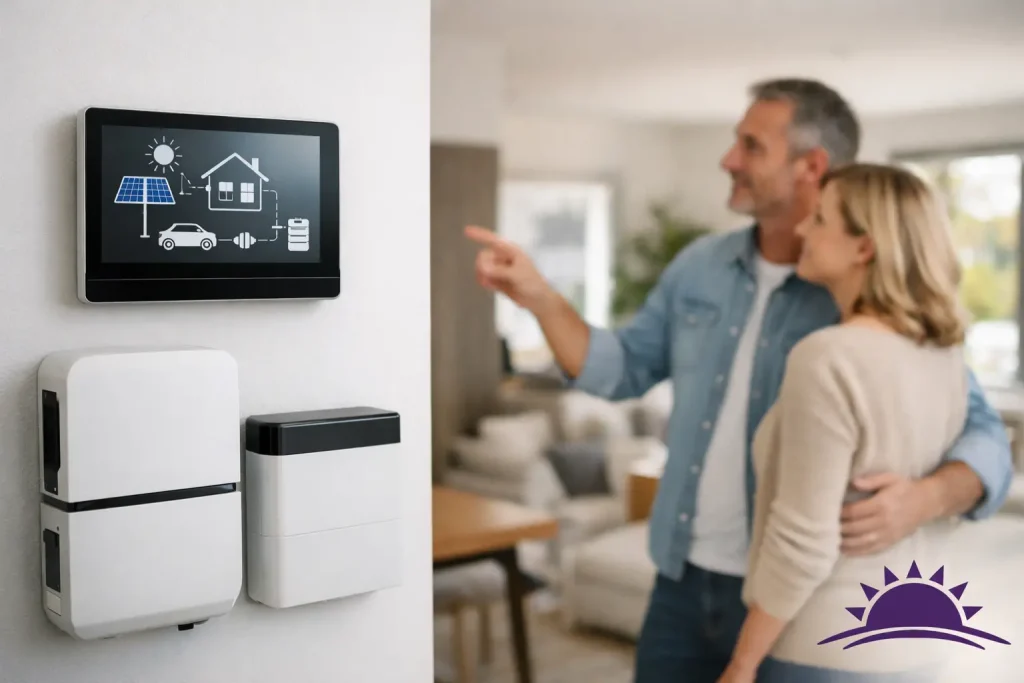
Home Energy Management System Review for Homeowners
A solar system can produce valuable electricity, yet homeowners may still see high bills if air conditioning, water heating, EV charging, and battery use are not coordinated. This home energy management system review explains what separates a useful monitoring app from a complete control platform – and how to evaluate the financial value before installation.
Key Takeaways
A home energy management system, or HEMS, should do more than display solar generation. The right system measures household consumption, identifies major loads, and helps prioritize solar or battery power when it has the highest value.
For homeowners, the strongest case is usually a combined solar, battery, and monitoring strategy. The result depends on the home’s load profile, tariff structure, family routines, and whether backup power or EV charging is part of the requirement.
Commercial and industrial facilities need a different level of solution. They require interval data, demand management, multiple meter integration, operational reporting, and controls designed around production or building loads. A residential HEMS should not be assessed as a simplified substitute for an industrial energy management system.
What a Home Energy Management System Actually Does
At its core, a HEMS connects information from solar inverters, smart meters, batteries, and selected household devices. It gives the homeowner a clear view of where electricity is going and, in more advanced configurations, makes rules-based or automated decisions about when equipment should run.
The distinction between visibility and control matters. A basic app may show daily solar output, imported electricity, and exported electricity. That is useful, but it does not necessarily reduce consumption. A more capable system can detect when the home is drawing power from the grid, send alerts when a major load exceeds a set threshold, or schedule compatible appliances to operate during periods of solar generation.
For a high-value home, the most relevant loads are often air conditioning, pool pumps, electric water heaters, EV chargers, kitchen equipment, and battery charging. These loads can be significant individually, but their timing is often more important than their total annual consumption. Running an EV charger at midday, for example, may use surplus solar that would otherwise be exported. Charging it after sunset may increase grid imports unless battery capacity and operating rules support that choice.
A Tuya-based Home Energy Management System can provide a practical foundation for smart-device integration, scene automation, and app-based visibility. However, homeowners should verify which devices are genuinely integrated, what data is measured directly, and whether the system can coordinate with the selected inverter and battery rather than simply operating smart plugs in isolation.
What to Look for in a Home Energy Management System Review
A credible review begins with the metering architecture. Ask whether the system measures whole-home import and export in real time, tracks solar production, and monitors battery charge and discharge. Without reliable measurements, savings recommendations are based on assumptions rather than actual household behavior.
Next, assess load-level visibility. Not every home needs a sensor on every circuit. However, a system should identify the loads that materially affect the bill. In a large residence, separate monitoring for air conditioning zones, EV charging, water heating, and pool equipment can reveal opportunities that whole-home data alone will miss.
Control capability is the next test. Look for scheduling, automation rules, remote switching, and notifications that can be configured around household priorities. A family may value comfort first and prefer limited automation of air conditioning. Another homeowner may want the system to prioritize daytime EV charging and pool filtration. Good energy management gives the owner control over those trade-offs rather than imposing a generic preset.
Data ownership and reporting deserve attention as well. The app should present understandable daily, monthly, and historical information, with clear separation between solar production, home consumption, grid imports, exports, and battery activity. Cloud reporting is helpful when it turns data into decisions. More charts do not automatically create more value.
Finally, ask how the system behaves when internet connectivity is interrupted. Some features depend on cloud access, while safety-critical inverter and battery functions should retain their essential local protections. The installer should explain these boundaries before commissioning.
Solar, Batteries, and Automation: Where Savings Come From
Solar savings begin with self-consumption: using solar electricity in the home when it is generated. A HEMS can improve self-consumption by moving flexible loads into daylight hours. This is often the first and most economical use case because it requires behavior changes or automation, not necessarily additional hardware.
A battery adds another layer. It can store solar energy for evening use, reduce reliance on grid electricity during selected periods, and support backup circuits if the system is designed for resilience. Yet a battery is not automatically the best financial choice for every home. Its economics depend on the size of the solar surplus, evening consumption, electricity rates, backup requirements, battery cycling strategy, and expected degradation over time.
For example, a homeowner with high daytime occupancy and substantial daytime air-conditioning use may already consume much of their solar output directly. Their priority may be monitoring and load control rather than a large battery. A household that is empty during the day but has heavy evening cooling, cooking, and EV charging may have a stronger case for storage.
Automation should follow the energy strategy. Start with predictable loads such as pool pumps, water heaters, EV chargers, and selected appliance schedules. Then consider more advanced controls. Excessively aggressive automation can create frustration if it conflicts with comfort, convenience, or household routines. The goal is measured cost control, not a home that requires constant manual intervention.
Installation Quality and Financial Fit Matter as Much as the App
The HEMS is only as effective as its electrical design, commissioning, and settings. Current transformers must be installed correctly. Inverter, battery, meter, and app data must align. Automation rules should be tested under realistic operating conditions, including solar production changes, battery reserve limits, and high-load events.
This is where an end-to-end provider brings practical value. Amsolar approaches residential energy management as part of a complete energy system, combining PV engineering, monitoring, battery optimization, and financial assessment. The objective is not to sell a dashboard. It is to build a system that performs against the homeowner’s consumption profile and priorities.
Before approving a proposal, request a clear explanation of the expected operating logic. Understand what will happen to surplus solar, when the battery will charge and discharge, which circuits are backed up, and what loads can be automated. Ask for projected savings assumptions and distinguish them from guaranteed outcomes. Weather, occupancy, utility tariffs, and future electricity use can all change the result.
Malaysia homeowners considering solar should also assess available program support, including the Suria RM3K rebate where eligible, alongside the broader system economics. A rebate can improve payback, but it should not replace a proper technical and financial evaluation.
The best system is rarely the one with the longest feature list. It is the one that accurately measures the home, supports the loads that matter, and converts solar generation into lower grid dependence without compromising daily comfort. Start with your actual usage pattern, then design the controls, solar capacity, and battery strategy around it.
