
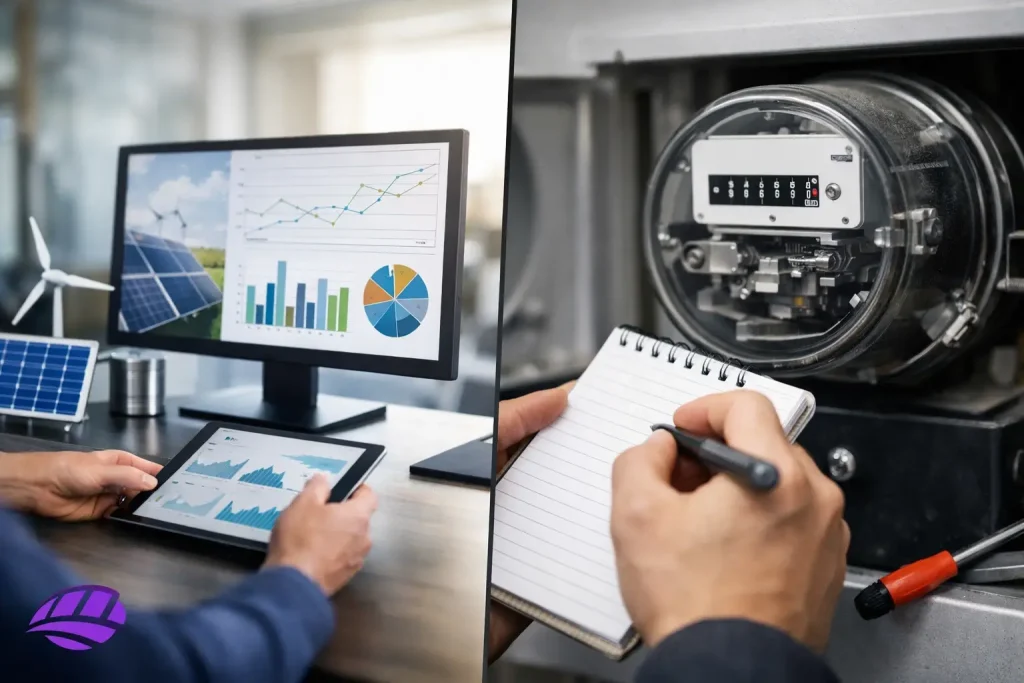
Energy Analytics vs Manual Metering Compared
Key Takeaways
Energy analytics vs manual metering is not simply a choice between software and spreadsheets. It is a decision about how quickly a facility can identify cost drivers, verify energy savings, and act on changing demand patterns.
Manual readings can be sufficient for a small site with stable loads and a limited number of meters. For commercial and industrial operations, however, analytics provides the interval-level visibility needed to manage peak demand, solar generation, battery dispatch, and equipment performance with greater confidence.
The strongest business case is usually not based on collecting more data. It is based on turning accurate data into specific operating and investment decisions that reduce avoidable electricity costs.
Why Manual Metering Falls Short at Scale
Manual metering has a role. A technician can record a main meter reading, compare monthly consumption against the utility bill, and spot major changes in usage. This approach is low-cost at the outset and can help establish a basic energy baseline.
The limitation is timing. A monthly meter reading tells a facility what happened after the billing period has ended. It cannot reliably explain whether a cost increase came from higher production, an equipment fault, poor power factor, a short-lived demand spike, or a change in operating hours. By the time the issue is visible, the charge has often already been incurred.
Manual processes also become harder to control as a site grows. Multi-tenant properties, factories with several production lines, cold storage facilities, and campuses may have dozens of loads worth tracking. Readings may be recorded at different times, entered inconsistently, or missed during shift changes. The result is data that is difficult to compare and even harder to use for financial decisions.
For management teams, the bigger concern is verification. If a facility installs solar PV, changes a chiller schedule, or upgrades production equipment, a monthly total cannot prove whether the expected savings were achieved. It may show that overall consumption moved, but not why.
Energy Analytics vs Manual Metering: The Operating Difference
Energy analytics connects smart meters, solar inverters, battery systems, and selected equipment loads to a centralized reporting environment. Instead of a single cumulative figure, the team can review consumption and generation by time interval, location, tariff period, or operational area.
That distinction changes the quality of decision-making. A demand charge is often driven by a relatively brief period of high simultaneous load. Monthly consumption may appear reasonable while the facility continues to pay avoidable peak-demand charges. Interval data can show when the peak occurred, which loads were active, and whether schedule changes, demand control, solar output, or battery discharge could reduce the exposure.
Analytics also supports exception-based management. Rather than asking a facilities team to inspect every meter reading, a system can flag unusual overnight consumption, unexpected inverter underperformance, demand events, or battery behavior that does not match the intended operating strategy. The goal is not to replace engineering judgment. It is to direct that judgment toward the issues with the highest financial impact.
For solar assets, monitoring should extend beyond whether the system is producing electricity. Facility owners need to understand how much solar energy is being generated, how much is used on-site, whether curtailment is occurring, and whether operating loads are aligned with daytime production. A PV system that generates well but offsets the wrong load periods may deliver less value than the financial model projected.
When battery energy storage is included, analytics becomes even more central. Battery value depends on when it charges, when it discharges, the applicable tariff structure, site demand, solar availability, and operating constraints. A battery that is simply charged and discharged on a fixed routine may not deliver the best economics. Adaptive control based on live and historical data can help prioritize peak shaving, solar self-consumption, or resilience according to the facility’s actual needs.
The Financial Case Depends on the Facility
Energy analytics is not automatically the right first investment for every building. A small commercial site with one utility meter, predictable hours, and limited controllable load may benefit more from a basic monitoring setup and disciplined monthly review. Installing extensive submetering where there is no practical action to take can add cost without improving outcomes.
The case becomes stronger when electricity costs are material, demand charges affect the bill, operations run across multiple shifts, or management is evaluating solar PV and storage. It is particularly useful where a facility cannot clearly allocate energy use by department, tenant, process, or equipment group. In those cases, submetering can turn an unclear overhead into an accountable operating metric.
Before selecting a platform, decision-makers should define the questions the data must answer. These typically include: Which loads create the monthly peak? How much solar energy is self-consumed? What is the actual consumption profile before sizing a battery? Are efficiency projects producing measurable savings? Which sites should receive capital first?
This approach also improves financial modeling. Solar payback and internal rate of return calculations depend on credible load data, tariff assumptions, generation estimates, and degradation factors. Using annual utility consumption alone can produce an incomplete model because it does not show the timing relationship between site demand and solar production. Better interval data leads to better system sizing and fewer surprises after commissioning.
From Data Collection to Energy Control
A useful energy program has three layers: measurement, interpretation, and action. Manual metering usually concentrates on measurement. Analytics can support all three, but only when the monitoring design is tied to operational responsibility.
For example, a factory may find that its highest demand occurs during a short morning startup window. That finding is valuable only if the operations team can sequence equipment differently, pre-cool a process, adjust noncritical loads, or use battery capacity during that period. Similarly, identifying overnight base load matters only if someone can investigate compressed air leaks, idle equipment, cooling loads, or controls that are running unnecessarily.
This is where engineering support matters. The right solution is not necessarily the platform with the most dashboards. It is the system that uses correctly installed meters, reliable communications, clear reporting, and controls that fit the facility’s actual electrical architecture and operating constraints.
Amsolar approaches monitoring as part of a wider energy strategy, linking electricity usage data with PV performance, battery optimization, financial analysis, and practical control measures. For a commercial or industrial customer, this creates a clearer path from a utility bill problem to an engineered solution and a measurable result.
What Residential Customers Should Consider
Residential solar customers have a different decision. Most homes do not need the depth of submetering used in a factory or commercial property. Homeowners generally benefit most from visibility into solar generation, household consumption, grid import, and, where installed, battery status.
A home energy management system can help owners see whether high-use appliances are operating during solar production hours and whether the system is performing as expected. The value is practical: improve solar self-consumption, identify unusual usage, and make informed choices about future battery capacity or appliance scheduling.
For high-value residential projects, monitoring should still be specified early. It is easier to integrate metering and controls during system design than to retrofit them after installation. The level of detail should match the household’s goals, not imitate a commercial control room.
The right starting point is a focused energy assessment: identify the loads, tariff exposure, solar opportunity, and operating decisions that can genuinely change the outcome. From there, meter only what needs to be measured, and make sure every report leads to a decision someone can act on.
