
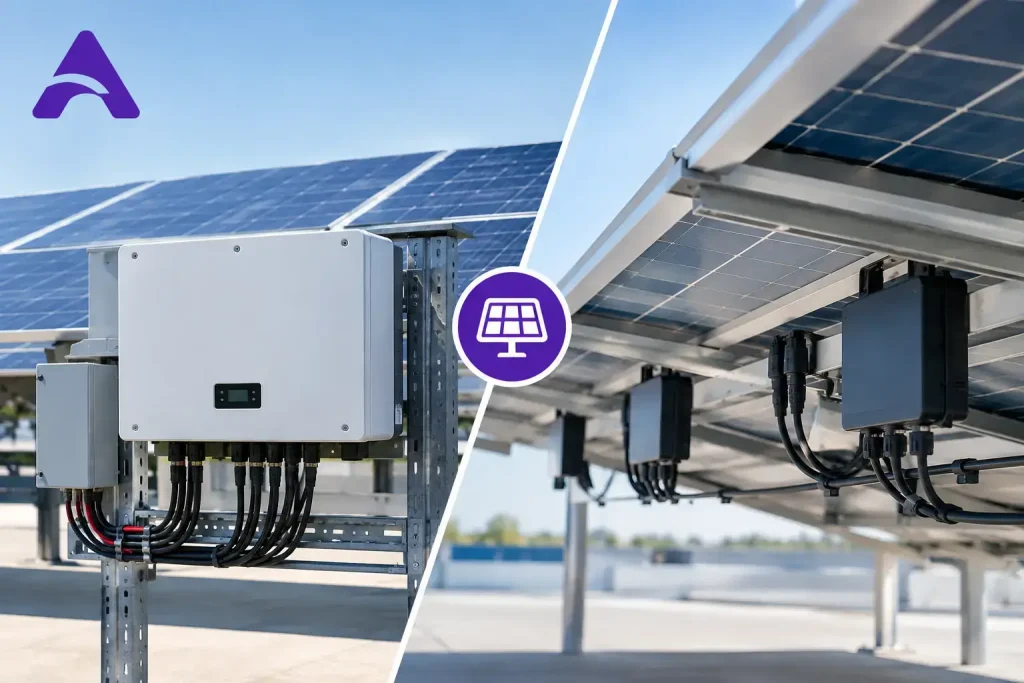
String Versus Microinverters for C&I Solar
Key takeaways: For most commercial and industrial rooftops, string inverters provide the strongest balance of capital cost, serviceability, and high-capacity performance. Microinverters can be valuable where roofs are heavily shaded, fragmented, or built with many different orientations. The right choice depends on the site’s energy profile, roof design, maintenance strategy, and the value placed on module-level visibility.
The string versus microinverters decision is not simply a choice between two solar components. For a factory, hospital, warehouse, mall, or data center, it affects system uptime, fault response, rooftop installation complexity, and the long-term economics of every kilowatt-hour produced. The best design is the one that performs reliably under real operating conditions while supporting the facility’s wider energy-cost strategy.
How the Two Architectures Work
A string inverter connects a group of solar modules in series, forming a string that feeds a centralized inverter. Larger commercial systems may use multiple string inverters distributed across the roof or near electrical rooms. This architecture has become a standard choice for C&I solar because it efficiently handles high system capacities with relatively few power-conversion units.
Microinverters are installed at each solar module. Every panel converts DC electricity to AC electricity independently before it is combined into the building’s electrical system. The main advantage is independence: if one module produces less energy because of shade, soiling, orientation, or a localized fault, the effect on neighboring modules is reduced.
That distinction matters most when a roof has inconsistent conditions. It matters less on a large, open roof with uniform module rows and limited shading.
String Versus Microinverters: Performance on Real Roofs
String inverters perform very well when module strings receive similar sunlight. A manufacturing facility with a broad, unobstructed metal roof is a strong example. Proper string layout, multiple maximum power point trackers, and thoughtful inverter placement can limit mismatch losses while keeping the system architecture straightforward.
Microinverters are better suited to roofs where conditions vary panel by panel. This may include sites with rooftop equipment casting moving shadows, multiple small roof sections, frequent changes in roof direction, or architectural constraints that force modules into different orientations. Their module-level operation can preserve production from unaffected panels when one section is underperforming.
However, microinverters do not eliminate the need for sound engineering. Poor panel placement, inadequate cable routing, and overlooked shading sources will still reduce output. For C&I owners, solar yield should be assessed through detailed site modeling rather than assumed from equipment type alone.
Cost, Maintenance, and Uptime Considerations
For large systems, string inverters generally offer lower upfront cost per watt. Fewer inverter units are required, equipment is easier to access, and replacement work can often be completed without disturbing rooftop modules. This is particularly relevant for facilities where maintenance access must be planned around production schedules, safety procedures, and roof access controls.
Microinverters can require a higher initial investment because each module has its own power electronics. When a microinverter needs replacement, technicians typically need rooftop access and may need to remove the associated panel. On a high or operationally sensitive roof, that access requirement can increase lifecycle service costs.
There is also a practical uptime trade-off. A failed string inverter can affect a larger block of capacity until it is repaired. A failed microinverter affects only one module, but a system with hundreds or thousands of rooftop electronic devices creates more individual service points. The relevant question is not which system can fail, but which failure mode your operations team can manage most effectively.
For many commercial sites, a distributed string-inverter design offers a useful middle ground. Multiple string inverters prevent a single equipment issue from taking down the entire array while retaining accessible, centralized maintenance.
Monitoring Must Connect to Energy Management
Microinverters are commonly associated with module-level monitoring. That visibility can be useful for identifying underperforming modules, especially on complex roofs. Yet data alone does not reduce an electricity bill. It must lead to timely action and be considered alongside demand patterns, tariff exposure, battery operation, and facility load behavior.
String inverter monitoring can provide meaningful performance visibility at inverter and string level, which is sufficient for many well-designed C&I systems. Where deeper diagnostics are needed, string-level monitoring and selective module-level tools can be incorporated without making every module dependent on its own inverter.
For energy-intensive facilities, solar monitoring should feed a broader operational view. Generation data is most valuable when it is compared with interval consumption, maximum demand, power quality, and battery dispatch. This is where an intelligent energy platform can turn solar data into decisions: shifting loads where practical, identifying abnormal consumption, and improving the use of onsite generation.
Selecting the Right Architecture for Your Facility
Choose string inverters when the roof is largely uniform, the project has significant capacity, accessible maintenance is a priority, and the financial case depends on disciplined capital deployment. This is often the preferred architecture for factories, warehouses, processing plants, and large retail or logistics facilities.
Consider microinverters when the roof is fragmented, shading is difficult to avoid, module orientations vary substantially, or module-level production visibility has a clear operational value. They may also fit smaller commercial installations where design flexibility outweighs higher equipment cost.
The equipment decision should sit within the full project model. Amsolar evaluates solar design alongside energy consumption behavior, financial return, monitoring requirements, and future battery integration. That approach prevents an inverter choice from being made in isolation from the facility’s actual operating priorities.
A solar system should be engineered for the roof you have and the energy costs you need to control. Start with accurate site data, realistic shading analysis, and a maintenance plan that fits your operations. The result is not merely a better inverter selection, but a solar asset built to deliver dependable business value over its operating life.
