
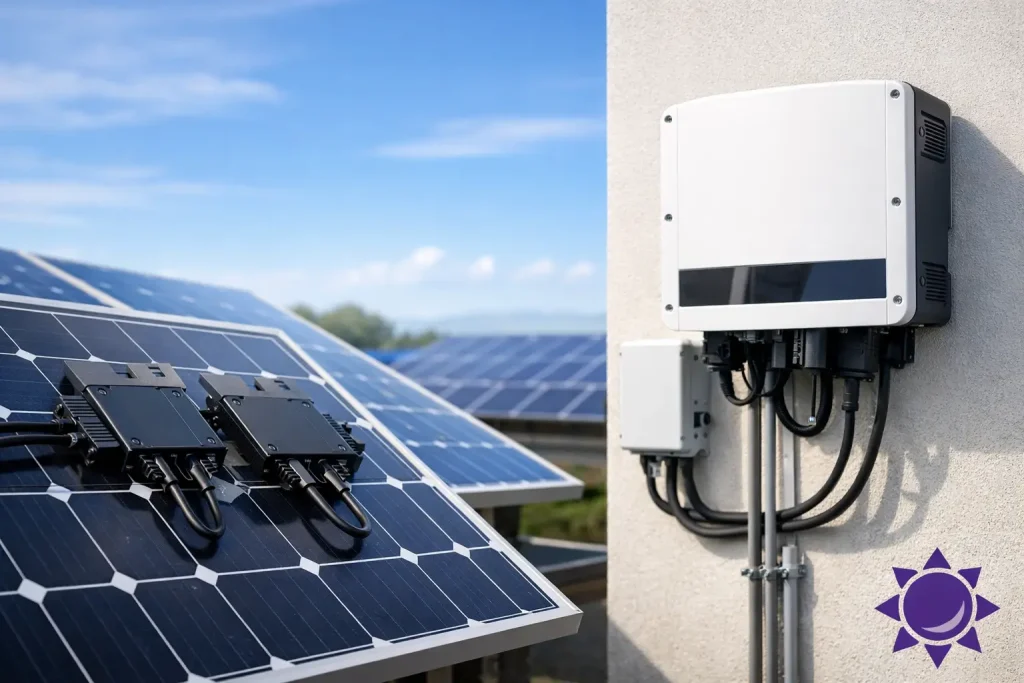
Choice of Micro Inverter Over String Inverter
Solar design decisions rarely fail on headline pricing alone. They fail when the inverter architecture does not match the site. That is why the choice of micro inverter over string inverter deserves a closer look before any commercial, industrial, or residential PV system is approved. On paper, both convert DC to AC. In practice, they behave very differently once shading, roof geometry, maintenance access, monitoring needs, and long-term expansion enter the picture.
Key takeaways
The choice of micro inverter over string inverter usually makes sense when a site has multiple roof angles, partial shading, module-level monitoring requirements, or plans for staged expansion. String inverters remain a strong option for large, uniform arrays where cost efficiency, simpler servicing, and centralized power conversion are priorities. The right decision is rarely about which technology is better in absolute terms. It is about which architecture fits the energy profile, operating conditions, and financial model of the project.
Use photos from Website.
Why the choice of micro inverter over string inverter matters
For a facility manager or property developer, inverter selection affects more than conversion efficiency. It changes how the system performs under mismatch conditions, how faults are diagnosed, how quickly service teams can respond, and how future additions are handled. These factors directly influence energy yield, downtime risk, and operating cost.
A string inverter setup connects multiple modules in series to one central conversion point. It is efficient and widely used, especially in commercial and industrial installations with consistent layout and solar exposure. A micro inverter setup places a small inverter at each module, so every panel operates independently. That independence can be valuable, but it comes at a cost premium and changes how maintenance is managed.
The best specification is not the one with the most advanced component. It is the one that protects project economics over the system life cycle.
How the two architectures behave on real sites
String inverters favor scale and uniformity
If a rooftop has long, unobstructed rows with the same tilt and orientation, string inverters usually deliver strong value. The design is straightforward, equipment cost per watt is generally lower, and service technicians only need to inspect a smaller number of inverter units. For factories, warehouses, and larger commercial buildings, that can simplify both procurement and maintenance planning.
This matters in projects where internal rate of return and payback period are closely watched. Lower upfront inverter cost can improve the business case, particularly when the array design is clean and mismatch losses are limited.
Micro inverters favor complexity and flexibility
Micro inverters perform better when each module may experience different conditions. A roof with skylights, parapet shadows, water tanks, adjacent blocks, or mixed orientation can cause a string to underperform because the weakest module affects the group. A micro inverter reduces that issue by allowing each panel to operate at its own optimum point.
That design also helps in phased projects. If a business plans to add capacity later, module-level conversion can make expansion easier without redesigning string lengths or finding exact electrical matches for an existing string topology.
The real reasons buyers choose micro inverters
Shading and mismatch losses
This is the strongest technical argument for the choice of micro inverter over string inverter. When one area of the roof receives less sunlight due to intermittent shading, dirt loading, or uneven module aging, micro inverters isolate the impact. The rest of the array keeps producing normally.
In a string system, module mismatch can pull down the performance of the connected series path. Modern string inverter designs can reduce some of that impact, especially when paired with optimizers in certain configurations, but the site still needs careful engineering.
Better visibility at module level
For asset owners who care about reporting, diagnostics, and performance assurance, micro inverters offer clear visibility. If one panel underperforms, the issue can often be identified quickly in monitoring software. That can be useful for high-value residential systems and select commercial sites where access is difficult and maintenance needs to be precise.
This level of data becomes more relevant when energy decisions are tied to occupancy patterns, load shifting, or cloud-based performance tracking. It supports a more granular maintenance strategy rather than waiting for a larger drop in string-level output.
Safety on certain rooftops
Micro inverter systems convert power at the module, which can reduce the presence of high-voltage DC runs across the roof. For some owners and consultants, that is a meaningful design preference, particularly on buildings where rooftop safety and fire risk management are central concerns.
That said, safety is not a simple micro versus string debate. Properly engineered string systems can also meet safety requirements when designed and installed to code with the correct protections, shutdown features, and commissioning standards.
Where string inverters still win
The case for string inverters remains strong, especially in commercial and industrial applications.
First, capital cost is usually lower. If the site is suitable for a clean string layout, the savings can be significant across a large array. Second, maintenance is often more centralized. Replacing or servicing one inverter at ground or serviceable level is different from troubleshooting dozens or hundreds of module-mounted devices on a roof. Third, system design and integration can be more efficient at larger scales.
For many factories and commercial buildings, those practical advantages outweigh the performance gains of module-level electronics. A well-designed string system on an unobstructed roof can produce excellent returns with lower complexity.
Trade-offs that should be discussed early
Upfront cost versus lifetime yield
Micro inverters typically increase equipment cost. The question is whether the extra yield from reduced mismatch and better panel-level operation justifies that premium. On a shaded or irregular site, the answer may be yes. On a broad, consistent industrial roof, the answer is often no.
This is why financial modeling matters. The right evaluation compares additional capex against projected annual generation, maintenance assumptions, and downtime exposure over the asset life.
Maintenance access and replacement strategy
Micro inverters distribute electronics across the array. That helps performance but can complicate service access, especially on roofs with limited maintenance clearance. A centralized inverter is easier to locate and replace, even if it creates a larger single point of failure.
Owners should ask not only how often components fail, but how they are accessed, how quickly faults are isolated, and what the replacement workflow looks like in an occupied building.
Monitoring sophistication versus operational needs
More data is not always more value. Module-level monitoring is useful if someone will act on it. For a high-performance home system or a premium commercial project with active energy management, that visibility can support better decisions. For a straightforward self-consumption solar system where monthly savings are the main KPI, string-level monitoring may be enough.
How to decide for commercial and industrial projects
The most reliable approach is to start with the site, not the product category. Evaluate shading patterns across the year, roof segmentation, orientation changes, maintenance access, available installation area, and the client’s reporting expectations. Then test both architectures against the commercial model.
If the project includes battery integration, advanced monitoring, AI-driven energy controls, or staged capacity growth, inverter choice should also be reviewed in the context of the wider energy system. A solar plant is not just a generation asset anymore. It is increasingly part of an operating-cost control strategy.
For this reason, experienced engineering teams often avoid one-size-fits-all recommendations. Amsolar approaches system design from performance, safety, and project economics together, which is the right way to frame this decision for both business and premium residential clients.
Residential projects follow similar logic
Homeowners often hear that micro inverters are automatically better. That is too simplistic. For homes with multiple roof faces, chimney shading, or a desire to monitor each panel, micro inverters can be an excellent fit. For homes with a simple roof plane and strong sun exposure, a string inverter may provide better value.
The decision should also account for future plans. If the owner expects to expand the system later, add batteries, or use home energy management features, the inverter architecture should support that roadmap without unnecessary redesign.
A practical rule of thumb
Choose micro inverters when the roof is electrically messy, shading is real, monitoring needs are detailed, or future expansion is likely. Choose string inverters when the array is large, uniform, serviceability matters, and project economics depend on lower upfront cost.
Neither option is universally superior. The better choice is the one that aligns technical performance with financial return and operational reality.
A solar system should work as designed not just on day one, but through years of weather, load changes, and business growth. The smartest inverter decision is usually the one made after careful engineering, not marketing claims.

2 Comments
Types of Micro Inverters for Plug-In Solar - Amsolar
[…] panel and converts that DC electricity into alternating current, or AC, for household use. Unlike a conventional string inverter, which manages several panels from one central location, a micro inverter works at the panel level […]
Plug In Solar Carport Example for Landed Homes - Amsolar
[…] usable space, this could provide roughly 1.8 kWp to 2.2 kWp of solar capacity. The panels feed a suitable inverter configuration, while generation data is displayed through an app or home energy monitoring […]