
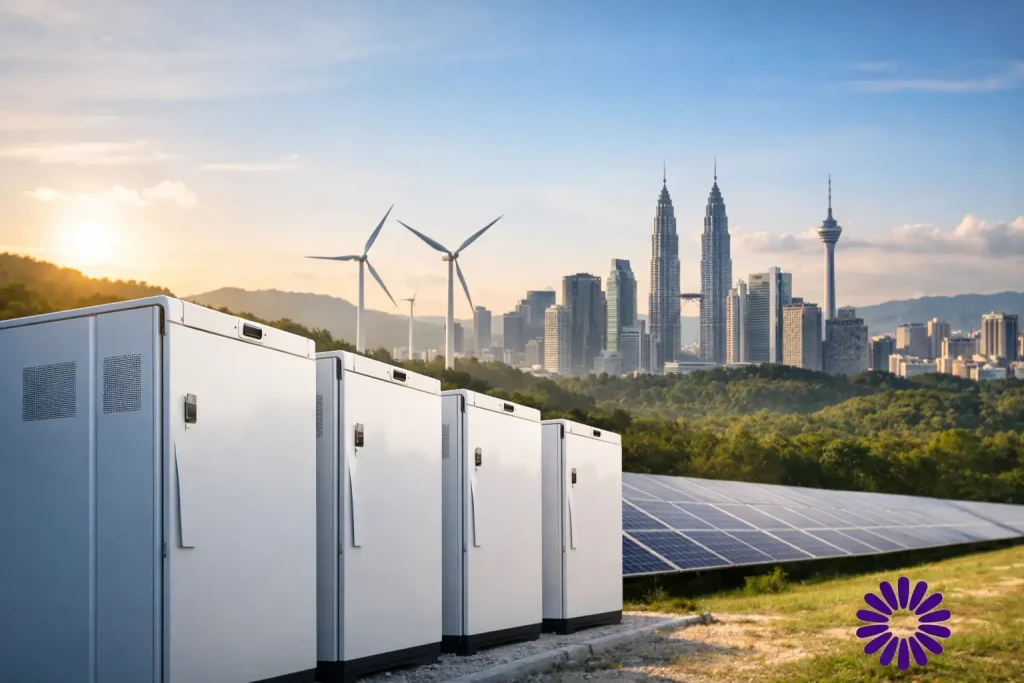
Battery Storage Malaysia for Smarter Energy Costs
Key Takeaways
Battery storage Malaysia is becoming a practical cost-control tool for facilities facing high peak demand, variable electricity usage, or business-critical power requirements. The strongest projects are not sized by battery capacity alone. They are engineered around interval load data, tariff exposure, solar generation, operating hours, and the value of keeping essential loads running.
For commercial and industrial users, a battery energy storage system, or BESS, can reduce peak demand, shift energy use, improve solar self-consumption, and support operational continuity. For homeowners, storage is most valuable where backup capability, evening solar usage, and home energy visibility matter as much as bill savings.
Why Battery Storage Malaysia Is Now a Cost-Control Decision
A factory can produce efficiently all month and still incur disproportionate electricity costs during a handful of high-demand intervals. Chillers starting at the same time, production lines ramping up after a shutdown, compressed-air systems cycling together, or a building’s cooling load rising during the afternoon can create these peaks. Solar PV lowers daytime grid consumption, but it does not automatically remove every demand spike.
That is where battery storage changes the energy strategy. A properly configured BESS can discharge during targeted high-load periods, limiting electricity drawn from the grid when demand is most expensive. It can also store excess solar generation for later use rather than exporting it at a lower value or allowing it to go unused.
The financial case is not identical for every site. A facility with a flat, predictable load may see a different return than one with sharp daily peaks. A business operating primarily at night may prioritize tariff shifting, while a food-processing plant may place greater value on continuity for refrigeration and critical controls. The right decision starts with measured consumption data, not a generic battery size.
For management teams, the question is broader than “How many kilowatt-hours do we need?” It is: which operating events are driving cost, what loads must remain available, and how can energy assets be controlled to improve the site’s financial performance?
Where the Business Case Is Strongest
Battery storage is often most compelling when it solves more than one operational issue. Peak shaving may be the primary driver, but the same asset can increase the value of an existing solar PV system, provide limited backup capability for selected loads, and give operators greater control over when power is imported.
Commercial and industrial facilities should assess several factors together: interval electricity data, maximum-demand patterns, production schedules, existing and planned solar capacity, roof or site constraints, and the cost of downtime. A BESS that is oversized for backup but rarely used for cost optimization may have weak economics. A battery designed only for daily arbitrage may not provide the protection required for a critical process. Engineering must balance these objectives.
The best candidates commonly include manufacturing facilities with recurring load peaks, warehouses with significant cooling demand, hotels and hospitals with essential loads, retail and office portfolios with concentrated daytime consumption, and property developers planning energy-ready buildings. Sites in Penang, Johor, Kelantan, and across Malaysia can have very different load conditions, so regional location matters less than the facility’s actual consumption profile and tariff structure.
For finance leaders, the analysis should include avoided peak-demand costs, expected solar self-consumption gains, battery cycling assumptions, maintenance requirements, degradation over time, and financing structure. A project can look attractive on a simplified savings estimate but underperform if it ignores operating behavior or deploys a control strategy that does not respond to real-time conditions.
Engineering Battery Storage Malaysia for Performance
A BESS is not simply a container of batteries connected beside a solar inverter. It is an integrated system comprising battery modules, a battery management system, power conversion equipment, protection systems, switchgear, communications, and an energy management platform. Each component must be specified for the site’s operating environment, electrical configuration, safety requirements, and intended use case.
The control layer is especially important. A battery that discharges too early can be empty when the site’s actual peak occurs. One that holds charge for backup without a clear reserve policy may miss valuable opportunities to reduce electricity costs. Effective operation requires a defined hierarchy: protect critical loads where required, manage demand limits, absorb available solar energy, and optimize charging and discharging against the facility’s schedule and tariff conditions.
Advanced monitoring makes this measurable. Facility teams need visibility into grid import, solar production, battery state of charge, peak events, discharge history, and estimated savings. Cloud-based reporting can turn a battery from a capital asset into an operating tool, helping managers identify whether production changes, equipment faults, or unexpected usage are affecting energy costs.
AI-enabled energy control can improve these decisions when it is built on accurate site data and clear operating rules. It can forecast likely demand periods and adjust battery readiness accordingly. But technology does not replace engineering discipline. Metering quality, protection coordination, commissioning tests, and grid compliance remain fundamental to dependable performance.
Commercial and Residential Priorities Are Different
For commercial and industrial customers, battery storage should be evaluated as part of a broader energy-cost and resilience plan. The project may involve electrical studies, PV design integration, regulatory submissions, utility coordination, construction planning, testing, and post-commissioning monitoring. Decision-makers should expect a clear model showing projected savings, payback scenarios, IRR assumptions, operating limitations, and the responsibilities of each party.
Capital allocation can be a barrier even where the operating case is strong. BESS as a Service can address this by allowing qualifying businesses to adopt battery storage through a Zero Capex model rather than funding the full asset upfront. The commercial structure still needs careful review. Savings-sharing terms, performance commitments, contract duration, maintenance coverage, and end-of-term arrangements should be transparent.
Residential customers have a different set of priorities. A high-value home may use battery storage to retain more solar power for evening consumption, support selected circuits during an outage, and manage household loads through a home energy management system. The battery should be matched to actual evening use and backup expectations, not just the size of the rooftop PV system.
Homeowners should also distinguish between whole-home backup and essential-load backup. Supporting every air conditioner, water heater, and appliance requires considerably more battery and inverter capacity than maintaining lighting, refrigeration, internet, security, and selected outlets. A well-designed residential system makes those trade-offs clear before installation.
Turning Data Into a Bankable Project Decision
Before selecting a provider, request a site-specific assessment rather than a generic package. The starting point should be at least several months of interval electricity data, supported by a review of operating schedules and any planned expansion. From there, the engineering team can identify peak events, estimate solar charging availability, define critical loads, and propose a battery dispatch strategy.
A credible proposal should explain the battery’s usable capacity, power rating, expected cycles, reserved backup capacity, warranty conditions, safety design, monitoring scope, and assumptions behind projected savings. It should also identify what happens when solar output is lower than expected, when production schedules change, or when the facility exceeds the modeled demand limit.
Amsolar approaches this process as an integrated energy project, combining solar engineering, BESS optimization, energy monitoring, financial modeling, and regulatory support. That integration matters because the battery, solar array, grid connection, and facility load must operate as one coordinated system.
Battery storage delivers its best results when it is treated as an active energy resource, not passive backup equipment. Start with the load profile, define the financial and operational outcome that matters most, and build the control strategy around how the site actually uses power.
