
How to Size Factory Solar for Lower Energy Costs
Key takeaways
- A factory solar system should be sized around daytime electricity demand, not simply the largest available roof area.
- Half-hourly or interval-meter data reveals the load profile needed to prevent excess generation and improve project economics.
- Roof capacity, structural condition, shading, tariff structure, grid requirements, and future expansion plans all affect the final system size.
- Battery storage can improve the value of solar where demand charges, peak consumption, power-quality needs, or energy resilience justify it.
A factory that installs more solar than its operations can absorb may produce an impressive kilowatt-peak figure but a weaker financial return. Knowing how to size factory solar starts with one practical question: when does the facility use electricity, and how much does it use at those times? The answer determines whether solar offsets high-value daytime consumption or creates generation that is less valuable under the applicable grid and tariff arrangement.
For commercial and industrial leaders, solar sizing is an engineering and financial decision. The right system reduces purchased electricity while fitting the building, production schedule, regulatory pathway, and capital plan. It should also leave room for operational changes such as new production lines, electric vehicle charging, or battery energy storage.
Start With the Factory Load Profile
Monthly utility bills provide a useful starting point, but they are not enough to size a serious C&I solar project. A bill shows total kilowatt-hours consumed. It does not show whether the factory draws power at 10 a.m., when solar generation is strongest, or at 8 p.m., after generation has stopped.
A proper assessment uses interval data, ideally in 30-minute or shorter increments, across at least 12 months. This captures production cycles, seasonal shifts, shutdown periods, weekend demand, and major equipment starts. A factory running two daytime shifts may support a larger solar array than a facility with the same annual consumption but predominantly overnight production.
The design team compares the expected solar generation curve with the facility’s demand curve. The goal is high self-consumption: solar electricity should directly offset power that the factory would otherwise buy from the grid. This is usually more valuable and predictable than sizing solely for annual energy totals.
For example, a facility consuming 1,200,000 kWh a year may appear suitable for a 1 MWp system. Yet if its daytime base load falls below 300 kW during weekends and low-production periods, a 1 MWp design may require careful export treatment, curtailment analysis, or battery integration. Conversely, a factory with a stable 800 kW daytime load may have a strong case for a larger installation, subject to roof area and interconnection approval.
Match the Solar System to the Site
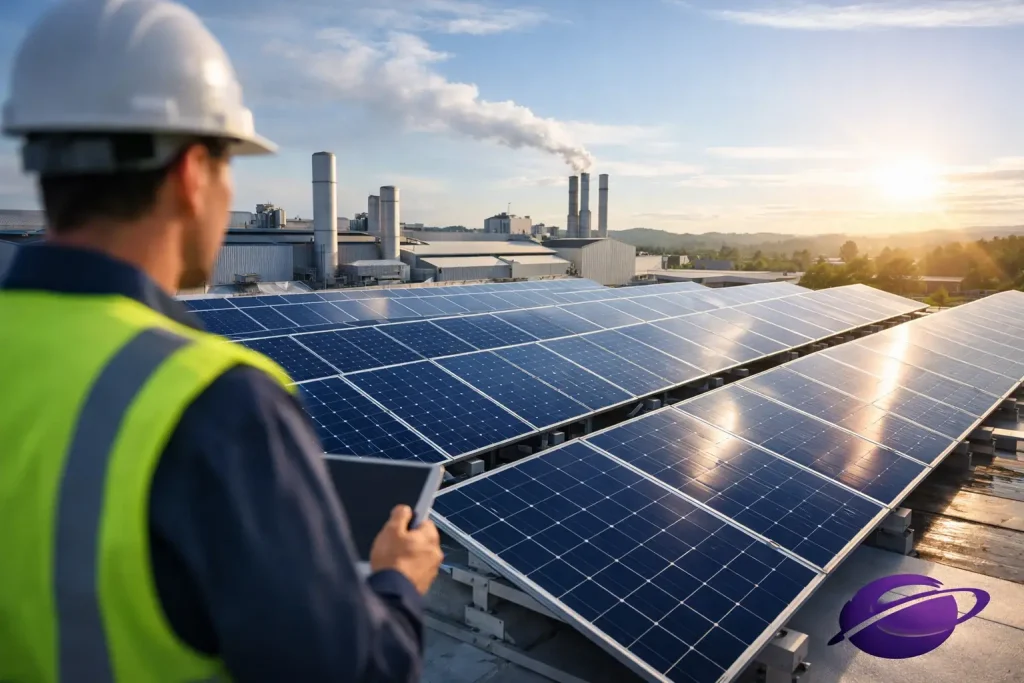
Once the load profile is clear, the next constraint is the physical site. Rooftop solar is often the first option because it uses existing building space and can generate power close to where it is consumed. However, usable roof area is smaller than gross roof area.
Engineers need to account for setbacks, fire access, ventilation equipment, skylights, drainage routes, maintenance walkways, cable paths, and zones that cannot safely support PV loading. Roof orientation and tilt influence output, but they should be evaluated alongside generation timing. A west-facing array, for instance, may generate later in the afternoon and better match a facility with stronger late-day demand.
Structural assessment is equally important. The roof must carry the PV modules, mounting system, ballast where required, wind loading, and maintenance activity. A low-cost design that overlooks roof repairs or structural reinforcement can delay the project and distort the business case. In some cases, a carport, ground-mounted system, or combination of rooftop and other structures creates a better long-term result.
Shading deserves the same level of scrutiny. Water tanks, neighboring buildings, exhaust stacks, trees, and future rooftop additions can reduce output significantly when they shade critical sections of an array. Modern PV design software models these effects before construction, allowing the layout and inverter configuration to be optimized rather than corrected later.
Size for Tariffs, Grid Rules, and Financial Return
The best factory solar size is not always the largest technically possible system. It depends on the electricity tariff, grid export conditions, demand charges, financing approach, and expected degradation of the PV system over time.
Financial modeling should calculate more than estimated annual generation. Decision-makers need to see projected bill savings, self-consumption ratio, demand-charge effects where applicable, payback period, internal rate of return, and cash flow under conservative generation assumptions. The model should also consider roof replacement timing, insurance, operations and maintenance, and expected changes in energy prices.
Grid connection requirements can set another limit. The local utility may require studies, protection settings, export controls, or capacity upgrades before approving a proposed system. In Malaysia, these requirements vary by connection type and program structure, so regulatory submissions should be developed alongside electrical design rather than treated as an administrative task at the end.
A practical approach is to model several sizes. A smaller system may deliver the fastest payback because almost all generation is consumed on site. A larger system may produce greater absolute savings and stronger long-term value if grid conditions allow it. The appropriate choice depends on the company’s capital priorities, risk tolerance, and planned operating horizon.
Decide Whether Battery Storage Changes the Equation
Solar PV reduces daytime energy purchases. A battery energy storage system can store some excess solar generation, discharge during higher-cost periods, reduce peaks, and provide operational support during grid events, depending on the system design and site requirements.
Battery storage is not automatically necessary for every factory. If the facility has a consistent daytime load that absorbs nearly all solar production, PV alone may offer the clearest economics. If the site experiences sharp demand peaks, operates into the evening, faces power-quality concerns, or needs greater resilience for critical processes, battery storage can materially improve the outcome.
The battery should be sized separately from the PV system. Its power rating in kilowatts determines how quickly it can charge or discharge. Its energy capacity in kilowatt-hours determines how long it can sustain that output. A battery designed only around solar excess may be too small to manage a major demand peak, while a battery designed for backup may need different controls and reserve capacity.
This is where monitoring, adaptive power control, and AI-driven energy management add value. Rather than following a fixed schedule, the system can respond to live load, solar generation, tariffs, and battery state of charge. For factories with variable production, that control layer can protect savings that a static design would miss.
Build Expansion Into the Design
Factory energy demand rarely stays fixed. New machinery, larger refrigeration loads, automation upgrades, or a second production shift can change the solar opportunity within a few years. A system sized only for current consumption may be appropriate, but the design should preserve options for growth.
That may mean reserving roof zones, allowing space in electrical panels, selecting inverter architecture that supports expansion, or planning a future battery connection point. It also means installing accurate monitoring from day one. Without clear visibility of solar production, grid import, demand peaks, and consumption by major load, the business cannot verify savings or identify the next energy improvement.
Amsolar approaches factory solar sizing as a complete energy project: site engineering, PV design, financial analysis, grid commissioning, monitoring, and optimization must work as one plan. The final capacity should be defensible in the boardroom and dependable on the factory floor.
Before committing to a system size, ask for a model based on real interval data and realistic operating assumptions. A solar system that fits the way your factory actually uses power will continue to create value long after the installation is complete.

1 Comment
Integrating Solar Into Warehouses That Pay - Amsolar
[…] warehouse, even when the buildings appear similar from the outside. That distinction affects system sizing, projected savings, and the case for energy […]