
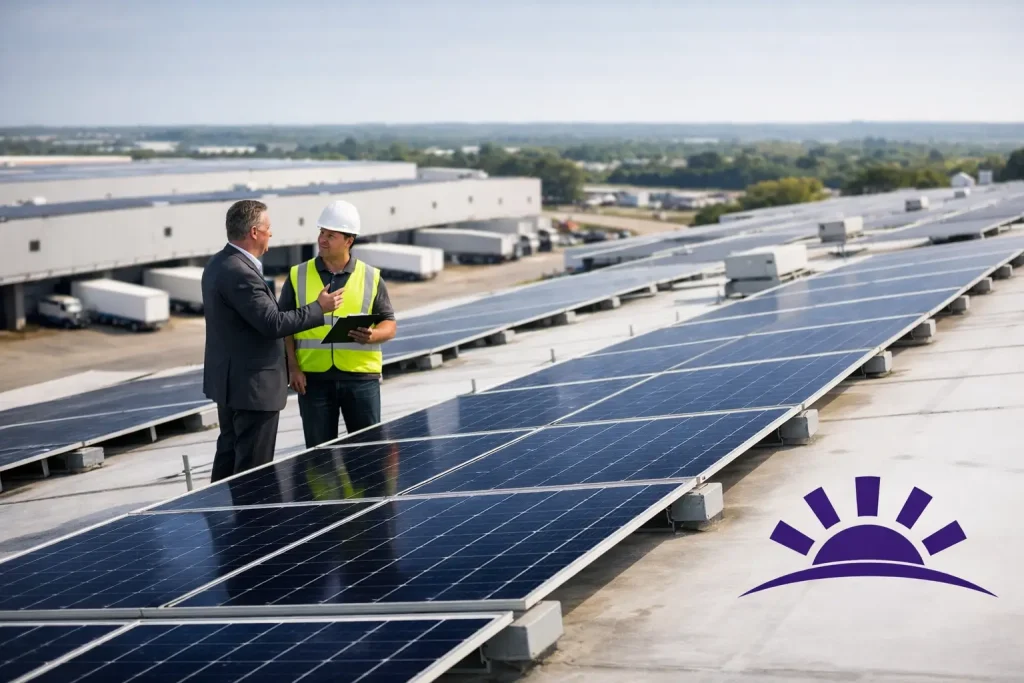
Integrating Solar Into Warehouses That Pay
Key takeaways: Warehouse roofs can become productive energy assets when solar design starts with the building’s load profile, roof condition, and operating schedule. The strongest business case is not simply maximum panel capacity – it is a system engineered to reduce the most expensive electricity use while maintaining safe, measurable performance. Batteries, monitoring, and adaptive controls can add value where demand peaks, operating hours, or resilience needs justify them.
A warehouse can carry a large electricity bill long before a new machine is installed. Lighting, ventilation, cold storage, conveyors, charging equipment, office loads, and expanding automation all draw power across a broad footprint. For many operators, integrating solar into warehouses is therefore less about making a sustainability statement and more about controlling a material operating cost with an asset that sits on the roof.
The opportunity is substantial, but warehouse solar is not a one-size-fits-all rooftop exercise. A successful project must account for structural constraints, electricity consumption patterns, roof access, shading, safety, and long-term maintenance. The system should serve the facility’s commercial objectives, not merely fill every available square foot with modules.
Start With the Warehouse Energy Profile
The first question is not, “How many panels fit on the roof?” It is, “When does this facility consume the most electricity, and what does that electricity cost?” A warehouse operating primarily through daylight hours can often consume solar generation directly, increasing the value of each kilowatt-hour produced. Facilities with refrigeration, extensive material handling, or high daytime loading can be particularly well aligned with solar output.
A proper assessment reviews interval consumption data, seasonal operating changes, peak demand periods, planned expansion, and the equipment responsible for major loads. A distribution center may have a different load shape from a temperature-controlled warehouse, even when the buildings appear similar from the outside. That distinction affects system sizing, projected savings, and the case for energy storage.
Oversizing a system without understanding its production-to-consumption relationship can weaken returns. Conversely, sizing too conservatively may leave cost-saving potential on the table as electric forklifts, automation, or cooling capacity grow. Financial modeling should test realistic scenarios, including energy price movement, anticipated load growth, system degradation, and the expected return over the asset’s operating life.
Design the Roof as an Operating Asset
A warehouse roof is valuable real estate, but not every roof is immediately ready for solar. Engineering teams need to examine roof age, membrane condition, load capacity, drainage paths, penetrations, access routes, and areas required for maintenance. Addressing these factors early prevents an installation from creating avoidable repair costs or interrupting warehouse operations later.
Shade matters as well. Nearby structures, rooftop equipment, parapets, and future building additions can reduce production in ways that are not obvious from ground level. Detailed site analysis helps determine module layout, equipment placement, cable routing, and whether the site benefits from a particular system configuration.
The design also has to preserve warehouse operations. Installation schedules should account for delivery traffic, stock movement, loading-bay activity, and safety controls around the building. The best EPC approach coordinates procurement, construction, testing, and commissioning as one managed scope, reducing handoffs that can cause delays or unclear accountability.
For roof owners with aging surfaces, solar timing matters. Re-roofing before installation may increase the upfront project cost, but it can reduce the risk of dismantling and reinstalling the array in the near future. The right decision depends on the roof’s remaining service life and the economics of completing related work together.
Integrating Solar Into Warehouses With Storage and Controls
Solar production follows daylight, while warehouse demand may spike in the morning, late afternoon, or during equipment-intensive shifts. That is where battery energy storage and intelligent controls become relevant. They are not automatic additions to every project, but they can improve the value of solar where electricity costs rise sharply during peak periods or where a facility needs more predictable energy use.
A battery can store surplus solar energy for later use, reduce short-duration demand spikes, and support selected critical loads during outages. The practical value depends on battery size, charging strategy, load volatility, and the site’s energy cost structure. A battery that is too small may have little effect on major peaks; one that is too large can dilute financial returns if it is underused.
AI-driven energy cost control adds another layer of discipline. Instead of treating solar, batteries, and building loads as separate systems, smart controls can forecast generation, monitor demand, and optimize when the battery charges or discharges. Adaptive power control can also help operators prioritize high-value loads when the facility is approaching an expensive demand threshold.
This is why monitoring should be part of the project scope from the beginning. Cloud-based reporting gives operations and finance teams visibility into generation, consumption, battery status, avoided energy costs, and system performance. It turns solar from a capital project that is reviewed once a year into an actively managed component of warehouse energy strategy.
Measure Performance After Commissioning
Commissioning is the point at which a solar system begins to prove its value, not the end of the work. The system should be tested against design expectations, with clear baselines for expected production and visibility into the warehouse’s actual consumption. If output drops, monitoring can identify whether the cause is weather, soiling, equipment performance, shading, or an operational change inside the building.
Ongoing performance management is especially useful for multi-site operators. Comparable reporting across facilities can show which rooftops are producing as expected, which buildings have the strongest future storage opportunity, and where operational loads have changed enough to warrant a revised energy strategy. It also gives finance teams a cleaner view of savings against the original business case.
Amsolar approaches this through integrated engineering, financial analysis, commissioning, energy monitoring, and optimization rather than treating the rooftop array as an isolated installation. The goal is measurable cost control supported by system data, qualified execution, and decisions that remain commercially sound after the panels are energized.
Warehouse solar works best when it is planned around how the building actually earns money: through reliable throughput, controlled operating costs, and room to grow. Start with the load, validate the roof, and build a system that can be measured and managed long after installation day.
