
Smart Meter Selection Review for Home Solar
Key Takeaways
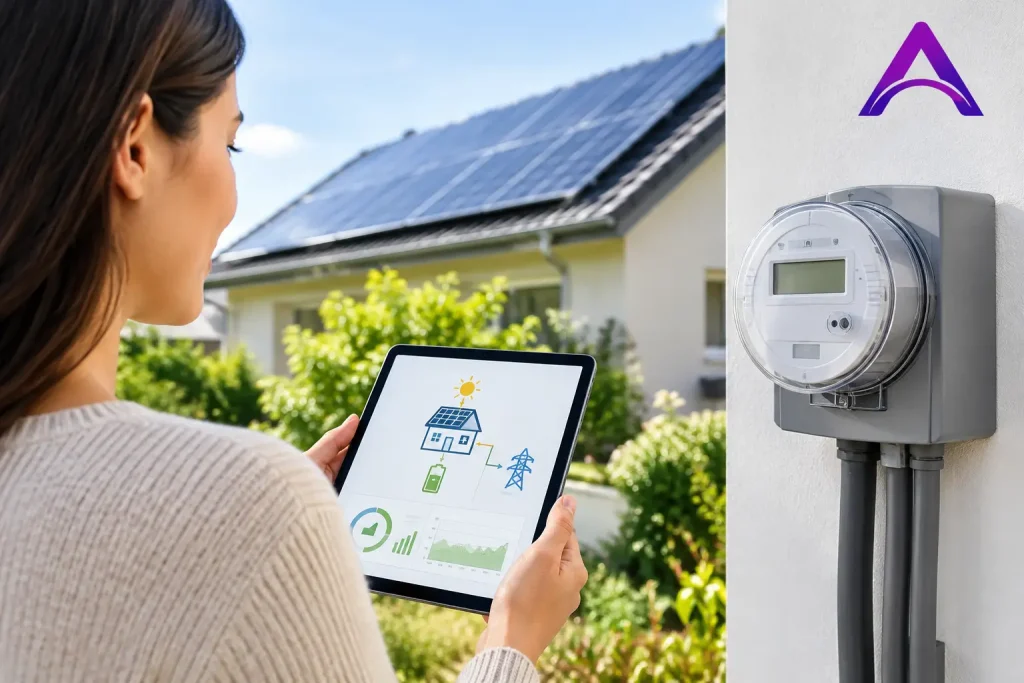
A smart meter is the measurement layer behind a useful home energy strategy. For landed homeowners adding plug-in solar on a balcony or car porch, this smart meter selection review comes down to four decisions: match the meter to the home’s electrical phase, choose accuracy that supports real decisions, confirm it can measure import and export separately, and make sure its data works with the energy management system you intend to use.
The least expensive meter is not always the best value. A device that only shows total consumption can be helpful, but it cannot explain when solar production is being used, when the home is drawing power from the grid, or which loads are creating the evening peak. Select the meter for the question you need it to answer, not just for the dashboard it offers.
Start With the Energy Decision You Want to Make
A smart meter should do more than turn a household’s electricity use into another screen to check. It should help the homeowner make a practical operating decision: run an appliance during solar hours, identify a load that is consuming more than expected, or see whether a battery would have a meaningful role in the home.
For a small plug-in solar setup, monitoring total household demand is often the most valuable starting point. It shows whether daytime production is offsetting active loads such as air conditioning, refrigeration, pumps, kitchen appliances, and home-office equipment. If solar output is present but consumption remains high, the meter reveals the gap between generation and actual savings.
A more detailed setup can measure individual circuits. This is useful for larger landed homes or households with clearly separate high-demand loads. Circuit-level monitoring can isolate an air-conditioning distribution board, an electric vehicle charger, or a water heater. The trade-off is higher installation complexity and more data to manage. It is worthwhile when the homeowner intends to act on that detail, rather than simply observe it.
Smart Meter Selection Review: Accuracy and Measurement Type
Accuracy affects confidence in every decision that follows. A meter with poor low-load performance may miss the steady consumption of always-on devices. A meter that updates slowly can hide short demand spikes. Neither issue necessarily makes a device unusable, but both limit its value for optimizing solar self-consumption.
For home energy management, choose a meter designed to measure active power, energy consumption in kilowatt-hours, voltage, current, and power factor. It should display data at a useful interval, ideally close to real time. Fast, stable readings help homeowners see the immediate effect of switching a load on or off.
The most critical capability is bidirectional measurement. The meter needs to distinguish electricity imported from the grid from electricity flowing in the opposite direction. Without this distinction, total usage figures can look plausible while giving an incomplete picture of how solar energy is moving through the home.
Current transformer, or CT clamp, meters are common because they can be installed around existing conductors without major rewiring. Their suitability depends on correct sizing, orientation, and installation. A clamp placed incorrectly can reverse the direction of power flow in the app, while an undersized clamp may reduce accuracy during high-demand periods. Engineering-led installation matters as much as the meter specification.
Match the Meter to Your Electrical Supply
Before selecting a model, establish whether the property has single-phase or three-phase electrical supply. This is not a minor technical detail. A single-phase meter installed on a three-phase home will only capture part of the household’s energy behavior unless it is paired with additional measurement equipment.
Many compact urban homes use single-phase supply, while larger landed properties may use three-phase supply to support greater air-conditioning capacity and heavier equipment. A three-phase smart meter should measure each phase independently and show whether loads are balanced. An imbalance may not be noticeable on a monthly bill, but it can affect how effectively solar generation aligns with household demand.
Also consider the main distribution board layout. The meter must be positioned where it can observe the loads that matter. If the goal is to understand whole-home electricity use, place monitoring at the main incoming supply. If the goal is to monitor a dedicated solar circuit or a specific appliance group, a submeter may be appropriate. These are different use cases, and one device does not automatically replace the other.
Choose Connectivity That Will Still Work After Installation
A smart meter is only smart if its readings remain available. Wi-Fi-connected meters are practical for many homes, particularly where the distribution board is close to reliable coverage. However, a metal cabinet, a concrete wall, or a distant car porch can weaken the signal enough to create missing data.
Assess connectivity before installation. If Wi-Fi at the board is weak, a network extender or an alternative communications method may be needed. It is better to solve that issue at the design stage than to discover that the meter drops offline after the installer leaves.
The platform matters too. Look for clear historical views by hour, day, month, and billing period. Data should show consumption, solar production where applicable, grid import, and export as separate values. A good dashboard turns a chart into an answer: how much electricity did solar cover during the day, and when did the household return to grid dependence?
For homeowners using a Tuya-based Home Energy Management System, compatibility should be verified at device level. Products may share a familiar app ecosystem but still differ in data fields, update intervals, automations, and integration behavior. A meter that can trigger practical actions, such as shifting a controllable load toward solar hours, has more long-term value than one that only reports consumption.
Build for the Next Energy Upgrade, Not Just Today’s Solar Panels
A meter chosen for plug-in solar can become the foundation for a broader energy system. If you expect to add more solar capacity, battery storage, an electric vehicle charger, or automated load control, select equipment and a monitoring architecture that can scale without starting from zero.
That does not mean every household needs an advanced meter from day one. A simple whole-home, bidirectional meter is often the right first step for a homeowner testing the value of plug-in solar. It provides a baseline, exposes daytime demand, and creates evidence for the next investment.
For homes with substantial evening consumption, a more capable monitoring system can support battery analysis. The meter’s load profile shows how much energy is needed after solar generation falls and whether storage could reduce costly grid use at the times that matter. This is where monitoring becomes an input to financial modeling rather than a lifestyle gadget.
Amsolar approaches energy monitoring as part of system performance, not as an accessory added after installation. The right meter, correctly installed and connected to a usable reporting platform, gives homeowners a clearer view of what their solar system is delivering and what the home still needs.
Choose the meter that makes your next energy decision easier. Clear measurement today creates better solar, storage, and load-management choices tomorrow.
