
Best Plug In Solar Kits for Smarter Energy Use
For facility teams looking at the best plug in solar kits, the first question should not be which panel has the highest wattage. It should be whether a plug-in system fits the load profile, electrical infrastructure, and operating objective of the site. A small kit can be useful for selected low-demand applications, but it is not a substitute for engineered solar, battery storage, and energy controls in a high-consumption operation.
Key Takeaways
- Plug-in solar kits are best suited to simple, limited-load applications where installation flexibility matters more than large-scale energy savings.
- The right kit depends on usable solar production, inverter quality, electrical compatibility, monitoring capability, and the load it is intended to support.
- For factories, hospitals, malls, data centers, and production sites, a properly engineered PV and energy-management solution delivers far greater value than multiple small plug-in units.
- Monitoring is not an optional extra. Without production and consumption data, it is difficult to verify savings or identify avoidable energy costs.
What Makes a Plug-In Solar Kit Worth Considering?
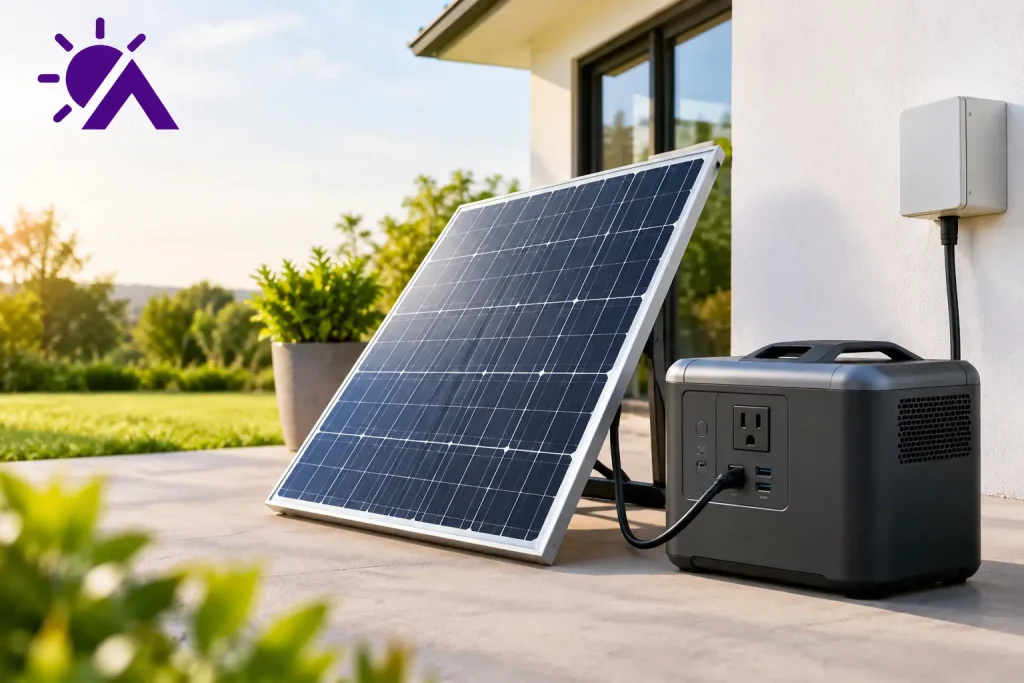
A plug-in solar kit generally combines one or more photovoltaic panels with a compact inverter, mounting hardware, cabling, and sometimes an energy monitor or small battery. Its appeal is clear: it offers a relatively accessible way to generate electricity close to where it is used, without the scale or construction effort of a full rooftop solar system.
The best kits are not simply the ones with the largest advertised output. Their practical value depends on panel quality, inverter conversion efficiency, heat performance, mounting stability, and how well the system matches the energy demand during daylight hours. A kit that produces power when the connected load is low will have a weaker financial result than one designed around a predictable daytime load.
For small offices, guardhouses, remote equipment areas, site cabins, lighting circuits, or low-load auxiliary spaces, a plug-in system can be a sensible starting point. It can also help an operations team understand real-time solar generation and consumption before considering a larger deployment.
The limitation is scale. A site with substantial equipment loads, refrigeration, pumps, compressed air, HVAC systems, or process machinery needs more than a compact solar kit. Those facilities require engineering around load behavior, roof structure, electrical distribution, demand peaks, power quality, and future expansion.
How to Compare the Best Plug In Solar Kits
Start with the output you can realistically use, not the output printed on the box. Panel capacity is expressed in watts, but actual generation changes with solar exposure, panel orientation, shading, temperature, dirt accumulation, and inverter performance. In hot climates, heat can materially affect solar-panel output, making equipment selection and installation design more significant than headline wattage alone.
The inverter deserves the same attention as the panel. It converts DC power from the modules into usable AC electricity, and it influences system safety, efficiency, monitoring, and long-term reliability. Look for an inverter with clear performance data, dependable thermal management, fault detection, and app or platform-level visibility. Low-cost equipment that cannot report production data may appear attractive initially, but it limits the ability to prove savings or identify a fault quickly.
Mounting is another practical differentiator. A panel may perform well in ideal test conditions yet underperform when installed at a poor angle, exposed to intermittent shade, or secured with unsuitable hardware. Wind exposure, waterproofing around rooftop installations, cable protection, and service access should all be considered before purchase.
Finally, assess whether the kit can be monitored alongside the facility’s wider electricity consumption. A solar production figure on its own does not show the business impact. The useful metric is how much grid electricity the solar generation displaces at the time the facility needs it.
When Plug-In Kits Fall Short for Commercial Sites
Plug-in solar kits can reduce a small portion of daytime consumption, but they do not address the energy challenges that typically drive costs in commercial and industrial sites. High bills are often shaped by the timing of loads, short-duration peaks, reactive power behavior, poor visibility across equipment, and the gap between solar production and consumption.
A manufacturing plant, hospital, shopping center, mining operation, or data center cannot manage its energy strategy through isolated plug-in devices. These environments need an integrated approach that connects solar production with site demand, battery dispatch, power quality, and live performance data.
For example, solar generation may be strong at midday while a site’s most expensive operating periods occur at different times. Without battery storage or intelligent load management, a solar-only installation may not deliver the level of cost control the business expects. Similarly, a facility with power factor issues may continue to carry unnecessary energy costs even after adding solar capacity.
This is where an engineered system changes the discussion. Instead of asking how many panels can be plugged in, the better question is: what combination of PV, battery energy storage, reactive energy management, and monitoring will produce measurable operating value?
From Solar Generation to Active Energy Control
A mature energy strategy treats solar as one component of a controlled system. On-site PV reduces daytime grid consumption. Battery energy storage can shift available energy to periods when it has greater value. Monitoring provides the operational data needed to verify results and spot abnormal consumption. Advanced control can respond to changing site conditions rather than relying on fixed assumptions.
For high-usage sites, this approach is more relevant than selecting from the best plug in solar kits because it aligns the investment with operational reality. It also creates a clearer path for staged implementation. A business can begin with load analysis and monitoring, deploy solar where it offers the strongest return, then evaluate battery storage and power-quality solutions based on measured performance.
Amsolar applies this engineering-led model through solar design, energy monitoring, battery optimization, financial modeling, and AI-driven control capabilities. Its eCOS platform is designed to give operators better visibility of consumption patterns and support more responsive energy decisions. Where reactive energy is affecting performance, static VAR generation can also form part of the solution.
The objective is not to install the most equipment. It is to reduce avoidable energy costs while improving the predictability and resilience of how electricity is used.
A Better Starting Point for High-Consumption Operations
If a plug-in solar kit is being considered for a commercial site, use it as a narrow application rather than a facility-wide answer. Define the equipment or area it will serve, estimate its daytime load, confirm the physical installation conditions, and ensure production can be measured against actual consumption. That turns a small solar project into a useful source of operational insight rather than an isolated asset.
For larger facilities, begin with an energy assessment that maps interval consumption, peak demand behavior, solar potential, power factor conditions, and battery opportunities. This provides a more credible basis for deciding whether a compact kit, a rooftop PV system, battery storage, or an integrated energy-control strategy will create the strongest business case.
The best result is rarely the smallest or fastest installation. It is the system that gives your team clear visibility, measurable savings, and the control to make every unit of generated energy work harder.
