
Best Solar Inverters for Commercial Energy Control
Key takeaways
- The best solar inverter is rarely the highest-rated unit on a datasheet. It is the one sized and configured around a facility’s load profile, operating hours, power quality, and expansion plans.
- String inverters often suit distributed commercial rooftops, while central inverters can make sense for larger, uniform utility-scale arrays. Both require careful engineering.
- For factories, hospitals, data centers, and high-demand sites, inverter monitoring must work alongside energy monitoring, maximum demand control, and battery strategy.
- Inverter selection should consider serviceability, grid behavior, thermal conditions, communications capability, and lifetime energy yield – not purchase price alone.
A production line can lose more value from a poorly controlled energy profile than it gains from choosing a lower-cost inverter. That is why the best solar inverters for commercial and industrial sites are not selected as standalone hardware. They are selected as part of an engineered energy system that must perform under changing loads, high daytime consumption, heat, shading, and grid events.
For a facility manager, the question is not simply, “Which inverter brand is best?” A more useful question is, “Which inverter architecture will deliver dependable generation while helping us control energy cost and operational risk?” The answer depends on the site.
What makes a solar inverter right for a commercial site?
A solar inverter converts DC electricity from PV modules into AC electricity that a building can use. In a commercial setting, its role is more demanding than simple conversion. It must coordinate with the site’s electrical distribution, respond appropriately to grid conditions, maintain high conversion efficiency across a changing generation range, and provide data that operators can act on.
The first selection factor is the facility’s daytime load. A factory with stable daytime production can often consume most solar generation directly. A shopping center may have a more variable air-conditioning load. A hospital or data center has critical loads and a lower tolerance for interruptions or uncontrolled electrical behavior. Each profile changes the preferred inverter capacity, configuration, and control logic.
DC-to-AC ratio also matters. Oversizing the PV array relative to inverter AC capacity can increase energy harvest during lower-light periods, but excessive oversizing can create more clipping during peak generation. There is no universal ratio that is automatically correct. The design should model irradiance, module orientation, temperature, expected degradation, and the facility’s actual load interval data.
Electrical quality is equally relevant. Sites with inductive equipment, motors, welding loads, pumps, compressors, or large HVAC systems may face poor power factor, voltage fluctuations, or maximum demand pressure. Solar generation helps reduce imported energy, but it does not automatically solve every power quality issue. In many cases, the best outcome comes from coordinating PV inverters with static var generation, reactive energy management, and site-level monitoring.
Best solar inverters: string vs. central designs
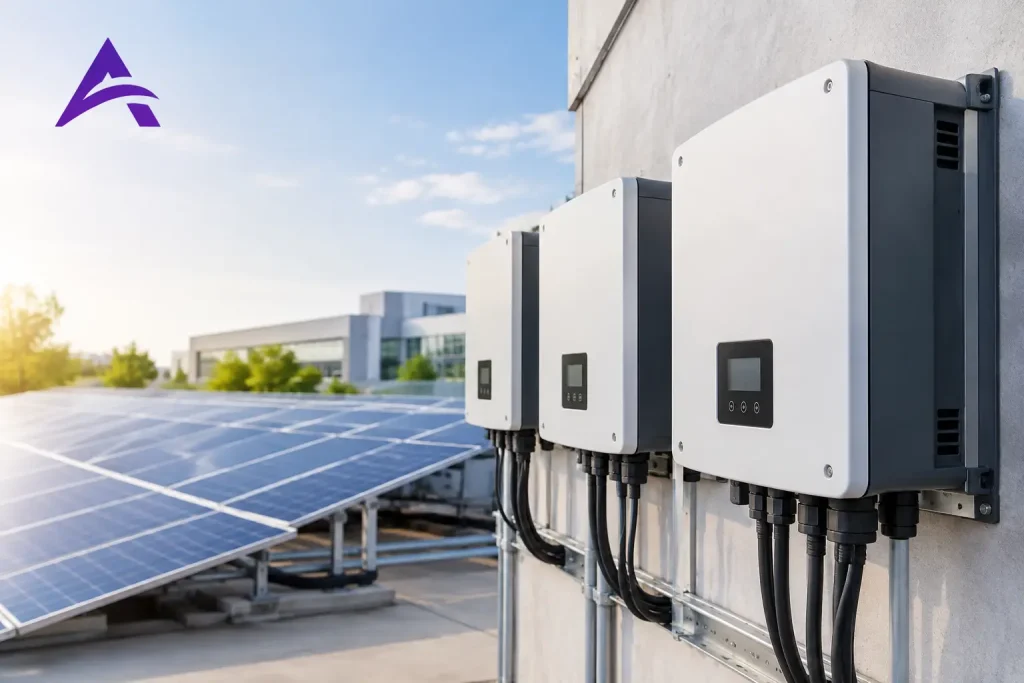
For most commercial rooftops, string inverters are the practical default. They divide the PV field into multiple smaller conversion units. This approach can simplify installation on complex roofs, support multiple orientations, and reduce the impact of partial shading or a single equipment failure. If one string inverter requires service, the rest of the system can often continue generating.
String inverter designs are particularly useful for facilities with roof obstructions, separate buildings, varied roof pitches, or phased solar deployment. Their distributed layout can also shorten DC cable runs when equipment placement is well designed. The trade-off is that a large system may have many units to inspect, monitor, and maintain. Good fleet-level visibility is therefore essential.
Central inverters consolidate conversion capacity into larger equipment blocks. They can be effective for large, uniform solar fields where the array layout, access routes, and electrical infrastructure support a centralized design. Fewer units can simplify certain maintenance tasks, but a central inverter outage affects a larger share of generation. The system must be designed with appropriate availability expectations and service planning.
There is also a middle ground: high-capacity commercial string inverters deployed in a modular architecture. This can provide substantial capacity while retaining redundancy and flexibility. It is often a strong fit for manufacturing campuses, warehouses, processing plants, and retail properties where rooftop conditions vary by building.
The correct choice is not a brand contest. It is an engineering decision based on layout, generation targets, criticality of supply, maintenance access, and the financial value of uptime.
Monitoring and controls are part of inverter performance
An inverter that produces energy but cannot explain its performance is difficult to manage at scale. Commercial owners need more than a monthly generation total. They need visibility into generation by inverter, string-level behavior where applicable, fault histories, temperature trends, availability, and the relationship between solar output and facility demand.
This is where inverter data must connect to broader energy intelligence. A site may generate strongly at noon yet still experience costly demand peaks at other times. It may have high solar output but poor power factor caused by process equipment. It may export energy at low value while importing during expensive periods. Looking at the inverter in isolation hides these operational patterns.
Amsolar approaches this through integrated monitoring and AI-driven energy cost control. The goal is to combine PV generation data with electricity usage, battery status, and load behavior so operating decisions are based on the full energy picture. For sites with battery energy storage, inverter and battery controls must be coordinated carefully. The battery should charge, discharge, or hold capacity according to the site’s priorities, rather than following a fixed schedule that ignores real-time demand.
Communications compatibility deserves close attention during procurement. Confirm which protocols are available, how data is retained, whether alarms can be escalated, and whether the inverter can work with the site’s supervisory monitoring platform. A lower-priced inverter can become expensive if it creates a data gap or requires manual troubleshooting across multiple buildings.
How to evaluate inverter value beyond the quote
Efficiency ratings matter, but they are only one component of lifetime value. A small difference in conversion efficiency can be meaningful over decades, yet it should not outweigh poor service access, inadequate thermal design, limited communications, or weak local support.
Start with the operating environment. Malaysian commercial rooftops and outdoor electrical areas experience high heat, humidity, and heavy rainfall. Equipment enclosures, cooling design, corrosion resistance, installation clearances, and cable management affect reliability. An inverter must be installed where technicians can safely access it without disrupting operations or exposing equipment to avoidable heat and water risks.
Then assess availability. Ask how quickly faults can be diagnosed, what spare-part strategy is proposed, whether replacement units are accessible, and how the contractor will verify performance after commissioning. The best solar inverter on paper cannot deliver its modeled savings if it remains offline while a fault waits for attention.
Financial evaluation should also include expected energy yield, downtime assumptions, degradation, maintenance cost, and the interaction with demand charges and battery operations. A system with a slightly higher upfront cost may produce stronger lifetime returns if it reduces outages, improves self-consumption, or supports better maximum demand management.
Finally, do not separate inverter selection from system design. Module strings, DC protection, AC switchgear, transformer capacity, cable losses, earthing, surge protection, and monitoring architecture all influence performance. Commercial solar is an electrical asset, not a rooftop appliance.
For high-usage facilities, the right inverter decision creates a platform for more than solar production. It gives the business clearer energy visibility, better control over operational costs, and a practical path to add storage and advanced power management when the load profile demands it.
