
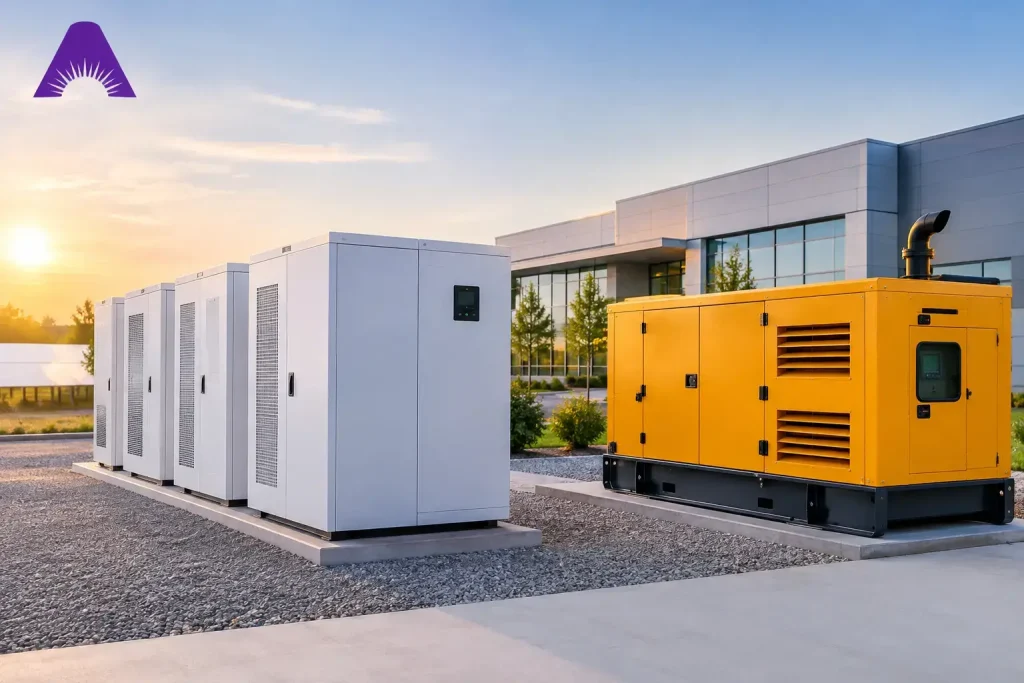
Energy Storage Versus Generators for C&I Sites
Key takeaways
For commercial and industrial facilities, energy storage versus generators is not simply a backup-power decision. Batteries can reduce maximum demand, respond within milliseconds, and optimize daily energy costs. Generators provide long-duration emergency power, but they depend on fuel, maintenance, and start-up time. In many high-load operations, the strongest design combines both assets under intelligent control.
A factory’s most expensive power events are often brief: a production line starts, a chiller bank ramps up, or several large motors run at once. Those short peaks can set the facility’s maximum demand charge for the billing period. A generator may keep critical loads alive during an outage, but it is rarely the most efficient tool for managing those recurring, minute-by-minute operating costs.
Energy Storage Versus Generators: The Operating Difference
Battery energy storage systems, or BESS, store electricity for controlled use later. They can charge from solar, the grid, or both, then discharge almost instantly when site load crosses a defined threshold. For sites with fluctuating demand, this makes battery storage a practical asset for peak shaving, load shifting, solar self-consumption, and short-duration resilience.
Generators convert fuel into electricity when needed. Their traditional role is emergency standby power for essential loads, particularly during utility interruptions. A well-sized genset can operate for many hours or days when fuel logistics are available, making it valuable where outages may be prolonged or where continuity of critical operations cannot depend on battery duration alone.
The response profile is different. A battery can react in milliseconds, allowing it to cover sudden load spikes before they become a demand event. A generator needs time to start, stabilize, and accept load. For a data center, hospital, precision manufacturing line, or automated processing plant, that gap matters. Batteries can bridge the transition while a generator starts, preventing interruption to sensitive equipment.
Where Batteries Deliver the Stronger Financial Case
For high-electricity users, a BESS is usually evaluated first as a cost-management asset, not just an outage asset. Its value comes from using stored energy at the right time, rather than buying every kilowatt from the grid at the moment demand is highest.
Maximum demand management is the clearest example. When a facility approaches its agreed demand threshold, a battery can discharge for 15 minutes, 30 minutes, or longer depending on system design. This lowers the peak seen by the grid without forcing operations teams to delay production, reduce cooling, or manually shed loads.
Solar integration adds another layer of value. Many industrial sites produce solar energy when daytime demand is already high, but not always when the load profile is at its peak. A battery can retain excess solar generation for a later production shift, evening cooling load, or a planned demand-management window. This improves solar utilization and reduces unnecessary export or curtailed generation.
Battery storage also supports power quality when paired with the right electrical design. Facilities with large motors, welding equipment, variable-speed drives, compressors, or nonlinear loads may experience reactive energy challenges and poor power factor. A battery is not a substitute for specialized reactive power equipment, but an integrated energy strategy can coordinate BESS dispatch, monitoring, and static var generation to improve how the facility consumes power.
The financial case depends on the site’s load data. A battery with no clear peak window may sit underused. Conversely, a plant with repeated demand spikes, predictable shift changes, or high daytime solar production may generate value every working day. This is why interval data analysis, demand profiling, and financial modeling should come before equipment selection.
When Generators Are Still Essential
Generators remain the right answer for long-duration backup. A battery system sized economically for peak shaving may support critical loads for minutes or a few hours, not an extended utility disruption across an entire facility. Expanding battery duration is possible, but the capital requirement rises with every additional hour of stored energy.
A generator can sustain selected critical loads as long as fuel is supplied. For hospitals, cold storage, remote production facilities, mines, and operations with life-safety or process-critical loads, that endurance can be non-negotiable. The key is to distinguish between the loads that must remain online and the loads that can be paused safely.
Generators also make sense where outages are infrequent but potentially lengthy, and where demand charges are not a major cost driver. In that situation, installing a large battery only for rare emergency use may not deliver an attractive return. A properly maintained generator can provide dependable contingency power at a lower upfront cost.
That said, generator ownership carries ongoing obligations: fuel management, regular testing, mechanical servicing, emissions considerations, noise control, and the risk of fuel deterioration during long standby periods. A generator that has not been tested under real load is not the same as a generator that is ready for a critical event.
The Best Design Is Often Battery Plus Generator
The choice does not have to be either-or. A hybrid design assigns each asset the job it performs best. The battery handles fast-response demand control, solar shifting, short interruptions, and the transfer period before backup generation is available. The generator provides endurance for extended outages and protects the most critical operations when battery reserves are depleted.
This arrangement can also reduce generator stress. Instead of forcing a generator to accept a large, sudden motor load, the battery can absorb the first surge and smooth the load ramp. The generator then operates more steadily, which may improve performance and reduce unnecessary cycling.
For facilities with multiple priorities, controls are as important as hardware. An AI-driven energy management platform can monitor live load, solar output, battery state of charge, tariff periods, and facility demand limits. It can then decide whether to charge, discharge, reserve capacity for resilience, or coordinate backup power according to operating priorities.
Amsolar applies this approach through engineering-led BESS design and its eCOS energy control platform, aligning battery dispatch with actual site behavior rather than a fixed schedule. The objective is measurable: lower avoidable demand exposure, improve energy visibility, and preserve power availability for the loads that matter most.
How to Make the Decision for Your Facility
Start with the load, not the equipment. Review at least 12 months of electricity data, interval demand patterns, operating hours, outage history, solar generation potential, and the cost of production downtime. Then separate loads into three categories: essential, operationally important, and deferrable. This determines whether the project needs minutes of support, several hours of support, or prolonged generator-backed operation.
Next, identify whether the main business problem is demand cost, outage risk, solar utilization, power quality, or a combination. A mall with large air-conditioning peaks may prioritize battery peak shaving. A fabrication plant may need reactive power management alongside load control. A hospital may require battery ride-through and generator endurance. A data center may prioritize instantaneous continuity and carefully managed transfer sequences.
Finally, assess the project against a complete lifecycle model. Compare capital cost, fuel, servicing, battery degradation, expected dispatch cycles, avoided demand cost, solar savings, and downtime risk. A low equipment price does not automatically create the lowest operating cost. The right system is the one that supports your facility’s actual load profile, production priorities, and resilience target every day it operates.
For most high-demand facilities, the better question is not whether batteries will replace generators. It is where each technology can create the most value, and how intelligent controls can make them work as one power strategy.
