
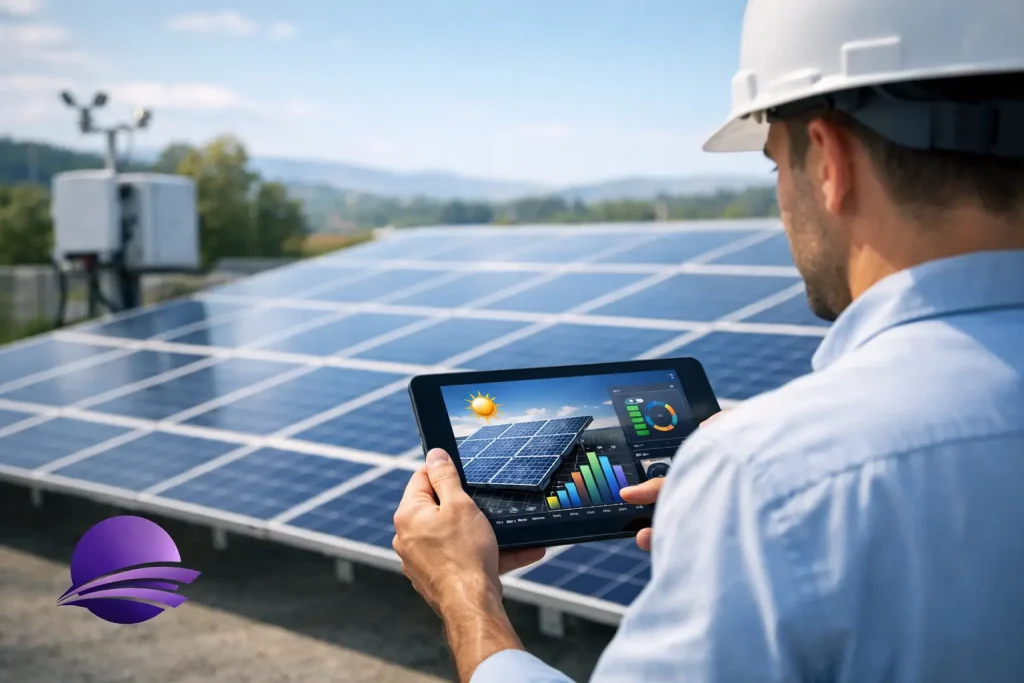
How Solar Monitoring Prevents Energy Waste
A solar system can be producing power every day and still waste money in ways that are easy to miss. That is exactly how solar monitoring prevents energy waste – by turning generation, consumption, and storage data into clear operational decisions.
Key takeaways: monitoring shows when PV output drops below expected performance, reveals wasteful site consumption patterns, identifies inverter and battery issues early, and gives facility teams the data to protect savings and system payback.
For commercial and industrial sites, energy waste rarely comes from one dramatic failure. More often, it comes from small losses that compound over months – a string underperforming, an inverter clipping at the wrong time, a battery cycling inefficiently, or a building load profile that pushes solar generation into low-value periods. Without monitoring, these issues stay hidden behind a monthly utility bill. By the time someone notices a problem, the financial impact has already accumulated.
Why how solar monitoring prevents energy waste matters in practice
Monitoring matters because solar performance is not just about whether the system is on or off. A plant can remain online while producing below its design potential. From a business perspective, that is still waste.
A proper monitoring platform compares expected generation with actual output, tracks irradiance where relevant, follows inverter behavior, and overlays energy consumption patterns. This creates a much more useful picture than raw production data alone. For a factory, warehouse, office tower, or mixed-use development, the real question is not only how much energy the PV system produced. The question is whether that energy was produced at the right time, consumed effectively, and converted into measurable savings.
That distinction becomes even more important when batteries are part of the system. Storage can reduce peak demand charges and improve self-consumption, but only when charging and discharge schedules match actual site behavior. Monitoring provides the evidence needed to tune that strategy rather than relying on assumptions.
The main ways solar monitoring stops hidden losses
The first job of monitoring is fault detection. Inverters, combiner boxes, meters, and communication devices can all continue operating in a degraded state without causing a full shutdown. A single string fault may not trigger immediate alarm at the management level, but it can reduce yield every day. Monitoring catches these deviations faster because it flags unusual output patterns against historical and expected baselines.
The second job is performance verification. Many sites install solar based on detailed financial models, including projected savings, payback, and internal rate of return. Those outcomes depend on the system meeting its modeled assumptions. Monitoring validates whether performance ratios, specific yield, and self-consumption levels are tracking as planned. If they are not, the owner can investigate before the underperformance erodes the business case.
The third job is load visibility. This is where many organizations find the largest avoidable waste. A site may generate healthy solar output and still import expensive grid electricity because major loads start too early, too late, or all at once. Monitoring aligns building or process consumption with solar generation windows. In some cases, the answer is operational discipline. In others, it may require automation, adaptive controls, or battery support.
How solar monitoring prevents energy waste in C&I facilities
Commercial and industrial facilities have more variables than residential systems, so the value of monitoring is much higher. Production schedules shift, HVAC demand fluctuates, peak charges can distort savings, and a single operational change can alter the load curve significantly.
A facility manager may assume daytime solar is covering a large share of demand, but interval data often tells a different story. Midday export can occur while high-value loads spike later in the afternoon. That means the site is selling low and buying high, even though total solar generation appears acceptable. Monitoring exposes that mismatch. Once visible, the site can reschedule selected loads, retune battery dispatch, or update controls to improve self-consumption and reduce imported power during expensive periods.
Monitoring also supports maintenance planning. A drop in output might come from panel soiling, shading growth, cable degradation, inverter thermal derating, or metering error. These problems do not all require the same response, and not every dip justifies immediate site intervention. Good monitoring helps separate noise from meaningful performance loss so maintenance budgets can be directed where they create the highest return.
For finance leaders, this matters because wasted energy is not only a technical issue. It affects operating cost forecasts, savings verification, and confidence in capital allocation. Data-backed reporting makes it easier to understand whether the system is delivering on its investment assumptions and where corrective action will have the greatest financial impact.
Monitoring, batteries, and smarter energy control
Once batteries are added, monitoring becomes central to optimization. A battery that charges at the wrong time or discharges too early can reduce savings instead of improving them. The same is true when a battery cycles more often than necessary, shortening useful life without delivering enough financial value.
This is where technology-led energy management becomes more than a dashboard exercise. Monitoring data can support control logic that prioritizes peak shaving, self-consumption, tariff arbitrage, or backup readiness depending on the site objective. But there is always a trade-off. A strategy that maximizes bill reduction may increase battery cycling. A strategy that protects battery life may leave some savings unrealized. The right balance depends on tariff structure, process criticality, outage risk, and asset economics.
For sites using a zero capex or service-based battery model, monitoring also supports performance accountability. If the provider is managing system output and savings targets, transparent reporting becomes part of the commercial value proposition. That gives the customer clearer evidence of what the energy assets are doing and why.
Advanced setups go further by combining monitoring with AI-driven control. This can improve decision-making around forecasted load, weather conditions, and battery dispatch. Still, AI is only as good as the data quality behind it. Poor metering architecture or inconsistent communications can lead to weak recommendations. The engineering design of the monitoring system matters just as much as the software layer on top.
What to look for in a monitoring setup
Not all monitoring platforms prevent waste equally. Some show generation totals and basic inverter status, which is useful but limited. A stronger setup connects generation data with site consumption, tariff context, alarm management, and reporting that decision-makers can actually use.
For C&I owners, the practical question is whether the monitoring system supports action. Can it detect underperformance at component level? Can it show when energy is exported unnecessarily? Can it verify savings against financial assumptions? Can it support battery optimization and demand management? If the answer is no, then the system may be collecting data without reducing waste.
It is also worth considering who will interpret the data. A facility team may need clear exception reporting rather than dense engineering screens. An energy manager may want interval analysis and benchmarking. A CFO may need cloud-based reporting tied to operating cost outcomes. The best approach is usually role-based visibility, where each stakeholder sees what is relevant without losing access to technical depth when needed.
For companies managing multiple sites across Malaysia, centralized monitoring adds another layer of value. It standardizes performance review, highlights underperforming assets faster, and creates a stronger foundation for portfolio-level energy planning. That is especially useful when expansion, retrofits, or battery integration are being evaluated across different facilities.
Amsolar’s approach reflects this broader view of monitoring – not as a passive reporting tool, but as part of a full energy performance strategy that connects engineering, financial outcomes, and intelligent control.
Solar savings are not protected by installation alone. They are protected by visibility, fast intervention, and better operating decisions made over time. When monitoring is designed properly, it does more than show what happened. It helps a business waste less tomorrow than it did today.
