
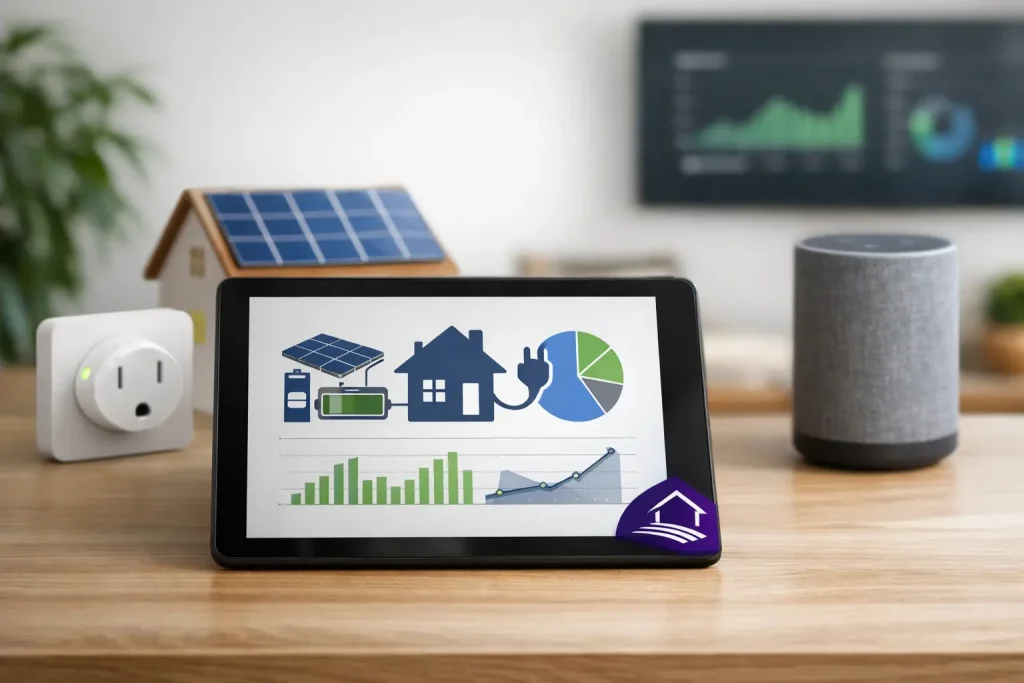
Home Assistant Energy Management System
Key takeaways: A home assistant energy management system gives homeowners one place to monitor solar production, household loads, battery behavior, and usage patterns. The real value is not just visibility – it is better control over when energy is used, stored, or imported from the grid. The best results come from pairing software intelligence with properly designed solar, battery, and monitoring hardware.
Your electricity bill usually tells the story too late. By the time you see a spike, the waste has already happened – air conditioning ran longer than expected, the water heater cycled at the wrong time, or solar production was underused during the day. A home assistant energy management system changes that by turning household energy from a monthly surprise into something you can actively manage.
For homeowners investing in solar, batteries, or smart devices, this matters because energy savings do not come from panels alone. They come from how generation, storage, and consumption work together. That is where a properly configured control layer makes a measurable difference.
What a home assistant energy management system actually does
At its core, a home assistant energy management system collects data from multiple sources and turns it into actions. It can track solar generation, battery charge and discharge, grid import, appliance consumption, and time-based usage patterns. Instead of looking at separate apps for your inverter, smart plugs, air conditioning, and battery, you get a unified operational view.
That visibility is useful, but control is where the system starts paying off. A well-designed setup can shift selected loads to solar-rich hours, reduce unnecessary imports from the grid, and prioritize battery use based on cost or backup needs. For example, if solar production is strong at midday, the system can favor running high-load devices during that window rather than later in the evening when grid dependence increases.
This is also why not every setup delivers the same results. A dashboard alone is not an energy strategy. If the system only reports consumption without automating decisions or supporting practical operating rules, the savings may be modest.
How it works with solar, batteries, and smart loads
The strongest use case for a home assistant energy management system is in homes that already have, or plan to install, solar PV and possibly battery storage. Solar produces energy when the sun is available. Household demand does not always match that profile. Without monitoring and control, excess daytime generation may be underutilized while expensive evening demand still comes from the grid.
An energy management layer helps close that gap. It can identify when solar generation is high and route usage accordingly. It can also decide whether battery energy should be preserved for nighttime use, held for outage protection, or discharged to reduce peak imports. In homes with smart water heaters, EV chargers, air conditioning, or selected appliances, these decisions can be automated based on priorities set by the homeowner.
There are trade-offs. More automation usually means more integration work, more device compatibility checks, and more attention to commissioning. Some homeowners want deep control and custom rules. Others prefer a simpler system that handles the main energy decisions without constant adjustment. The right approach depends on the home, the equipment mix, and how hands-on the user wants to be.
Where homeowners see the biggest gains
The biggest gains usually come from three areas: self-consumption, load timing, and operational awareness. Self-consumption means using more of your own solar generation instead of exporting or wasting the opportunity. Load timing means moving discretionary usage to the periods when your solar system is most productive. Operational awareness means catching problems early, such as abnormal nighttime loads, inverter underperformance, or appliances that consume far more than expected.
For high-value homeowners looking for a complete solution, this becomes more than a convenience feature. It is a way to protect the return on their solar investment. A high-performing PV system can still underdeliver financially if the home continues to consume power at inefficient times or if no one notices performance issues for weeks.
Battery-backed homes can benefit even more, but only if battery dispatch is managed intelligently. A battery that discharges too early may leave little reserve for the evening peak or an outage. A battery that remains too conservative may miss opportunities to reduce imports. Good energy management balances economics, resilience, and comfort rather than treating the battery as a simple backup box.
What to look for before choosing a system
The first requirement is compatibility. The system should work with your inverter, meter, battery, and selected smart devices without creating unstable workarounds. The second is measurement quality. If data is delayed, incomplete, or inaccurate, the automation decisions built on top of it will be weak.
The third is control logic. This is often overlooked. A useful platform should allow practical operating rules such as prioritizing solar charging, limiting grid imports during certain periods, or scheduling specific loads around generation patterns. It should also be easy to interpret. If a homeowner cannot understand what the system is doing, confidence drops and overrides become common.
Cybersecurity and reliability also matter. A home energy platform is connected to real equipment that affects comfort, savings, and sometimes backup power. It should not feel experimental. Stable integration, disciplined commissioning, and ongoing support are more valuable than a long feature list that rarely works as intended.
For homeowners in Malaysia, where solar adoption is rising and programs such as Suria RM3K can improve project economics, the decision should not stop at panel sizing alone. The better question is whether the entire home energy system is designed to perform as one coordinated asset.
Why engineering matters more than the app
Many homeowners start with the interface because that is what they can see. The app looks polished, the charts are clean, and the controls feel modern. But the app is only the surface. What drives performance is the engineering behind system sizing, device selection, commissioning, monitoring architecture, and control strategy.
A home assistant energy management system works best when it is part of a broader energy design, not an add-on chosen at the end. If the solar system is undersized, if battery capacity does not match usage behavior, or if critical loads were never mapped properly, software cannot fully compensate. Good outcomes come from integrating hardware and logic from the beginning.
That is also why complete providers tend to deliver better long-term value than fragmented setups. When system design, procurement, installation, testing, monitoring, and performance analysis are handled in a coordinated way, there is less guesswork and fewer blind spots. Amsolar approaches residential energy with that same engineering-led mindset, combining solar delivery with smart monitoring and home energy management so the homeowner is not left stitching together separate technologies after installation.
The most effective residential energy systems are not the ones with the most apps or the most notifications. They are the ones that quietly reduce waste, make solar work harder, and give the homeowner confidence that energy is being used at the right time, in the right way, for the right reason.
If you are evaluating solar or battery storage for your home, do not just ask how much power the system can produce. Ask how intelligently the home will use it once it is there.
