
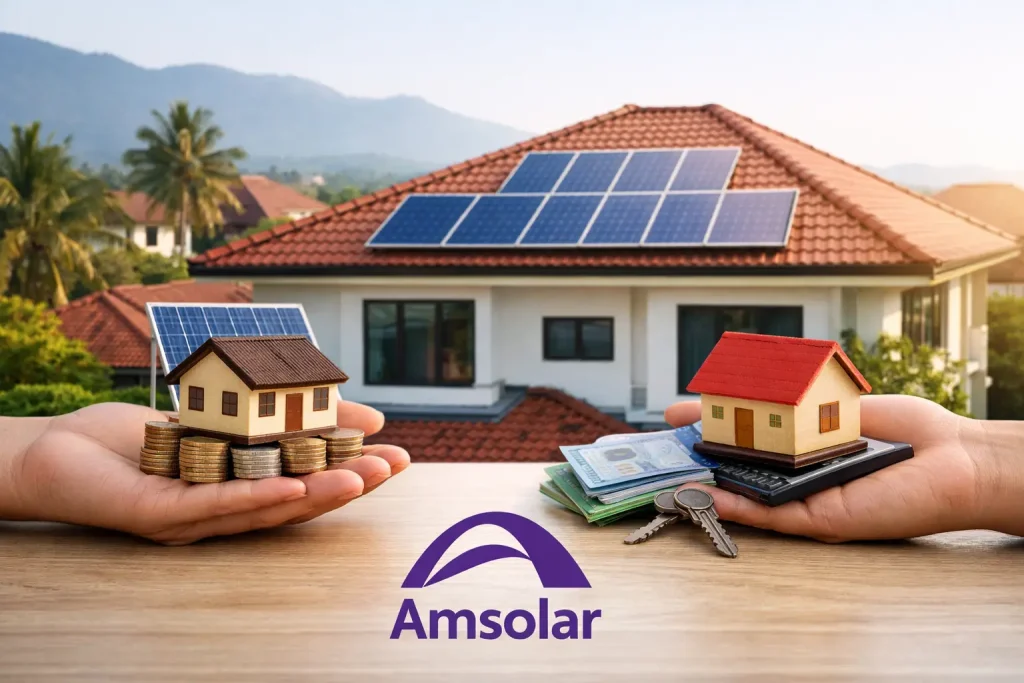
Solar PPA Versus Loan for Malaysian Homes
Key takeaways
- A solar loan helps you own the system from the start, giving you direct access to its long-term energy savings and property value benefits.
- A solar PPA can reduce or remove upfront spending, but a third party owns the equipment and sells its generated electricity to you.
- For most landed homeowners planning to stay in their home for years, ownership often delivers stronger lifetime value.
- The right choice depends on cash flow, financing terms, roof suitability, household consumption, and how much control you want over your energy system.
A solar ppa versus loan decision is not simply about whether you can afford panels today. It determines who owns the system on your roof, who receives the financial upside from its energy production, and how much flexibility you retain as your household energy needs change. For urban owners of landed homes in Malaysia, especially those considering a car-park canopy or a Plug-In Solar setup, the better option is the one that matches both your monthly cash flow and long-term home plans.
Solar PPA versus loan: the core difference
With a solar loan, you borrow funds to purchase the solar system. You own the panels, inverter, mounting structure, and associated equipment once the system is installed, subject to the terms of your financing arrangement. Your monthly loan repayment is predictable, while the electricity generated offsets the power you would otherwise buy from the grid.
A solar power purchase agreement, or PPA, takes a different path. A provider funds and owns the equipment, then sells the electricity produced by that system to you at an agreed rate. The homeowner typically pays little or nothing upfront, but does not own the asset. The provider is compensated through the electricity payments over the agreement period.
That ownership difference affects nearly every part of the decision. A loan turns solar into a home energy asset. A PPA turns it into an energy service. Neither structure is automatically right or wrong, but they serve different priorities.
When a solar loan creates better long-term value
A loan is often the stronger financial choice for a homeowner who expects to remain in the property for the medium to long term. Once the financing is repaid, the system can continue producing electricity with comparatively low ongoing costs. That means more of the value generated over the system’s useful life stays with the homeowner.
The trade-off is the upfront commitment. Even when financing is available, the homeowner needs confidence that monthly repayments fit the household budget. It is also essential to model expected production against actual consumption. A system that is too small may leave substantial grid usage untouched. One that is oversized for daytime consumption may not deliver the same financial efficiency unless the home can shift loads or incorporate energy storage.
Ownership also gives you more strategic control. You can add battery storage later, use a home energy management system to coordinate high-consumption appliances, or expand solar capacity as electric vehicle charging and household loads grow. Monitoring data becomes especially useful here. It shows when the home consumes energy, how much solar is being used directly, and where battery optimization or load scheduling could further reduce costs.
For a homeowner who values control, transparency, and lifetime savings, a properly modeled loan can be a practical way to turn a roof, balcony-facing structure, or car park into a producing energy asset.
When a solar PPA makes sense
A PPA can be attractive when preserving cash is more important than owning equipment. Rather than committing capital or taking on a loan, the homeowner pays for the solar electricity produced. This can make solar more accessible for households that prefer an operating expense over a financed asset.
It may also appeal to owners who want a simpler financial structure. Depending on the provider’s offer, the PPA arrangement may include performance monitoring and certain maintenance responsibilities. That can reduce the operational burden on a homeowner who wants lower electricity costs without managing a solar asset directly.
However, simplicity should not be confused with automatic savings. Compare the PPA electricity rate, its escalation terms if any, the expected duration of the agreement, and the estimated cost of grid electricity over the same period. A low upfront cost can be valuable, but it may also mean giving up a meaningful share of the system’s long-term financial return.
A PPA deserves closer scrutiny if you may sell the home, renovate the roof, or significantly change your household energy use during the contract period. Ask how the agreement handles those scenarios before making a commitment. The goal is not just to secure a favorable rate today, but to avoid a structure that limits your options later.
Compare the numbers, not just the monthly payment
The most common mistake in choosing between a PPA and a loan is comparing only the first month’s payment. A sound decision looks at the full financial picture: total electricity savings, financing cost, system output, maintenance expectations, future equipment upgrades, and the value of ownership after the agreement or loan ends.
Start with your real electricity usage, ideally across a full year. Homes with significant daytime consumption can use more solar energy as it is produced, which usually strengthens the economics. A household that is empty during the day may need smarter load control, battery storage, or changes in appliance schedules to improve solar self-consumption.
Next, assess the physical installation area. A car-park solar structure may produce excellent results while creating shaded parking. A compact Plug-In Solar solution can be a lower-commitment entry point for suitable landed homes. The correct design depends on orientation, shading, usable area, structural conditions, and your energy goals, not a generic panel count.
Then compare two complete scenarios side by side. For the loan option, calculate the financed amount, repayment period, total payment, estimated production, and savings after the loan ends. For the PPA, calculate projected energy purchases under the agreement, the provider’s price terms, and the costs or options available at the end of the term. This makes the trade-off visible: lower initial commitment versus greater long-term ownership value.
Choose an energy plan that can grow with your home
Your solar decision should account for the home you will have in five or ten years, not only the bill you received last month. Air-conditioning use, work-from-home routines, additional family members, electric vehicles, and new appliances can all change electricity demand. A flexible design creates room to respond.
This is where engineering and monitoring matter. A quality solar system is more than modules on a roof. It should be designed around reliable generation, safe installation, clear performance visibility, and a realistic financial model. Cloud-based reporting and energy monitoring help homeowners verify output and identify consumption patterns that affect savings.
Amsolar approaches this as an energy planning decision, combining solar engineering with usage analysis and technology-led controls. For homeowners considering future batteries or a home energy management system, planning the system architecture early can avoid unnecessary redesign work later.
If you have capital available and want maximum long-term benefit, a loan will often be the more compelling route. If protecting cash flow is the immediate priority, a well-structured PPA may be worth consideration. The best next step is to model both against your actual household demand, because the right solar choice should keep working long after the first electricity bill changes.
