
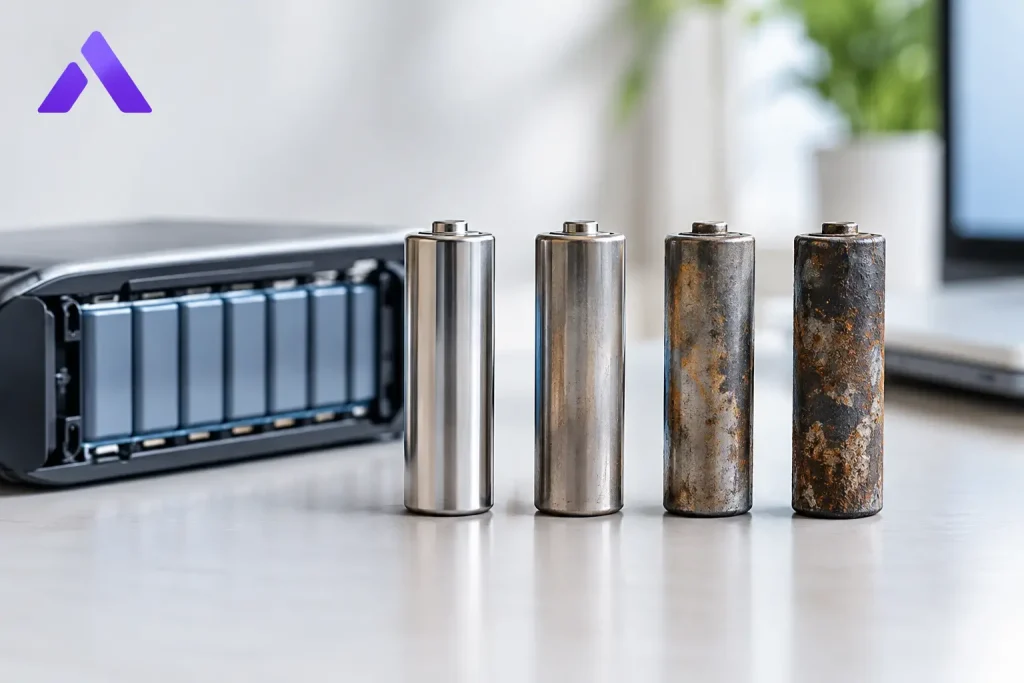
Why Do Batteries Degrade? The Science of Battery Aging
Key takeaways
- Battery aging is expected: capacity gradually falls and internal resistance rises, reducing both stored energy and available power.
- Heat, long periods at a very high state of charge, deep cycling, and rapid charging or discharging accelerate wear.
- A battery management system helps protect the battery, but operating habits and system design still determine much of its usable life.
- For solar homes, using more solar power while it is being generated can reduce unnecessary battery cycling and improve overall energy economics.
A battery can look perfectly normal from the outside while delivering less energy than it did a few years earlier. That gradual change is not a defect by default. Why do batteries degrade? Because the chemical reactions that store and release electricity also create small, cumulative changes inside the cells. Over time, those changes reduce how much energy the battery can hold and how effectively it can deliver power.
For homeowners considering plug-in solar, rooftop solar, or home energy storage, the useful question is not whether a battery will age. It will. The better question is how system design, operating conditions, and daily energy habits affect the rate of aging – and whether a battery is being used where it delivers real value.
Why Do Batteries Degrade Over Time?
Most home energy storage products use lithium-ion battery cells. When charging, lithium ions move into one side of the cell structure; when discharging, they move back. This process is highly efficient, but not perfectly reversible. A small portion of active lithium becomes unavailable over time, while materials inside the cell slowly change.
The result is two forms of degradation. First, capacity fade means the battery stores fewer kilowatt-hours than when new. A 10 kWh battery, for example, may eventually provide less usable energy even though the system remains operational. Second, power fade occurs as internal resistance increases. The battery may have difficulty supplying or accepting high power as easily as it once did, particularly during heavy household demand.
Battery aging happens through calendar aging and cycle aging. Calendar aging occurs simply with time, even if the battery is rarely used. Cycle aging is linked to charging and discharging activity. Neither operates in isolation. A lightly used battery kept in a hot location can age faster than expected, while a frequently used battery operating within a well-managed temperature and charge range can retain useful performance for longer.
This is why battery lifespan should never be reduced to one number. Cell chemistry, installation environment, depth of discharge, charging speed, and energy management all matter.
The Four Conditions That Accelerate Battery Aging
Heat raises chemical stress
High temperature is one of the strongest drivers of battery degradation. Heat speeds up unwanted chemical reactions inside the cell, including reactions that consume active lithium and degrade the electrolyte. In practical terms, a battery that regularly operates in a hot, poorly ventilated area can lose performance faster than one installed in a more controlled environment.
This matters in sunny climates, where solar equipment may be located near roofs, carports, utility areas, or exterior walls. The battery should not be treated as an afterthought to the solar design. Placement, airflow, enclosure design, and monitoring should be considered early because thermal conditions affect both long-term performance and available power.
Staying full for too long increases wear
Lithium-ion batteries generally experience more stress at very high states of charge. Keeping a battery at or near 100% for extended periods can accelerate calendar aging, especially in warm conditions. This does not mean a battery should never be fully charged. It means that repeatedly filling it early in the day and leaving it full for many hours may not be the best operating pattern when the goal is long-term health.
A well-designed energy management strategy can consider the household’s load profile, expected solar production, and timing of electricity use. For some homes, preserving room in the battery for later solar generation is more useful than holding a full battery all afternoon. The right approach depends on consumption patterns and the system’s intended role, whether that is backup support, evening self-consumption, or managing peak demand.
Deep cycles and high throughput add up
A battery cycle is not simply one charge event. It reflects the total energy moved in and out of the battery. Frequent deep discharge, where the battery is taken close to empty before being recharged, generally creates more wear than shallower cycling. Similarly, moving large amounts of energy through the battery every day increases total throughput and therefore cycle-related aging.
That trade-off is central to solar storage planning. Using stored energy can reduce grid purchases at certain times, but cycling a battery unnecessarily to chase a small saving can shorten its useful economic life. The best operating strategy balances energy savings against the cost of battery wear.
Rapid charging and discharging can also increase stress, although quality systems are designed with operating limits to manage it. High-power loads, sudden demand spikes, and aggressive charging settings should be evaluated as part of the full energy profile, not as isolated events.
Cell imbalance and weak control reduce usable performance
A battery pack contains many individual cells. Even cells from the same production batch do not age at exactly the same rate. Small differences in temperature, manufacturing variation, and usage can create imbalance, where some cells reach their limits before others.
The battery management system, or BMS, monitors voltage, current, temperature, and cell balance. It can limit charging or discharging when conditions become unsafe and helps keep the pack within an appropriate operating range. However, a BMS cannot reverse chemical aging. It is a protection and optimization layer, not a cure for poor thermal conditions or unsuitable operating behavior.
How Solar Homes Can Slow Battery Wear
The most effective strategy is to use the battery deliberately rather than treating it as a container that must be filled and emptied every day. Solar generation is most valuable when it directly serves household loads. Running suitable daytime loads while solar production is strong – such as cooling, appliances, pool equipment, or electric vehicle charging where applicable – can reduce the energy that needs to pass through a battery.
For plug-in solar users, this distinction is especially useful. A battery is not automatically required for every solar setup. If much of a household’s electricity demand occurs during daylight hours, direct solar consumption may provide strong value with less system complexity. Storage becomes more compelling when the home has meaningful evening demand, needs resilience for selected loads, or benefits from shifting solar energy beyond production hours.
When a battery is part of the system, intelligent controls can improve how it is used. Charge limits, reserve settings, load prioritization, and consumption monitoring help align battery operation with real household behavior. Rather than relying on a fixed schedule, advanced monitoring can identify when the home imports power, when solar is curtailed or underused, and when stored energy produces the greatest benefit.
Amsolar approaches this as an energy-management decision, combining system engineering with monitoring and battery optimization. The objective is not simply to install more equipment. It is to make each kilowatt-hour work harder while protecting long-term asset value.
What Battery Degradation Means for Your Investment
Battery degradation should be planned for in the same way solar owners account for changing household demand or seasonal production. Nameplate capacity is a starting point, not a permanent promise. What matters is usable capacity over the period when the battery is expected to deliver savings or resilience.
When comparing options, look beyond the headline battery size. Ask how much usable capacity is available, what operating conditions the system supports, how thermal management is handled, and how the battery will be monitored. Also consider whether the proposed size matches the home’s actual evening consumption. An oversized battery that sits full for long periods may not create better value, while an undersized battery may cycle deeply too often.
Good system design starts with measurement. Understanding interval energy use, daytime solar production, nighttime demand, and high-load events creates a clearer basis for selecting storage capacity and control settings. It also makes performance easier to verify after installation.
Battery aging cannot be eliminated, but it can be managed. Treat storage as a carefully controlled energy asset – not just a backup box – and the system can support lower energy costs with more predictable performance for years to come.
