
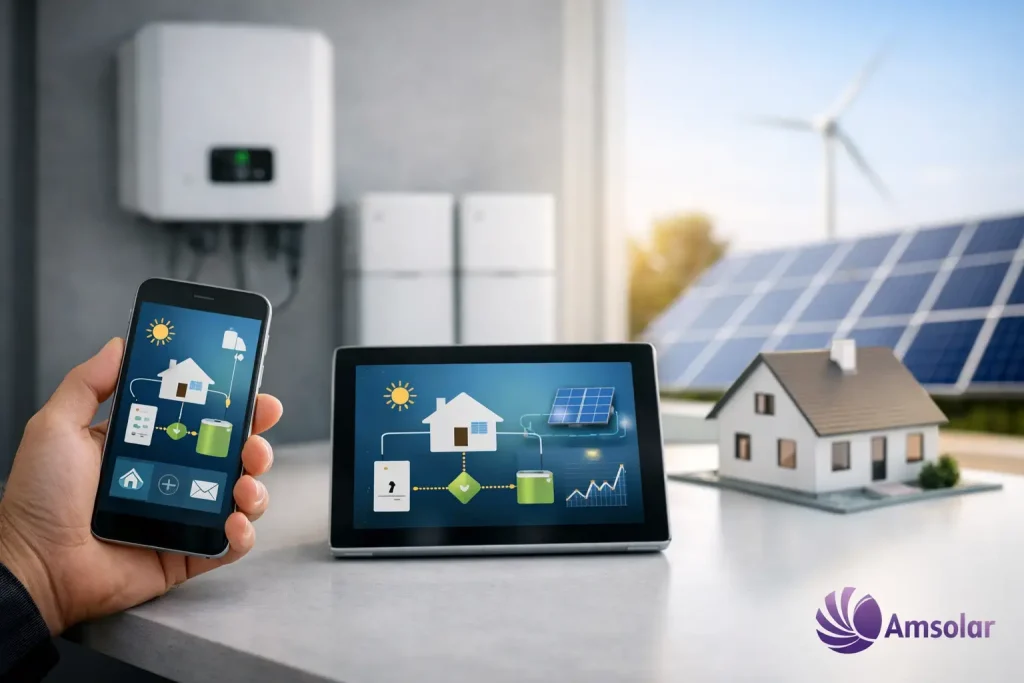
Tuya Home Energy Management System (HEMS)
Key takeaways
A tuya home energy management system (hems) gives homeowners clearer control over solar generation, battery use, and household loads from one interface. The real value is not just visibility – it is better self-consumption, smarter scheduling, and more disciplined energy use. For higher-value residential projects, HEMS works best when it is planned alongside solar, battery storage, and actual household load behavior rather than added as an afterthought.
If your home already has solar but your bill still feels unpredictable, the gap is usually not generation alone. It is control. A tuya home energy management system (hems) is designed to close that gap by showing where energy is going, when it is being used, and how selected devices can be managed more intelligently.
For homeowners investing in a complete energy solution, that matters. A modern solar setup should do more than produce electricity. It should help you use that electricity at the right time, reduce avoidable imports from the grid, and support more stable day-to-day energy costs.
What a tuya home energy management system (HEMS) actually does
At a practical level, a tuya home energy management system (hems) connects energy data, device control, and user monitoring into one platform. It typically works alongside solar inverters, smart breakers, metering devices, connected appliances, and in some cases battery storage. Instead of treating your home as a single power sink, it breaks usage into visible patterns.
That changes decision-making. You can see whether daytime solar is being consumed in real time, exported unnecessarily, or offset by large evening loads. You can also identify which circuits or appliances are driving your peak usage and whether those loads can be shifted.
For a homeowner, this often translates into simple but meaningful improvements. Water heaters, EV charging, air conditioning, and selected heavy loads can be scheduled around solar production windows. If battery storage is present, the system can support a more deliberate approach to charging and discharge behavior. The result is not magic bill elimination. It is better energy discipline backed by data.
Why HEMS matters more in solar homes
A standard rooftop PV system reduces grid dependency, but without active management, some of its value can be lost. Midday generation may exceed household demand, while evening consumption still pulls heavily from the grid. That mismatch is common in homes where occupants are out during the day or where major loads start after sunset.
This is where HEMS becomes commercially sensible even in a residential setting. It helps increase self-consumption, which is often more valuable than simply producing more energy. If your home can consume more of its own solar at the right times, the economics improve. You are not just installing panels. You are improving how the home behaves as an energy asset.
There is also a resilience angle. Homeowners adding battery systems want more than backup power. They want control over when stored energy is used, how much reserve is maintained, and which loads matter most. A HEMS platform supports that logic. It gives the system rules, not just hardware.
That said, performance depends on setup quality. A poorly configured system with weak load mapping or limited device compatibility will provide less value than a properly engineered solution. The interface may look smart, but the outcome depends on design.
Where the savings come from and where they do not
One of the biggest misconceptions around home energy software is that the app itself creates savings. It does not. Savings come from changed energy behavior, better timing, and tighter control of major electrical loads.
In a well-designed home, the financial gains usually come from four areas. First, more solar energy is consumed on-site instead of wasted through poor timing. Second, batteries can be charged and discharged in a more useful pattern. Third, inefficient habits become visible, which makes them easier to correct. Fourth, some homes can avoid unnecessary peak demand from simultaneous high-load usage.
But it depends on the profile of the house. A family with high daytime occupancy may already consume a good portion of solar production naturally, so the improvement from HEMS may be moderate. A larger house with multiple air conditioning zones, an EV charger, and variable occupancy will usually benefit more because it has more controllable loads.
This is why financial expectations should stay realistic. HEMS is not a substitute for proper solar sizing, inverter selection, or battery strategy. It is a control layer that makes those investments work harder. For high-value residential customers looking for a complete solution, that distinction matters because it shapes the return.
What to look for before choosing a Tuya-based setup
Not every smart home platform is equally useful for energy management. Before choosing a Tuya-based system, the first question is compatibility. The platform should work cleanly with your inverter environment, metering architecture, and any future battery expansion. If integration is partial, you may end up with monitoring in one app and device control in another, which weakens the value of the system.
The second issue is load strategy. A useful HEMS does not need to control every appliance in the house. It needs to control the right ones. That usually means high-consumption devices or loads that can be shifted without affecting comfort too much. Good system planning focuses on practical control points rather than smart-enabling everything for the sake of it.
The third issue is data quality. If monitoring is delayed, incomplete, or not mapped properly, decisions become unreliable. Homeowners often assume that if they can see a dashboard, the system is working well. In reality, dashboards are only as valuable as the engineering behind the data collection.
The fourth issue is expandability. A house may start with solar and monitoring today, then add storage, EV charging, or advanced automation later. A system that supports phased growth is usually the better long-term choice.
For this reason, many premium homeowners prefer a provider that understands not just device setup, but PV design, battery logic, commissioning, and performance analysis as one scope. That end-to-end view reduces the risk of buying isolated components that do not perform well together.
Is a tuya home energy management system (HEMS) right for your home?
If your goal is basic solar generation with minimal interaction, HEMS may feel unnecessary. But if you want a more controlled energy environment – especially in a larger home with solar, storage potential, or heavy electrical loads – it becomes far more relevant.
The strongest fit is usually a homeowner who wants three things at once: lower energy waste, better visibility, and a system that can evolve. In those cases, a tuya home energy management system (hems) is not just a convenience feature. It becomes part of the operating logic of the home.
That is particularly true in markets like Malaysia, where households are becoming more energy-aware and are increasingly evaluating solar as part of broader cost planning, not just as a standalone installation. Amsolar approaches this with the same principle used in larger energy projects: technology should support measurable control, not just add another screen.
A good HEMS setup does something simple but valuable. It gives the homeowner fewer blind spots. And once energy use is visible, it becomes much easier to manage it with intent.
