
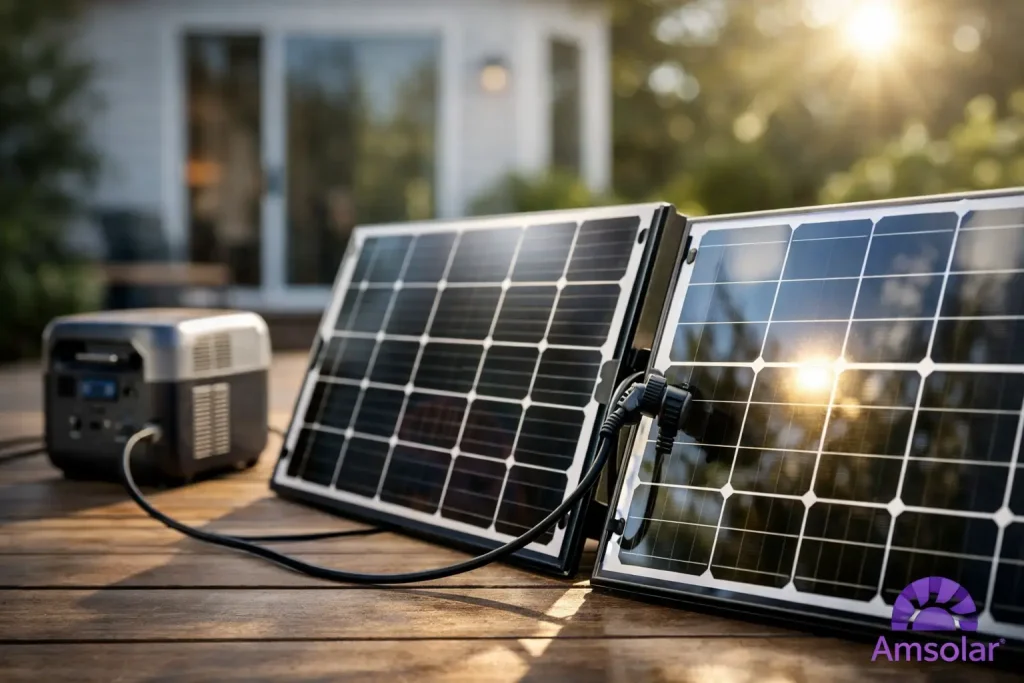
Bifacial Modules for Plug In Solar
A plug in solar system installed on a balcony, car porch, or compact roof has one job: generate as much usable electricity as possible from limited space. That is why bifacial modules, key ingredient for plug in solar, deserve serious attention. They can collect sunlight from the front and reflected light from the rear, which gives well-designed systems a practical edge where every panel and every watt matter.
Key takeaways
Bifacial modules can improve energy yield in space-constrained plug in solar setups by capturing rear-side irradiance as well as direct sunlight. Their value depends on installation conditions, especially surface reflectivity, tilt, shading, and mounting height. They are not automatically the right choice for every home or small commercial site, but when paired with sound engineering, monitoring, and the right inverter strategy, they can strengthen project economics and daytime self-consumption.
Why bifacial modules fit plug in solar so well
Plug in solar is usually chosen for speed, simplicity, and lower entry cost. It appeals to homeowners who want a complete solution without the complexity of a large rooftop build, and it can also suit small offices, retail lots, guardhouses, site cabins, and other smaller loads where fast deployment matters. In all of these cases, space is the constraint.
That constraint changes the design logic. When you cannot simply add more panels, module efficiency and real-world energy yield become more important than nameplate wattage alone. Bifacial panels help because they make use of light that conventional monofacial panels leave behind. On bright surfaces such as light-colored tiles, painted concrete, coated metal decking, or reflective balcony finishes, the rear side of the module can contribute meaningful extra generation.
For plug in solar, that extra production is especially useful during daytime consumption windows. A modest gain in output can offset standby loads, cooling, lighting, routers, pumps, or office electronics more effectively. Over time, the result is not just more kilowatt-hours, but a better match between generation and actual on-site usage.
Where bifacial modules deliver real gains
The strongest case for bifacial modules is not theoretical. It is situational. A panel mounted flush against a dark roof with little rear clearance will not behave the same way as one elevated above a bright surface with good exposure to reflected light. The difference can be material.
Rear-side light is the deciding factor
Bifacial technology performs best when the back of the module can “see” reflected light. In plug in solar, this often means raised frames on flat roofs, balcony rail installations with air gap, awning structures, and car porch layouts where light-colored flooring boosts albedo. If the installation sits over a black membrane, dense clutter, or deep shadows, the bifacial advantage shrinks.
This is where engineering discipline matters. Rear-side contribution should be estimated based on actual site conditions rather than assumed from brochure figures. The most credible approach is to model irradiance, orientation, and shading together with load behavior. That gives a more reliable picture of whether the higher module cost is justified.
Limited space makes every percentage count
In a large ground-mounted project, a modest efficiency difference can be absorbed through scale. In plug in solar, the opposite is true. If a customer only has room for two to six modules, every incremental gain matters more. A 5 to 15 percent uplift, where conditions support it, may be the difference between a system that only offsets minor standby loads and one that makes a noticeable dent in the monthly bill.
That is also why bifacial modules are often more relevant in premium residential applications. High-value homeowners are usually less interested in the cheapest hardware combination and more interested in total system performance, clean design integration, and credible long-term return.
The trade-offs most buyers miss
Bifacial modules are not a universal upgrade. They can outperform standard panels, but only when the rest of the system allows them to. For buyers comparing options, the discussion should go beyond panel type and include structure, inverter compatibility, safety, and monitoring.
First, mounting design matters. A bifacial module needs appropriate rear clearance, and that can affect frame selection, wind loading, and installation detail. In some homes, aesthetics or structural constraints may limit the ideal setup. Second, reflective surfaces help, but not every property has them. Creating those conditions artificially may add cost that weakens the business case.
Third, plug in solar systems often operate at smaller capacities, which means component matching is critical. The inverter or microinverter must handle the expected DC profile without unnecessary clipping or poor low-light behavior. A system that looks strong on paper can underperform if the balance of system is not properly engineered.
Finally, local operating conditions matter. In Malaysia, heat, humidity, and periodic cloud movement shape actual production patterns. A module with a strong datasheet still needs to perform reliably in tropical conditions, with durable encapsulation, sound connectors, and quality installation practices.
Bifacial modules and the economics of plug in solar
For decision-makers, the right question is not whether bifacial modules are better in general. The right question is whether they improve payback in the specific application.
Better yield can improve small-system economics
Plug in solar usually sits in a cost-sensitive segment. Even so, small systems have a challenge: fixed costs such as installation labor, electrical protection, and monitoring can represent a larger share of the project than they do in a bigger rooftop system. That means improving generation per module can have outsized value. If bifacial panels lift output without requiring significantly more roof area, they can improve cost per kilowatt-hour generated over the system life.
This is even more relevant where daytime tariffs are high or where the user has consistent daytime demand. Homes with air conditioning, refrigeration, pool equipment, or home office loads can benefit. Small businesses with daytime occupancy can benefit even more because self-consumption tends to be stronger.
Monitoring matters more than many expect
With compact systems, production issues can go unnoticed because the absolute numbers are small. But a small system underperforming by 10 percent is still losing value every day. Monitoring and reporting are not just enterprise features for large C&I plants. They are useful in premium residential and small-site plug in solar too, especially when customers want proof of savings and early fault detection.
This is where a technology-led installer adds value. Performance should be tracked against design assumptions, and any mismatch should be investigated through data rather than guesswork.
What to check before specifying bifacial modules for plug in solar
A sound assessment starts with the site, not the product catalog. Look at surface reflectivity, module elevation, nearby obstructions, usable area, and the customer load profile during daylight hours. Then assess whether the added yield supports the hardware and installation cost.
For residential buyers, it also makes sense to view bifacial modules as part of a broader home energy strategy. If the household may later add battery storage, smart load control, or a home energy management system, module selection should support that long-term path. For commercial users deploying small plug in solar installations at branch sites or ancillary buildings, standardization, remote visibility, and predictable maintenance may matter as much as raw panel efficiency.
Amsolar approaches this type of decision the way it should be handled: as an engineering and financial exercise, not a product pitch. The module choice needs to align with installation geometry, usage pattern, and measurable return.
Bifacial modules are not magic, but in the right plug in solar setup they are a smart lever. When space is tight and performance matters, they can turn reflected light into useful savings. The best results come from treating them as part of a complete system design rather than a premium add-on, because the panel only performs as well as the thinking behind it.
