
Plug In Solar Kit Review: What Homeowners Should Know
Key Takeaways
- A plug-in solar kit can reduce daytime electricity purchases, but its real value depends on circuit safety, local utility requirements, roof conditions, and how much solar generation a household can use at the time it is produced.
- The headline panel wattage is not the same as usable energy savings. Inverter limits, shading, orientation, temperature, and household load shape actual performance.
- For high-value homes, a professionally designed rooftop PV system with monitoring and energy management will often deliver a clearer long-term return than an entry-level plug-in setup.
- Commercial and industrial facilities should not treat plug-in kits as a substitute for engineered solar PV. Their load profile, protection requirements, approval process, and financial exposure require a designed solution.
A plug in solar kit review should start with a practical question: what problem is the kit meant to solve? A small plug-in system may look appealing because it promises a simple route to solar generation without the scale or initial commitment of a full rooftop installation. Yet solar is connected to a live electrical system, not simply placed in the sun. The best choice depends on technical fit, permitted connection method, and whether the savings justify the compromises.
What a Plug-In Solar Kit Actually Delivers
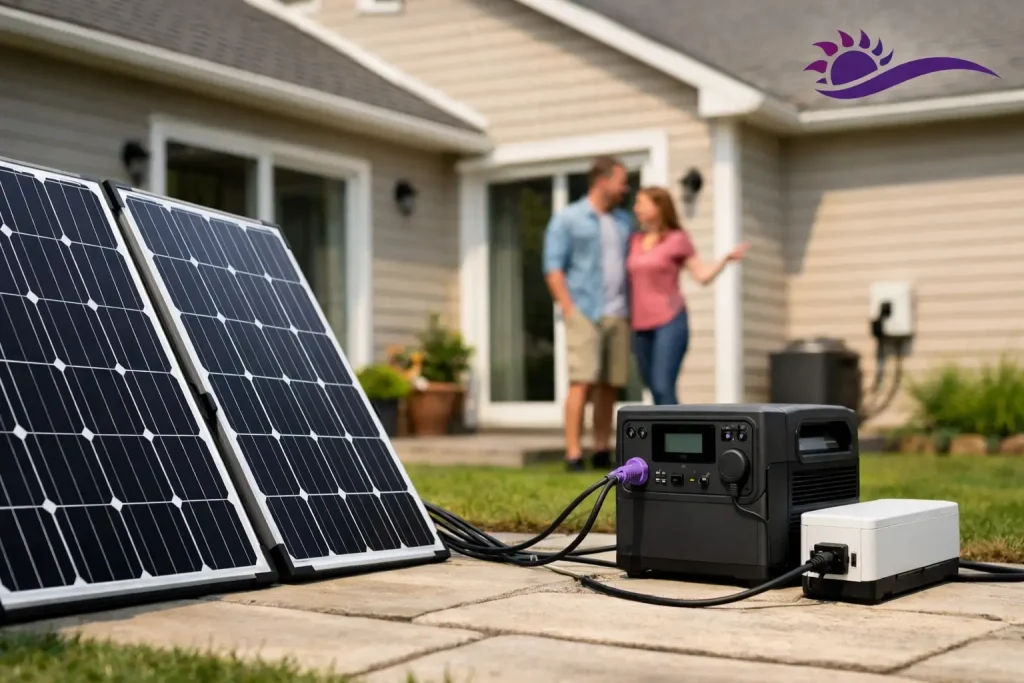
A typical plug-in kit combines one or more solar panels, a microinverter, mounting hardware, cabling, and sometimes an app. Panels produce direct current, while the microinverter converts it into alternating current for use by electrical loads. When sunlight is available, the home can consume that energy before drawing more electricity from the grid.
That description is straightforward. The limitation is timing. A kit only offsets consumption when it is generating and when there is an active load to absorb the output. If occupants are away during the day, major appliances are off, and no battery or managed load is available, a larger share of generation may have limited value depending on the approved system configuration and local rules.
Do not judge a kit by panel wattage alone. A 800-watt panel array will not produce 800 watts all day, every day. Solar output changes with irradiance, roof direction, tilt, cell temperature, shading, inverter clipping, dust, and weather. A credible supplier should discuss expected annual energy yield rather than relying on a best-case peak rating.
For Malaysian homeowners, this matters because rooftop heat and frequent cloud movement can affect production patterns. A site assessment should also identify shadows from neighboring buildings, water tanks, trees, parapet walls, and future development. A panel that is partially shaded at the wrong time can underperform far more than its specification sheet suggests.
Safety, Approval, and Installation Are Part of the Product
The phrase “plug-in” can create the impression that electrical design is optional. It is not. Grid-connected solar requires suitable protection, compliant equipment, correctly rated circuits, safe cable routing, grounding or earthing measures where applicable, and a connection approach accepted by the relevant authority and utility.
Before purchase, ask how the kit prevents unsafe islanding during a grid outage. Anti-islanding protection is fundamental: a solar inverter must not continue feeding a circuit that utility personnel may assume is de-energized. Confirm the equipment certifications, the inverter’s grid compatibility, warranty terms, and who is accountable if a fault occurs.
Installation quality also affects both safety and lifetime value. Mounting should account for roof structure, wind loading, waterproofing details, corrosion resistance, access for maintenance, and cable protection. A low-cost kit becomes expensive if roof penetrations leak, connectors degrade, or the system cannot be serviced without removing poorly planned hardware.
Homeowners should verify local requirements before connecting any system. Rules can differ by area, utility program, system capacity, and whether energy export is allowed. A complete solar provider handles the technical submission and commissioning process as part of the project, rather than leaving the owner to interpret electrical and regulatory obligations alone.
How to Evaluate a Plug-In Kit Beyond the Purchase Price
The right comparison is not kit price versus monthly bill. It is expected lifetime value versus the installed system’s cost, risk, and capability. Start by reviewing daytime electricity consumption. Smart meter data or a home energy monitoring system can show whether the property has consistent daytime loads from air conditioning, refrigeration, pumps, home offices, EV charging, or other equipment.
Next, assess the proposed generation profile. A west-facing array may better support afternoon cooling loads, while another orientation may produce more useful energy earlier in the day. There is no universal best orientation without examining when the household consumes power.
Monitoring deserves more attention than it usually receives. An app that merely shows daily solar output is useful, but it does not explain whether the home consumed that energy, exported it, or continued importing expensive power at peak periods. Better energy management compares generation and consumption, identifies abnormal performance, and can help coordinate controllable loads.
Warranty language should be equally specific. Separate the panel product warranty, panel performance warranty, inverter warranty, mounting warranty, and workmanship warranty. Ask who will diagnose a monitoring outage, inverter error, or water ingress, and whether labor is included. The most valuable warranty is one backed by a capable local service team.
A full residential assessment should also include available incentives and financing. In Malaysia, eligible homeowners may wish to consider the Suria RM3K residential solar rebate program, subject to its current terms and availability through December 2026. Incentives improve project economics, but they should not be used to justify a technically unsuitable installation.
When a Designed Rooftop System Is the Better Investment
A plug-in kit can be sensible for a limited use case: a modest load, a suitable and approved connection method, clear expectations, and an owner who accepts the system’s constrained output. It can also be an entry point for someone testing solar generation and consumption behavior before committing to a larger project.
For a high-value home with meaningful daytime demand, the case usually shifts toward a designed rooftop PV system. The system can be sized around electricity usage, roof geometry, future EV charging, air-conditioning patterns, and intended battery integration. It can also be paired with a home energy management system to make generation more visible and useful rather than treating solar as a passive add-on.
This is where engineering creates a measurable difference. Proper design addresses string configuration or microinverter layout, voltage protection, roof loading, shading losses, cable runs, monitoring architecture, and grid commissioning. It also gives the homeowner a credible production estimate and a financial model based on the property’s actual consumption, not a generic savings claim.
Battery storage should be evaluated separately from solar PV. A battery can increase self-consumption, support selected loads during outages when designed for backup operation, and shift energy use. But batteries add capital cost and cycle-life considerations. They are most compelling where resilience, time-based electricity costs, or controlled load management materially improve the economics.
Why Commercial Buyers Need a Different Standard
Commercial and industrial decision-makers should separate plug-in products from asset-grade energy projects. A factory, retail portfolio, warehouse, or office building has larger loads, complex electrical distribution, operational risk, and governance requirements. An informal plug-in approach does not provide the engineering control needed for protection coordination, demand analysis, grid approvals, or long-term performance management.
A commercial solar project should begin with interval data, site surveys, structural review, tariff analysis, and a financial model that considers payback, internal rate of return, operating schedules, and expansion plans. Battery energy storage may also be evaluated for demand management, resilience, or energy optimization, including zero-capex service models where appropriate.
The value is not simply more panels. It is a controlled energy asset with commissioned performance, monitoring, reporting, and accountability. That standard protects operations while making the financial case easier for management and finance teams to evaluate.
A plug-in kit is worth considering only after its electrical pathway, generation profile, and expected savings are clear. If the goal is dependable long-term cost control, start with the property’s energy data and let the system design follow it. Amsolar can assess whether a compact solution is appropriate or whether a fully engineered solar and energy-management system will create more value from the same roof.
