
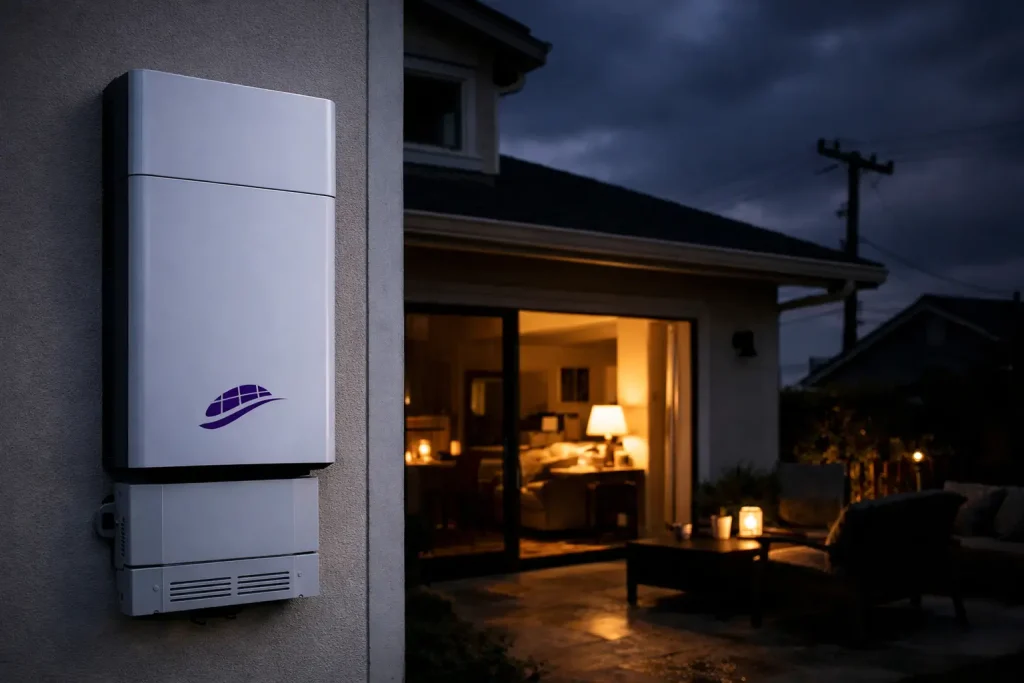
Does a Home Battery Work During Power Outages?
Key takeaways
A home battery can keep selected appliances and circuits running during a power outage, but only when it is designed with backup capability. Solar panels alone typically shut down when the grid fails. The useful question is not simply whether a battery works during outages, but which loads it can support, for how long, and how quickly the system switches over.
For landed-home owners, a properly engineered solar and battery system can provide practical continuity for essentials such as refrigeration, lighting, internet, security, and selected plugs. Running an entire home, central air conditioning, or high-demand equipment requires considerably more battery capacity and a larger budget.
Does a home battery work during outages?
Yes, a home battery can work during an outage if the system includes a compatible inverter and an automatic transfer function that safely separates the house from the utility grid. When the grid is unavailable, the battery supplies electricity to a dedicated backup panel or, in some designs, to a wider portion of the home.
This distinction matters. A standard grid-connected solar system is designed to stop producing power during an outage. That shutdown protects utility crews working on lines outside the home. Even if the sun is shining and the roof has solar panels, a solar-only system will usually not power the house while the grid is down.
A battery changes the operating model. It stores electricity for later use and, paired with the right backup equipment, creates a controlled power source within the home. The inverter detects the outage, disconnects from the grid, and begins supplying eligible circuits from the battery. Many systems complete this changeover quickly enough that lights and internet equipment remain on with little disruption.
The outcome still depends on system design. Not every battery installation is intended for backup power. Some are configured primarily to reduce electricity costs by storing solar energy or shifting usage away from higher-cost periods. If outage protection is a priority, it needs to be specified from the beginning.
What can a battery power during a blackout?
The answer depends on two numbers: battery capacity and inverter output. Capacity, measured in kilowatt-hours (kWh), indicates how much energy the battery stores. Inverter output, measured in kilowatts (kW), indicates how much power it can deliver at one time.
A battery with adequate capacity may have enough stored energy to run essential loads for many hours, yet still be unable to start several large appliances at once if its inverter output is limited. Conversely, a powerful inverter with a small battery may run heavier loads briefly but exhaust stored energy quickly.
For most homes, an essential-load backup plan is the most practical starting point. It commonly supports the refrigerator, a few lighting circuits, Wi-Fi, mobile-device charging, security equipment, ceiling fans, and selected outlets. This approach gives the household useful resilience without sizing the battery around every electrical load in the building.
High-demand equipment changes the calculation quickly. Central air conditioning, electric water heaters, induction cooktops, clothes dryers, swimming-pool pumps, and electric vehicle charging can draw substantial power. A single air-conditioning unit may be possible in a carefully designed system, but continuous whole-home cooling during a long outage requires a larger battery bank and enough solar generation to recharge it.
The most reliable approach is to identify what truly matters during an outage. A backup system should protect comfort, food storage, communication, and security first. It should not be oversized around occasional loads that can be paused until grid service returns.
How long will home battery backup last?
Battery runtime is driven by usable storage, the home’s active loads, and whether solar can recharge the battery during daylight. A simple estimate is to divide usable battery capacity by average load. For example, a 10 kWh battery delivering an average 1 kW of essential loads could operate for roughly 10 hours. Real-world results will vary because appliances cycle on and off, and battery systems maintain a reserve to protect long-term performance.
A refrigerator does not draw its maximum power continuously. Lights, routers, and phone chargers use comparatively little energy. With disciplined usage, a modest battery can often cover a night or a short outage comfortably. Add air conditioning, kitchen appliances, or multiple pumps, and runtime falls much faster.
Solar generation can extend backup duration significantly. During daylight, rooftop solar can serve active household loads and recharge the battery when production exceeds consumption. But solar output is not constant. Cloud cover, roof orientation, time of day, shading, and weather all affect available energy. A backup plan should therefore work from stored battery energy first, with solar treated as a valuable extension rather than an unlimited power source.
This is where energy monitoring adds real value. A home energy management system can show which appliances are drawing power, how quickly the battery is discharging, and whether certain loads should be switched off. Instead of guessing, the homeowner can make decisions based on live energy data.
Choosing between essential-load and whole-home backup
Essential-load backup is usually the stronger value proposition for most urban landed homes. It directs battery capacity to the circuits that keep daily life functional and reduces the upfront system size required. The backup panel is clearly defined, so homeowners know exactly what remains available when utility power is interrupted.
Whole-home backup is a different objective. It aims to supply most or all household circuits, creating a more familiar living experience during an outage. It can be appropriate for larger homes, households with medical or business-critical equipment, or owners who place a high value on uninterrupted comfort. It also requires a detailed assessment of peak demand, appliance starting currents, solar production, and expected outage duration.
Neither option is automatically better. The right choice is tied to actual usage patterns and the level of continuity the homeowner expects. A system sized around real load data is more likely to deliver dependable performance than one chosen solely by battery capacity advertised on a brochure.
At Amsolar, this is treated as an engineering decision rather than a one-size-fits-all product choice. Consumption monitoring, load profiling, inverter selection, battery optimization, and expected solar yield should work together. That creates a backup design that is both technically credible and financially sensible.
Questions to ask before installing backup battery power
Before choosing a system, ask whether it provides backup during a grid outage, which circuits will be connected, and how much usable battery capacity is available. Also ask about continuous and peak inverter output, since both affect what can run simultaneously.
It is equally useful to consider your household routine. Do outages tend to occur at night, when solar cannot contribute? Is refrigeration the main concern, or must the home support remote work, security devices, pumps, and cooling? Will residents be willing to manage large loads during an outage? These answers shape the design more effectively than a generic promise of whole-home power.
Battery backup is not a substitute for unlimited grid electricity. It is a controlled energy reserve that performs best when capacity, solar production, and priority loads are matched with care. With the right system architecture, an outage becomes a manageable interruption rather than an immediate loss of essential power.
A well-designed home battery should give you clarity before the lights go out: what stays on, how long it can run, and how your solar energy will support the home when it matters most.
