
Is Plug In Solar Safe for Your Landed Home?
Key takeaways: Plug-in solar can be a safe starting point for landed-home owners when the equipment is purpose-built, securely installed, and matched to the home’s electrical conditions. Most avoidable risks come from poor mounting, unsuitable outdoor placement, damaged cables, or using unverified components. A properly assessed system with ongoing performance monitoring turns a small solar installation into a controlled energy asset rather than a rooftop experiment.
A compact solar panel on a car porch or balcony can look deceptively simple. The panel captures sunlight, a microinverter converts it into usable electricity, and the home consumes that energy while daytime loads are running. But the question is not whether solar panels themselves are inherently risky. The practical question is: is plug in solar safe when it is exposed to heat, rain, wind, daily electrical use, and the realities of a landed home?
For the right property and installation, the answer can be yes. Safety depends less on the word “plug-in” and more on the engineering behind the equipment, mounting, cabling, and operating checks.
Is Plug In Solar Safe? Start With the System Design
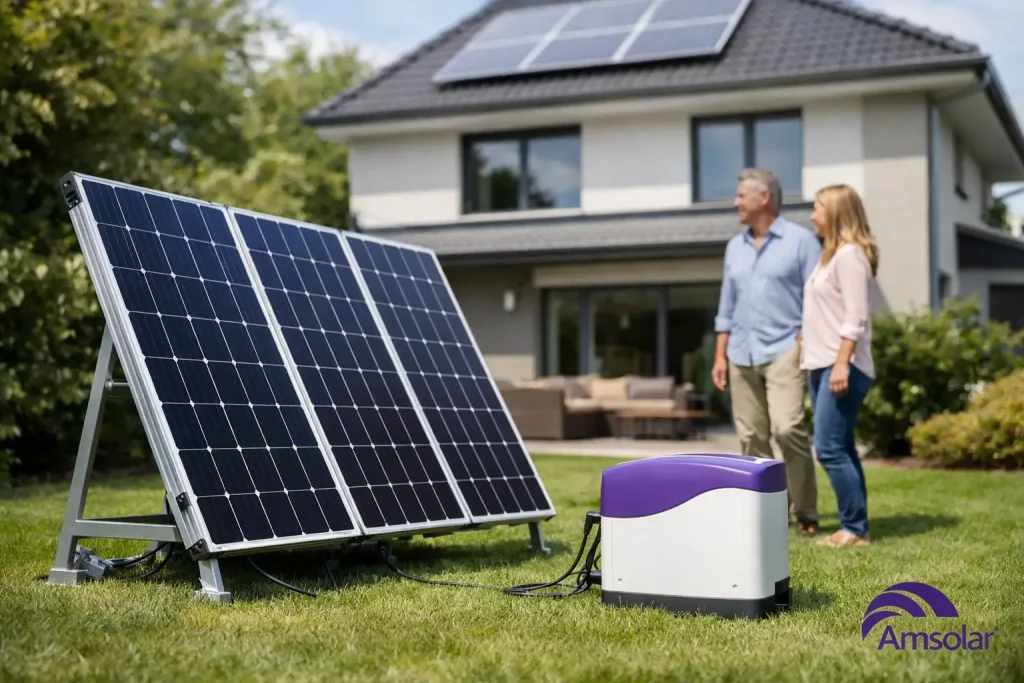
Plug-in solar is designed to make solar adoption more accessible. It is typically a smaller-scale system that can support daytime household consumption without the larger footprint of a conventional rooftop array. For homeowners beginning their green-energy journey, that simplicity is appealing. It should not, however, be confused with a system that can be placed anywhere and left unchecked.
A safe installation begins with components designed to operate together. The solar module, microinverter, mounting structure, connectors, protective devices, and cable specification must be compatible with one another. A weak link can undermine an otherwise high-quality panel. For example, an outdoor cable that is not suitably protected can deteriorate long before the panel reaches the end of its service life.
The electrical condition of the home also matters. A sound assessment considers the available circuits, the normal daytime load profile, and where solar generation will be used. A small system may be well suited to offset recurring daytime consumption from appliances, home office equipment, or cooling loads. It may be less effective if the property is empty during peak sunshine hours. Performance and safety are connected here: a system that is correctly sized and properly integrated is easier to monitor and manage.
Secure Mounting Matters More Than Panel Size
For landed homes, plug-in solar is often considered for a balcony, car porch, patio structure, garden area, or other sun-exposed space. Each location has a different risk profile.
A balcony rail may appear convenient, but it must be structurally stable and able to hold the panel and mounting hardware without movement. A car porch installation needs careful attention to wind exposure, overhead clearance, and the effect of shade from nearby roofs, trees, or parked vehicles. Ground-level placement can simplify access, but it also increases the chance of impact, accidental contact, and water exposure.
The panels must be fixed with mounting hardware suited to the surface and local weather conditions. They should not shift, vibrate, or rely on improvised supports. A loose panel is not only a generation issue. It can become a physical hazard during heavy rain and high winds.
Placement also affects panel temperature. Solar modules are built for outdoor operation, but they perform best with adequate airflow. Installing a panel flat against a surface with little ventilation can trap heat and reduce output. Good engineering balances sun exposure, secure fixing, drainage, service access, and airflow rather than chasing the largest possible panel in the smallest available space.
Weatherproof Cabling Is a Core Safety Feature
The visible panel gets most of the attention. In practice, cables and connectors deserve equal scrutiny. They carry electricity through changing outdoor conditions, including high heat, ultraviolet exposure, rain, and moisture.
Cables should be routed neatly, supported at appropriate intervals, and protected from sharp edges, crushing, standing water, foot traffic, and vehicle movement. A cable across a car porch floor or exposed at a gate line may be convenient on installation day, but it is vulnerable over time. The safest cable route is usually the one that is least likely to be touched, pulled, stepped on, or trapped.
Connectors must be properly seated and weather-protected. Loose or mismatched connectors can create heat at the connection point, particularly when the system operates for long hours in strong sun. Homeowners should never modify connectors, splice solar cables casually, or use makeshift extension arrangements to reach a preferred location.
Weatherproofing is not a one-time task. After severe weather, accidental impact, renovation work, or a change in the surrounding structure, visually check that the panel, brackets, cable protection, and connector housings remain intact. If anything looks cracked, loose, discolored, or damaged, stop using the system until it has been assessed.
Smart Monitoring Helps Keep Plug-In Solar Safe
Plug-in solar should be visible in more than one way. You should be able to see the equipment physically, and you should be able to see its operating behavior through monitoring.
A monitoring platform can show whether solar output is broadly consistent with sunlight conditions and household use. A sudden, unexplained drop in generation may point to shade, soiling, a connection issue, or a component fault. Conversely, unexpected system behavior is a reason to investigate rather than assume the installation is operating normally.
For homeowners who want more control, a home energy management system can add another layer of value. It helps make solar output more useful by matching generation with suitable daytime consumption. That can mean using more solar directly instead of treating the panel as an isolated device with no visibility into where energy is going.
Amsolar approaches residential solar as part of a managed energy system, not simply as hardware on a wall or porch. Monitoring, performance data, and practical energy-use insight help owners identify whether the system is doing the job it was designed to do. This is particularly useful for urban households where shading patterns and daily consumption can change as homes, vehicles, and routines change.
When Plug-In Solar May Not Be the Right Fit
Plug-in solar is not automatically the best option for every landed home. A heavily shaded balcony, a structurally unsuitable railing, an exposed area with frequent physical disturbance, or a home with little daytime energy use may reduce its value. In those cases, forcing a small system into an unsuitable space can create frustration and compromise the quality of the installation.
It is also worth separating safety from savings. A system can be safely installed yet deliver modest savings if sunlight is limited or household demand occurs mainly after sunset. Adding storage or adopting a larger, professionally designed solar system may be more appropriate for homeowners seeking greater energy independence, though those options require a different investment and design approach.
Before choosing plug-in solar, inspect the intended location at the times of day when it receives the most sun. Look for moving shade from trees, neighboring structures, gates, and vehicles. Consider how the panel will be secured, how cables will be protected, and whether the installation will remain accessible for inspection and cleaning. Those practical questions often reveal whether a site is genuinely suitable.
A safe solar decision starts with a realistic view of the home, not an assumption that every sunny-looking wall or car porch is ready for a panel. Choose quality equipment, insist on sound installation practices, and keep an eye on performance after commissioning. That is how a modest plug-in system can become a reliable first step toward smarter household energy use.
