
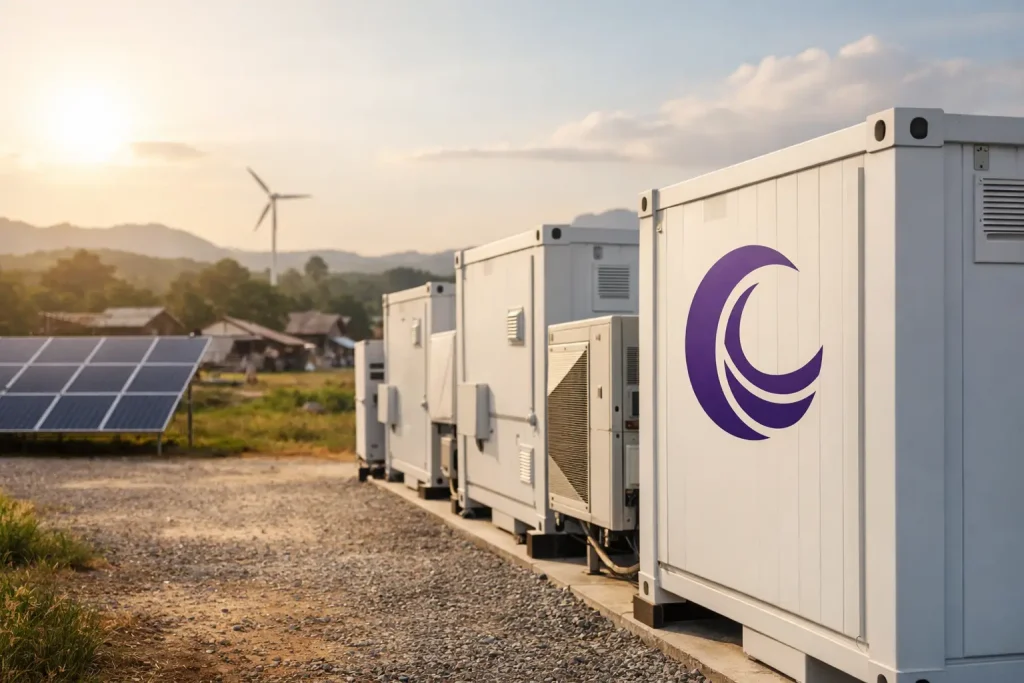
Battery Power Enlargement Where Grids Are Lacking
Key takeaways
Power enlargement using battery where the grid lacks is not about making electricity from nothing. It is about storing solar power, controlling demand, and directing available energy to the appliances that matter most. For landed-home owners, a correctly sized battery can extend useful solar hours into the evening, reduce dependence on unstable supply, and support essential loads during outages. The result depends on three practical factors: the home’s actual consumption pattern, available solar generation, and the battery’s usable capacity and power output.
A solar panel can generate strong energy at noon, yet a household may need its highest level of comfort and convenience after sunset. Air conditioning, cooking, lighting, refrigeration, water pumps, home office equipment, and EV charging can all overlap during the evening. When the grid is weak, unavailable, or simply expensive to rely on during peak use, that gap becomes more visible.
For homes in these conditions, power enlargement using battery where the grid lacks means expanding the practical value of each kilowatt-hour produced by solar. The battery does not enlarge the sun’s output. It gives solar energy a second shift, retaining surplus daytime production for controlled use later.
Why solar panels alone may not solve the problem
A plug-in solar system is an accessible starting point for homeowners with suitable balcony, car-park, or open-yard space. It can offset daytime consumption from appliances that are running while the sun is available. But without storage, surplus energy has limited usefulness when household demand is low in the middle of the day.
The mismatch is straightforward. Solar generation rises from late morning through early afternoon. Household demand often rises in the morning, drops while residents are away, then climbs again in the evening. If solar power is not stored, a home may still draw significant electricity when the family returns, even though its panels generated well earlier in the day.
A battery changes that operating pattern. It captures energy that would otherwise remain unused for the home’s evening needs, then releases it according to a defined priority. This can mean using stored energy for lighting, Wi-Fi, refrigerators, fans, selected sockets, or higher-demand loads when the system has been designed for them.
The value is especially clear where the grid lacks consistency. A battery can maintain selected circuits when outside supply is interrupted, provided the system includes backup capability and the required load separation. It is not a substitute for a utility-scale supply, and it should not be presented as one. It is a designed energy reserve for defined household needs.
Battery power enlargement starts with load priorities
The most common mistake in battery planning is choosing capacity before understanding loads. A home battery should be sized around what the owner wants to achieve, not around a generic claim of “whole-home backup.”
Start with the question: what must remain on, and for how long? For one household, that may mean internet connectivity, refrigeration, lights, security, and a few fans. For another, it may include a water pump, workstations, or selected air-conditioning units. Each decision changes the required battery capacity, inverter rating, and solar array size.
Capacity is measured in kilowatt-hours, while power output is measured in kilowatts. Both matter. A battery with sufficient stored energy may still be unable to start or support several high-demand appliances at once if its inverter output is too low. Conversely, a high-power system with limited stored energy may handle a large load briefly but not sustain it through the evening.
This is where engineering design matters. Load monitoring can identify how much electricity the house uses, when that use occurs, and which appliances create short but significant peaks. A smart energy management system can then prioritize solar, battery, and outside supply based on real conditions rather than a fixed, one-size-fits-all schedule.
The right battery strategy depends on the home
Not every homeowner needs the same battery configuration. A compact system may be appropriate for a household that wants evening solar self-consumption and basic backup for essential circuits. A larger system may suit a family with heavier evening demand, multiple air-conditioning units, or a desire to manage more of the home’s consumption from stored solar energy.
There is also a difference between backup duration and daily savings. A battery used mainly for outage protection may remain largely reserved until needed. A battery used for daily energy cost control cycles more frequently, storing solar during the day and serving loads after sunset. Some systems balance both objectives, but that balance should be intentional because reserving more backup energy can reduce the amount available for daily use.
Homeowners should also consider future loads. An electric vehicle, an additional air conditioner, a renovated kitchen, or a home office can change the household’s demand profile. A modular approach may allow storage capacity to expand over time, but the inverter, distribution design, and solar array should be planned with that path in mind.
Amsolar approaches this as an energy system, not a panel-and-battery transaction. Solar generation, battery behavior, load patterns, monitoring, and financial outcomes should work together. The objective is measurable: use more of the energy produced on-site, reduce unnecessary draw from outside supply, and maintain continuity for prioritized loads.
Smart controls make stored energy work harder
Battery capacity alone does not determine performance. Control logic determines when the battery charges, when it discharges, and which energy source is serving the home at a given moment.
A basic setup may charge from solar and discharge after sunset. A smarter home energy management approach can go further by observing real consumption patterns and adapting operating priorities. If a home consistently experiences a demand spike at a particular time, the system can preserve battery energy for that period. If solar production is stronger than expected, it can allocate more energy to daytime loads or storage.
Monitoring is equally important. Homeowners should be able to see solar production, battery state of charge, household consumption, and energy flow in a clear dashboard. This turns battery ownership into a managed asset rather than an invisible box mounted on a wall.
The trade-off is that advanced controls require proper commissioning and accurate load data. Settings that are too aggressive can drain the battery early. Settings that are too conservative can leave stored solar unused when the household needs it. Fine-tuning should reflect the way the home actually operates across weekdays, weekends, and changing weather conditions.
Designing for reliable, usable power
Battery power enlargement where grids are lacking works best when expectations are specific. A home can gain more independence from daytime solar, better control over evening consumption, and continuity for selected loads. It cannot ignore the physics of energy use. High-demand appliances, long backup periods, and limited roof or car-park solar area will require trade-offs.
The strongest solution begins with a site assessment, a review of consumption data, and a clear list of priorities. From there, the solar capacity, battery storage, inverter power, backup circuits, and monitoring platform can be matched to the household rather than guessed.
For a landed home, that design discipline is what turns solar and storage from separate products into a dependable energy strategy. The right battery does more than hold electricity. It helps the household use its own solar power at the moment it has the greatest practical value.
