
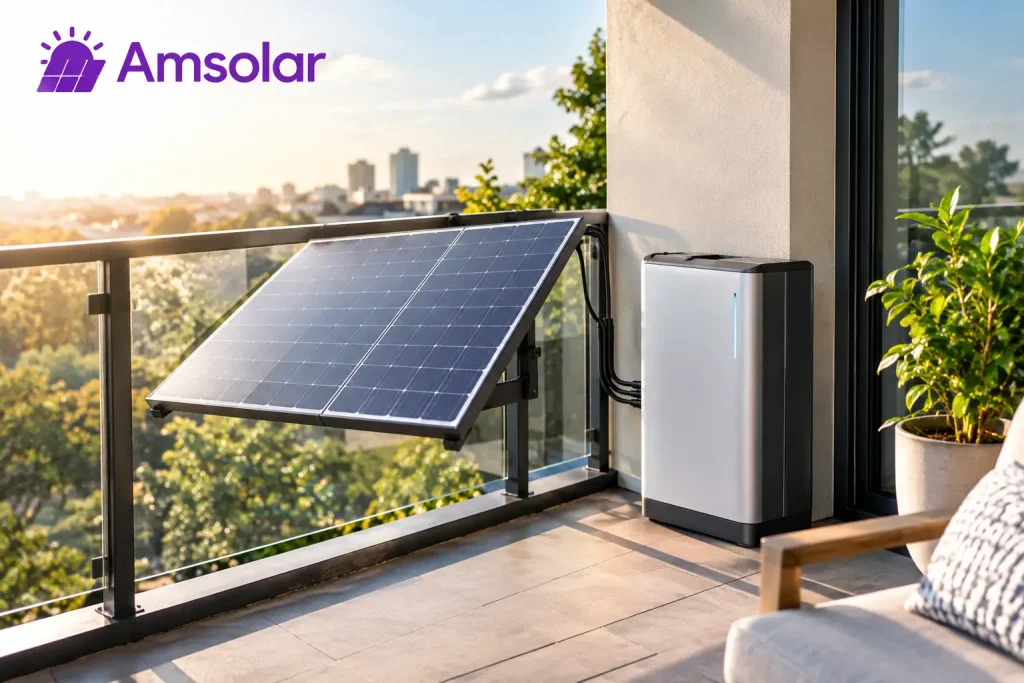
Can Balcony Panels Charge Batteries? A Practical Answer
Key takeaways
- Balcony solar panels can charge batteries, but only when the panel output, charge controller, inverter, and battery are designed to work together.
- A small balcony or carport array is best for covering daytime household loads and charging a modest battery gradually, not for replacing a full rooftop system.
- Shade, panel direction, usable space, and battery capacity have a larger effect on results than the panel’s headline wattage alone.
- The strongest setup starts with a measured load profile, then matches generation and storage to the appliances you want to support.
Can balcony panels charge batteries? Yes, but the useful answer is more specific: they can charge batteries effectively when the system has a compatible charging path and realistic expectations. A compact plug-in solar system may collect enough energy to run daytime devices, reduce grid consumption, and store some surplus for later use. It is not a shortcut to unlimited backup power.
For owners of landed homes, a balcony, upper-floor terrace, carport, or sunny side wall can be a practical starting point for solar. The engineering question is not simply whether a panel can produce electricity. It is whether that electricity can be captured safely, converted efficiently, and used at the time it delivers the most value.
How balcony panels charge a battery
Solar modules produce direct current, or DC. Batteries also store DC energy, which makes charging possible, but the voltage and current must be controlled. A battery cannot be connected casually to a solar panel and expected to perform well over time. The charging equipment must regulate power according to the battery’s chemistry, voltage range, and state of charge.
A direct DC setup usually includes panels connected to an MPPT charge controller and a compatible battery. MPPT, short for maximum power point tracking, continuously adjusts the operating point of the panels to collect more usable energy as sunlight and temperature change. The stored energy can then supply DC loads or pass through an inverter for standard household appliances.
Another approach uses solar panels with a microinverter. Here, the panel output is converted to AC for household use first. If a battery is part of the design, it needs an AC-coupled storage system or an inverter arrangement built for that purpose. A portable power station may accept solar input directly, but only if the panel voltage, current, connector type, and input limits match its specifications.
This distinction matters. A panel kit that works well for daytime appliances is not automatically a battery-charging system. The battery, controller, inverter, and protection equipment must be treated as one engineered energy system.
What determines how much battery power you get
Panel wattage is a starting point, not a performance guarantee. A 400-watt panel rarely delivers 400 watts for every hour of the day. Actual output changes with sunlight intensity, heat, dirt, cable losses, panel angle, and partial shading. Even a narrow shadow across part of a module can sharply reduce output.
Consider a small 800-watt balcony or carport array. On a favorable day, it may generate several kilowatt-hours of energy. That can be meaningful for Wi-Fi equipment, lighting, fans, laptop charging, refrigeration support, or part of your daytime air-conditioning use. Yet a 5 kWh battery may still take much of the day to charge after conversion losses and household loads have taken their share.
Battery size changes the outcome as well. A larger battery stores more energy, but it also requires more solar production to recharge fully. Oversizing storage against a small panel array can leave capacity underused. Conversely, a very small battery may fill early, leaving solar energy with fewer useful places to go during the best sunlight hours.
The most productive design begins with consumption, not equipment. Identify the loads that run during daylight, their power draw, and when you need stored energy. A home that uses significant electricity in the afternoon may benefit more immediately from direct solar consumption. A home that needs evening resilience may place greater value on battery capacity and intelligent discharge control.
Balcony, terrace, or carport: placement makes the difference
For compact solar, location quality can matter more than adding another panel. A clear, sun-exposed carport often produces more consistent energy than a shaded balcony. A balcony can still perform well when it faces strong sunlight and avoids obstruction from overhangs, neighboring buildings, railings, and nearby trees.
Orientation influences the generation profile. Panels receiving stronger morning sun will begin producing earlier, while west-facing panels can extend output later into the afternoon. There is no single best orientation for every home. If air conditioners, cooking loads, or electric vehicle charging occur later in the day, a later production profile can have real value.
Mounting angle also affects yield, but it should not distract from the basics. Avoiding shade, maintaining secure mounting, and allowing airflow around modules generally have a larger practical impact. Solar modules run less efficiently when they become very hot, so a tightly enclosed installation may underperform compared with a well-ventilated one.
A visual inspection is useful, but measurement is better. A qualified assessment can model shading patterns, estimate annual generation, and identify whether the available surface is worth developing. This prevents a common mistake: buying equipment based on nameplate power without first confirming the site can support that output.
Choosing between a simple setup and integrated storage
A simple plug-in solar setup can be an approachable first step for a household beginning its green energy journey. It is most compelling when the home has regular daytime demand and a suitable sunny surface. In this case, the solar energy is consumed as it is produced, lowering the electricity drawn from the grid during those hours.
Adding a battery brings another layer of value, particularly when you want to shift solar energy into the evening or support selected loads during an outage. It also adds cost, system complexity, and the need for more precise design. The battery should not be treated as an accessory. Its usable capacity, cycle life, charging rate, discharge limits, and control strategy all affect financial results.
For some homes, a smaller battery paired with smart energy management is the better choice. The system can prioritize solar power for active loads, charge storage when surplus is available, and reserve battery energy for higher-value periods. This is where monitoring matters. Without visibility into generation, consumption, and battery behavior, it is difficult to know whether the system is delivering the expected savings.
Amsolar approaches solar and storage as a performance system rather than a collection of products. Engineering-led design, energy monitoring, and battery optimization help ensure that a compact solar installation is matched to real household behavior, not just an attractive equipment specification.
When balcony solar and batteries make financial sense
Balcony panels and batteries make the most sense when they solve a defined energy problem. That may be reducing a predictable daytime load, improving the use of a sunny carport, supporting essential circuits, or building toward a larger home energy system over time.
They are less compelling when the usable surface is heavily shaded, the home has little daytime electricity demand, or the battery is sized far beyond what the panels can recharge. In those cases, a different panel location, a larger solar array, or a load-management strategy may deliver better value.
Start with the energy you use, then work backward to the solar and storage capacity that can improve it. A well-matched balcony or carport solar system will not promise more than it can produce. It will give you visible, measurable progress toward lower energy costs and smarter use of every kilowatt-hour.
