
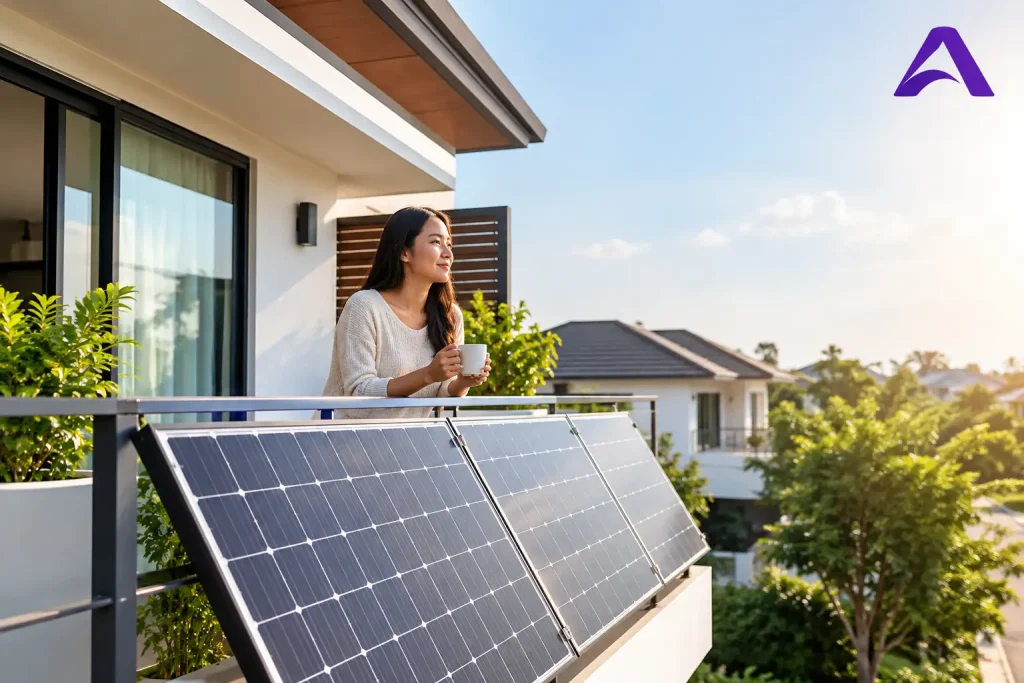
Balcony Solar for Landed Homes: What Works
Key takeaways
Balcony solar is best viewed as a practical starting point for landed-home owners who want to offset daytime electricity use without beginning with a full rooftop system. Its performance depends less on panel size alone than on usable sunlight, mounting location, household daytime consumption, and visibility into energy output. A properly selected plug-in setup can support a more measured path toward larger solar, battery storage, and smarter home energy control.
A balcony that receives clear afternoon sun can be more valuable than an expansive roof section shaded by trees, water tanks, or neighboring buildings. That is the real appeal of balcony solar for landed homes: it turns a compact, underused surface into a visible source of daytime energy.
For homeowners in Malaysia, the opportunity often extends beyond a literal balcony. Car porch roofs, terrace extensions, side patios, and upper-floor ledges can offer suitable positions for compact plug-in solar systems. The goal is not to make ambitious claims about powering the whole house. It is to reduce the electricity drawn from the grid when the sun is producing power and appliances are running.
Where balcony solar delivers the most value
Balcony solar works best when generation and consumption happen at the same time. A home that uses electricity during the day has more opportunity to benefit because solar output can support active loads such as refrigerators, routers, fans, home office equipment, water pumps, and selected air-conditioning use.
This makes household behavior as important as the hardware. If a property is empty from morning to evening and most electricity is used after sunset, a small solar setup will still generate energy, but its direct value may be lower. In that case, a future battery strategy or a larger system designed around evening loads may deserve consideration.
Orientation also matters. In Malaysia’s climate, panels facing east can favor morning production, while west-facing panels can better support afternoon loads, when many homes begin using more cooling. A south-facing position may provide balanced output across the day, but there is no universal “best” direction. The useful answer depends on when the household consumes electricity and which surfaces receive the least shade.
Shade is often the deciding factor. Balcony railings, roof eaves, tall landscaping, neighboring homes, and even drying racks can cast shadows that reduce output disproportionately. Before selecting equipment, observe the intended location across several hours. A spot that appears sunny at noon may be shaded when household demand is highest.
Size the system around real daytime loads
A compact solar system should be matched to a realistic purpose. It may offset the base load of a home, support daytime working hours, or contribute to air-conditioning demand in a frequently occupied room. It should not be sold as a substitute for thoughtful energy planning.
Start by identifying what runs consistently during daylight. A refrigerator is always on, but its power demand cycles. Internet equipment, security systems, fans, laptops, and standby appliances create a more stable daytime base load. Add the appliances used intentionally during sunny hours, such as a washing machine or selected air-conditioning unit, and a clearer operating profile emerges.
Panel rating is only one part of expected production. Heat, cloud cover, panel angle, dirt buildup, shading, and inverter efficiency all affect real output. A larger panel does not automatically deliver proportionally more usable energy if the installation site is poorly positioned or the home’s daytime demand is too low.
For this reason, good balcony solar planning starts with energy data rather than a product catalog. Monitoring can reveal whether the home has a consistent daytime base load and whether solar production is being used effectively. It also helps homeowners see patterns that are otherwise invisible, such as high afternoon cooling demand or equipment left running when the house is unoccupied.
A compact system can still be strategic
A smaller installation has value beyond immediate bill reduction. It lets homeowners understand their energy habits, build confidence with solar technology, and assess which parts of the property are suitable for future expansion. For many landed homes, it is a sensible first project before committing to a full rooftop array.
It can also be a practical fit for homeowners who prefer to invest in stages. Begin with a well-positioned compact system, monitor its performance, then consider whether a car porch solar structure, rooftop system, home energy management platform, or battery storage solution would create stronger long-term returns.
Design and installation are not afterthoughts
Balcony-mounted equipment is exposed to wind, rain, heat, and daily use of the space around it. The panel mounting must be appropriate for the structure and positioned so it does not create avoidable obstruction or maintenance difficulties. Cable routing should be clean, protected, and planned for the environment rather than treated as a last-minute detail.
The electrical side deserves the same care. Plug-in solar is appealing because it is compact and accessible, but reliable operation still depends on correctly matched components and a safe, professionally engineered setup. The inverter, connections, protective devices, and panel configuration must work as one system.
Amsolar approaches solar as an energy asset, not simply a panel installation. That distinction matters when a homeowner plans to add more capacity later. A well-considered first installation can provide useful data and preserve a clearer path toward expanded solar generation, smart load control, and battery energy storage.
Appearance matters, too. For urban homes, solar should complement the property rather than look temporary or improvised. Panel layout, mounting geometry, cable concealment, and the choice of surface all influence the final result. A clean installation usually performs better operationally because access for inspection and cleaning has been considered from the start.
Make production visible with smart monitoring
The most common mistake after installing solar is assuming it will manage itself. Solar panels are low-maintenance, but performance should not be left unobserved. Without monitoring, a homeowner may not notice lower-than-expected generation, new shading, equipment issues, or a mismatch between production and electricity use.
A connected monitoring platform turns solar output into practical information. Homeowners can see when generation peaks, how weather affects production, and whether daytime appliances are consuming energy during solar hours. This is where solar becomes part of an active home energy strategy rather than a passive feature on the building.
Smart home energy management can take that further by helping households understand and shape demand. If discretionary loads can be shifted into the sunniest part of the day, the value of each unit of solar generation improves. This approach is especially relevant for households with flexible appliance use, electric vehicle charging plans, or high cooling demand.
Battery storage may become relevant when the home has substantial evening consumption or needs stronger resilience from its energy system. It is not automatically necessary for every balcony solar installation. Batteries add cost and complexity, so the right decision depends on the home’s load profile, energy objectives, and the value placed on storing daytime generation for later use.
A starting point, not a shortcut
Balcony solar is not a one-size-fits-all answer. It is most effective for landed homes with clear sunlight, dependable daytime electricity use, and a suitable surface that can support a tidy, well-planned installation. For other homes, a car porch or rooftop system may offer better production and stronger economics.
The practical question is not whether a balcony can hold panels. It is whether that location can produce useful electricity when the home needs it. Assess the sun path, understand daytime loads, and choose equipment based on performance rather than appearance or headline panel capacity alone.
A compact solar system can be the beginning of a smarter energy plan. When it is engineered around how the household actually uses power, it creates useful savings today and better decisions for the next stage of the home’s energy future.
