
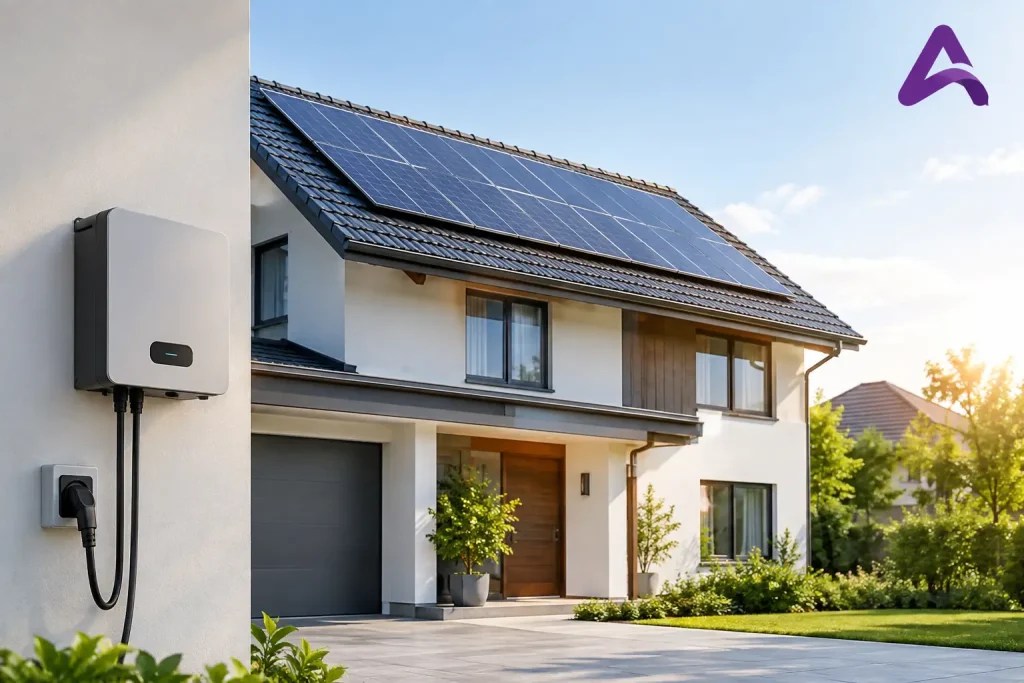
A Residential Plug In Solar Example for Landed Homes
A residential plug in solar example is easiest to understand when viewed through a real household pattern: a landed home that uses meaningful electricity during daylight but is not yet ready for a full rooftop solar system. A compact plug-in setup can turn an underused car porch roof, balcony edge, or sunny outdoor area into a practical starting point for lower daytime energy costs.
Key Takeaways
- Plug-in solar is a practical entry point for landed-home owners who want to start producing solar energy without committing immediately to a large rooftop installation.
- The strongest financial value comes when solar generation matches daytime consumption from appliances such as refrigerators, air conditioners, water pumps, and home-office equipment.
- Placement matters as much as panel capacity. Car porch roofs and unobstructed outdoor spaces often provide better results than shaded or poorly oriented balcony locations.
- Monitoring turns a small solar installation into an informed energy decision, showing how much electricity the home uses, produces, and may be able to offset.
What Plug-In Solar Solves for a Landed Home
Many urban households want to reduce their electricity dependence, but a full solar system can feel like a large first decision. Plug-in solar provides a more measured route. It is designed for homeowners who have usable sun exposure and want to begin with a smaller, focused system that supports daytime household demand.
This approach is particularly relevant for landed properties. Unlike high-rise residences, landed homes commonly have a car porch, patio, side yard, balcony, or low roof section that can accommodate solar panels with fewer practical limitations. The goal is not to power every appliance in the house at once. The goal is to use available daylight to reduce the energy drawn for steady loads already running during the day.
A compact solar system performs best when the home has a predictable base load. A refrigerator operates continuously. Wi-Fi equipment, security systems, fans, water pumps, and selected air conditioners may also consume energy during the day. When solar output is used at the same time those loads are active, more of the generated power delivers direct value to the household.
Plug-in solar is not automatically the right answer for every property. A home with heavy shading from trees, neighboring buildings, or roof structures may receive limited production. Likewise, a household that is empty from morning until evening may see less immediate daytime benefit unless its appliances maintain a meaningful base load. A site assessment should therefore look beyond panel size and focus on how the household actually consumes energy.
A Residential Plug In Solar Example in Practice
Consider a two-story landed home with a covered car porch that receives clear sunlight from late morning through the afternoon. The household includes four people, with one person working from home several days each week. During daylight hours, the refrigerator, internet equipment, ceiling fans, one air conditioner, and general standby loads remain active.
The owner begins with a modest plug-in solar configuration installed at the car porch rather than on the main roof. This location is chosen because it is accessible, receives consistent sun, and does not require the household to make a large-scale change to the property at the outset.
On a bright day, the panels begin generating electricity in the morning, increase output toward midday, and taper off later in the afternoon. That production can support a portion of the home’s live daytime demand. When the air conditioner is operating in the home office, for example, solar production can help reduce the electricity otherwise drawn from the utility supply. When the household’s demand is low, the system’s performance depends on its design and the available consumption at that moment.
The key financial lesson is simple: do not size a starter system based only on the highest possible generation figure. Size it around the home’s daytime energy behavior. A household with a consistent daytime load can often gain more practical value from a correctly sized smaller system than from a larger system whose output does not align with actual use.
This is also why energy monitoring matters. Without data, the owner may assume that solar panels alone determine savings. In reality, savings are shaped by production, appliance schedules, weather, shading, and how much electricity the household uses while solar generation is available.
Choosing the Right Location and System Size
For most landed homes, the car porch is a strong candidate because it can combine solar generation with functional shelter. It may also be easier to inspect and maintain than a high main roof. A balcony can work where there is clear sun exposure and sufficient usable area, but homeowners should be realistic about output. A small balcony installation can be an effective starting point, yet it has less surface area than a car porch arrangement.
Before selecting a system, assess sunlight across the full day. Morning-only or late-afternoon sun still has value, but a location with uninterrupted midday exposure generally delivers stronger production. Nearby trees can create seasonal shading, while new extensions or neighboring developments may change the site’s solar access over time.
Panel capacity should then be matched to the available mounting space and household demand. A starter configuration is not intended to replicate a large rooftop installation. It is a controlled first step that lets the homeowner evaluate production, electricity behavior, and the financial case for expansion.
Quality engineering remains essential even for a smaller project. The panels, inverter, mounting method, cable routing, protective components, and connection approach must work as one system. Poor equipment matching or rushed installation can reduce performance and undermine the reliability homeowners expect from a solar investment.
Monitoring Makes the First System More Valuable
A solar system should not become invisible after installation. Smart monitoring gives homeowners a clear view of daily generation and helps identify patterns that are otherwise easy to miss. A cloudy week, a shaded panel, or unusually high air-conditioning use can all affect the outcome.
For a plug-in solar owner, the first few months of data are especially useful. The household can compare solar production against electricity use during workdays, weekends, and hotter periods. If generation is consistently being used while daytime demand remains high, the case for adding capacity becomes clearer. If production is limited by shade or low daytime use, the homeowner can adjust expectations before making a larger investment.
A home energy management system adds another layer of control. Instead of treating energy consumption as a monthly bill, the household can begin to understand which appliances create the biggest daytime demand and when usage can be shifted. Running selected high-use equipment during strong solar hours may improve the value derived from the system without changing daily comfort.
This data-led approach reflects a broader principle in smart energy planning: solar capacity should be paired with visibility. The best system is not simply the one with more panels. It is the one designed around how the home operates and supported by clear performance information.
Planning the Next Step After Plug-In Solar
A well-designed starter installation can become the foundation for a broader home energy strategy. After gathering real production and usage data, the homeowner can decide whether to retain the compact setup, add more solar capacity, or consider energy storage for greater control over when solar energy is used.
Battery storage may be valuable for households seeking to manage evening consumption or improve energy resilience, but it should be evaluated against actual load patterns and financial goals. It is not necessary for every plug-in solar project. For some homes, increasing daytime self-consumption and monitoring usage will create the most immediate value. For others, a battery may become more relevant as the solar system grows.
Amsolar approaches this progression as an engineering and energy-cost decision, not a one-size-fits-all product choice. A smaller solar system can provide useful proof of performance, while monitoring provides the evidence needed to plan the next investment with greater confidence.
For homeowners with a sunny car porch or outdoor area, plug-in solar can be a disciplined first move toward smarter energy use. Start with the space you have, measure the results carefully, and let actual household data guide the next decision.
