
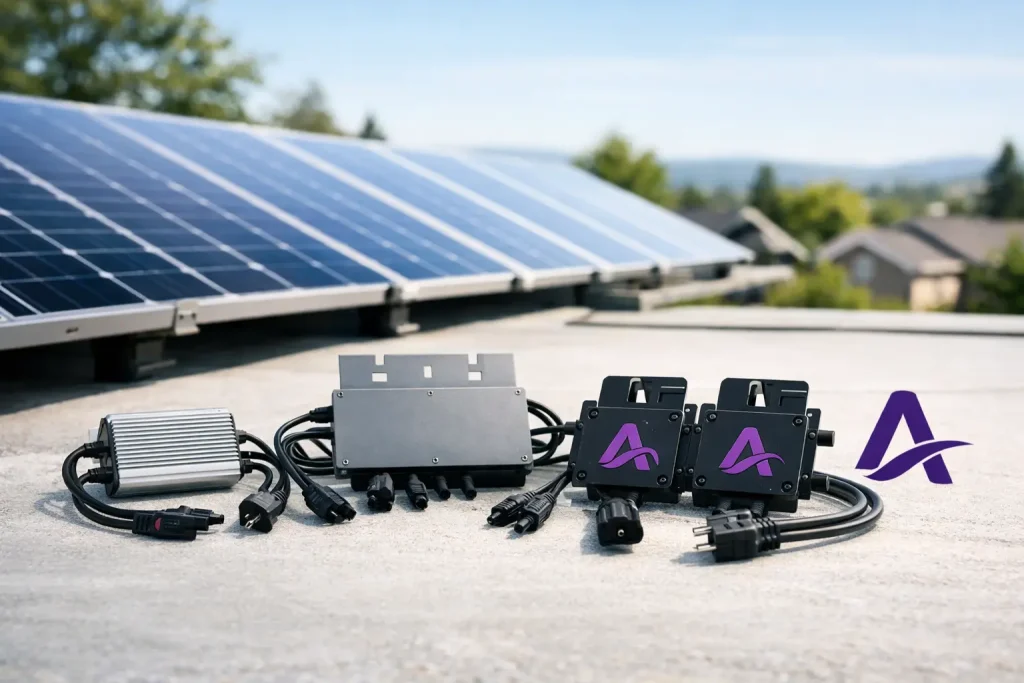
Types of Micro Inverters for Plug-In Solar
A plug-in solar kit may look simple from the outside: panels capture sunlight, a compact unit converts the power, and the home uses more of its own electricity during the day. Yet the types of micro inverters for plug-in solar determine how much energy the system can produce, how it behaves in partial shade, and how clearly you can see its performance.
For landed homeowners starting with a balcony, carport, or small roof section, the right micro inverter is less about choosing the highest published wattage. It is about matching the inverter to the panel layout, available sunlight, household electrical supply, and the level of visibility you want from your first solar investment.
Key Takeaways
- A micro inverter converts power from individual solar panels, so one shaded panel has less effect on the rest of the array.
- Single-input and dual-input micro inverters are the main choices for compact plug-in solar systems.
- Input current, voltage range, output rating, and environmental protection matter more than headline capacity alone.
- Monitoring capability turns a plug-in system from a basic energy device into a measurable home-energy asset.
- A well-engineered match between panels and inverter protects performance and leaves room for practical expansion.
How a Plug-In Solar Micro Inverter Works
Solar panels produce direct current, or DC. A micro inverter is installed close to the panel and converts that DC electricity into alternating current, or AC, for household use. Unlike a conventional string inverter, which manages several panels from one central location, a micro inverter works at the panel level or with a small pair of panels.
That distinction is particularly useful for urban homes. A carport may receive strong sun in the morning but partial shadow from a neighboring building later in the day. A balcony installation may have an air-conditioning ledge, railing, or tree affecting one panel at a time. With a micro inverter, the output of the affected panel is managed independently rather than pulling down the production of the entire group.
For plug-in solar, this modular design also keeps the starting system compact. A homeowner can begin with one or two panels and gain a clear view of daytime generation before considering a larger solar installation, battery storage, or a home energy management system.
Single-Input vs. Dual-Input Micro Inverters
The first meaningful distinction is the number of panel inputs a micro inverter supports. A single-input unit serves one solar panel. A dual-input unit serves two panels, provided both panels are compatible with the inverter’s electrical input limits.
Single-Input Micro Inverters
A single-input micro inverter is the most straightforward option. Each panel receives its own inverter, which gives the highest degree of panel-level independence. It is a sensible choice when panels face different directions, experience uneven shading, or must be installed in separate physical locations such as a balcony and carport.
This format can also simplify diagnosis. If one panel produces less energy than expected, monitoring data can identify the individual panel and inverter pair. The trade-off is that a system with several panels requires more individual units and may carry a higher equipment cost per watt.
Dual-Input Micro Inverters
Dual-input models connect two panels to one micro inverter. They are often a practical fit for a compact plug-in arrangement where two matching panels sit side by side on the same carport structure or roof plane. Fewer devices can reduce equipment and installation complexity while maintaining a small, tidy system footprint.
The key condition is electrical matching. Each input must accept the panel’s operating current and voltage, while the inverter must have enough combined capacity to handle both panels under strong sunlight. Two panels facing the same direction usually make the cleanest pairing. If one panel is consistently shaded while the other is fully exposed, separate single-input units may deliver better real-world results.
Output Ratings and Electrical Matching
Micro inverter ratings are frequently presented in watts, but the watt figure is only one part of a proper selection. A 600-watt or 800-watt micro inverter may appear suitable on paper, yet its actual fit depends on the connected panels and the site conditions.
Start with the panel’s rated power and its electrical specifications. The inverter needs an input voltage range that covers the panel’s normal operating voltage, as well as an input current limit that is not exceeded by the panel. Higher-output modern panels can have higher current ratings, so an older or lower-current micro inverter is not automatically compatible.
The AC output rating should then be considered in relation to expected solar production. A modest amount of DC panel oversizing can be reasonable because panels rarely operate at their nameplate rating all day. However, excessive oversizing can lead to clipping, where the inverter limits output during the brightest periods. Some clipping may be an acceptable trade-off for a small system, but it should be deliberate rather than accidental.
For a home in Malaysia, equipment also needs to match the household’s local AC supply characteristics and the intended connection equipment. This is a technical compatibility issue, not a place to rely on assumptions or generic online specifications. An engineering review helps ensure the system components operate as one coordinated package.
Monitoring-Ready and Smart Micro Inverters
Not all plug-in micro inverters provide the same level of performance data. Basic models may show that the system is operating. Monitoring-ready models can report generation through a gateway or app, often with daily, monthly, and lifetime production figures. Higher-capability systems can provide panel-level visibility and fault alerts.
For homeowners, monitoring is not a cosmetic extra. It answers useful questions: Is the carport array producing as expected? Did production drop after a period of haze or shade growth? How much daytime electricity demand is being offset? Without measured data, it is difficult to distinguish normal weather variation from an equipment or installation issue.
Smart energy features become more valuable as the home adds controllable loads. A home energy management system can help coordinate solar generation with suitable daytime consumption, such as selected appliances or energy storage. The micro inverter remains focused on converting solar power safely and efficiently, while the broader energy platform provides a clearer picture of use, savings, and load behavior.
Amsolar approaches this as an energy-performance decision, not simply a hardware purchase. Generation data, consumption patterns, and future battery considerations should inform the design from the start, even when the first step is only a compact plug-in solar system.
Choosing the Right Type for Your Home
Begin with the physical layout. A pair of matching panels on an unshaded carport usually favors a dual-input micro inverter. Panels installed at different angles, on separate structures, or in changing shade conditions may justify single-input units for stronger panel-level control.
Then assess the panel and inverter specifications together. Confirm the DC voltage window, maximum input current per channel, total input power, AC output capacity, connector compatibility, and outdoor durability rating. Heat exposure matters in tropical conditions, especially when equipment is installed under a carport roof with limited airflow. A unit that performs well in a catalog still needs adequate ventilation and a suitable mounting location.
Finally, decide how much visibility you need. If this system is a first step toward a more intelligent home-energy setup, choose monitoring that can provide useful production data from day one. If the objective is simply to offset a stable daytime base load with two well-positioned panels, a simpler monitored configuration may be enough.
The best micro inverter is the one that fits the panels, the structure, and the way your household consumes energy. Start with a design that produces measurable value now, then let real performance data guide the next step in your solar journey.
